


Resources by David Koll

Empty bowl

This is part of the worship series, "A Lively Look at the Seven Deadly Sins” Series Introduction Week 1 | Week 2 | Week 3 | Week 4 Week 5 | Week 6 | Week 7 | Week 8 WEEK 8: LUST“The Help of Holiness”ScriptureProverbs 5:1–6; 1 Peter 1:13–16Easter alternative: 1 Corinthians 6:12–20This final service deals with perhaps the most sensitive sin of all, since we live in a sexually charged culture that easily confuses lust and healthy desire. After recognizing that lust can apply to many objects, we recognized that the issue of lust between a man and a woman needs to be addressed. Using Proverbs 5:1-6 and 1 Peter 1:13-16, we compared and contrasted lust and love, identifying the ways in which lust is far from the “healthy, red-blooded American” virtue it is often thought to be.God’s call to holiness was described as a gracious gift of God intended to save us from the sure death that comes on the road called lust. We recognized in Job 31:1—“I have made a covenant with my eyes”—a practical biblical help to battle lust. In a fitting conclusion to this message and to the series as a whole, we lifted once again the gift of grace: “Set your hope fully on the grace to be given you” (1 Pet. 1:13).Note: If this series takes place during Lent, the topic of lust makes a surprisingly relevant topic for an Easter message. I would recommend selecting as the main passage 1 Corinthians 6:12–20, which speaks of God’s power in raising the Lord from the dead (v. 14), as it makes the very practical application of living in sexual purity.Song Suggestions“Perdón, Senor” Lockward“For Freedom Christ Has Set Us Free!” Dunstan“Lord, I Want to Be a Christian” Psalter“Christian, Do You Struggle?” Andrew of Crete

Read The Article
Empty bowl

This is part of the worship series, "A Lively Look at the Seven Deadly Sins” Series Introduction Week 1 | Week 2 | Week 3 | Week 4 Week 5 | Week 6 | Week 7 | Week 8 WEEK 7: GLUTTONY“The Secret of Contentment”ScriptureProverbs 23:1–3In a local happenchance I believe God engineered long before this series was planned, one of our newest attenders had been involved in a Christian weight-loss program called Prism. She was willing to be interviewed during the service. This person showed her vulnerability in a struggle with which many people are confounded. A quote from her weight loss program guidebook set the tone of the message: “We suffer spiritually when we overeat and binge. Our focus is on food and all that surrounds it. We think of food when we are sad, reward ourselves with food when we are happy, and tranquilize ourselves with food when we are anxious. We have taken the spot in our hearts and lives that rightfully belongs to God and given it over to food. In many cases food has become nothing less than our idol” (The Prism Weight Loss Program by Karen Kingsbury, www.pwlp.com).This woman established for the service a tone of honesty and humility. Statistics regarding the number of us who are overweight make it obvious that gluttony is a big problem. During the message we spoke not only of the size of our belt, but also of the state of our heart. Discipline was identified as a key issue, as Neal Plantinga suggests in his book Not the Way It’s Supposed to Be, where he speaks of discipline as a key to freedom and power in sports and music (p. 146).The Proverbs 23 passage offers what I called “a cartoon warning” regarding gluttony. We spoke of various lies (“deceptions”) involved with food in our culture and heard God’s call to “offer our bodies as living sacrifices” (Rom. 12:1). Then we recognized contentment as the positive alternative to gluttony and considered the call to contentment in Philippians 4:12. Jesus’ offer as “the bread of life” (John 6:35) concluded the message with the promise that as we seek him, we will never go hungry!Note: If this series is used in the Lenten season, this seventh study may well be used for a midweek service for Maundy Thursday or Good Friday. As the Lord’s Supper is often celebrated in these services, the theme of proper spiritual food and an improper use of material food will be appropriate.Song Suggestions“Go, My Children, with My Blessing” Vajda“God of Justice Ever Flowing” Moore“I Am the Bread of Life” Toolan

Read The Article
Empty bowl

This is part of the worship series, "A Lively Look at the Seven Deadly Sins” Series Introduction Week 1 | Week 2 | Week 3 | Week 4 Week 5 | Week 6 | Week 7 | Week 8 WEEK 6: GREED“Generous Living”ScriptureLuke 12:15–21Dealing with greed in a pastoral manner is difficult. I didn’t want to have people walk away having heard only another diatribe against the materialism of our day. My goal was to encourage an honest assessment of the heart and an honest recommitment to generosity, the holy alternative to greed.I began by giving a walking tour through my kitchen appliances—displayed on two tables in the front of the worship center. As a congregation we recognized lightheartedly (at my expense) that our homes are filled with “an abundance of possessions.” This led naturally into the passage in Luke 12 (note verse 15!). We talked about greed (or avarice, as it’s also called). Simply put, greed is a fondness for accumulating wealth. It’s hard to live in North America without developing this fondness.The pain of this fondness comes in the way our possessions distract us, and in the way we objectify people by equating them with their possessions. Fairlie suggests, “We are in danger in our affluent societies of destroying our humanity, as Midas came near to doing.” Furthermore, we ignore issues of waste and injustice, which are primary calls to us as God’s earthkeepers.We concluded by using 2 Chronicles 31:5-10 as a call to cultivate a thankful spirit, a worshiping spirit, a generous spirit. We sang the short song “In the Lord I’ll Be Ever Thankful” over and over, interspersed with readings on God’s gift of generosity and God’s call to generosity (Eph. 1:3-5; 2 Cor. 8:8; 2 Cor. 9:6-8; 1 Tim. 6:17-18).Note: If this series is presented during Lenten season, it may well be that this service (appropriately) takes place on Palm Sunday. The kingdom Jesus represents and claims was and is much different than the kingdom of power and possessions our world seeks. Jesus lived to lay down his life, not to hold on to possessions; his commitment to eternal justice and generosity of spirit guides us all!Song Suggestions“Children from Your Vast Creation”Robb“O God, Your Justice Towers”Stuempfle“Give Me A Clean Heart” Douroux“God of All Living”Morse“In the Lord I’ll Be Ever Thankful”The Community of TaizéRevised Common LectionaryYear C: Season after Pentecost—Proper 13 (18)

Read The Article
Empty bowl

This is part of the worship series, "A Lively Look at the Seven Deadly Sins” Series Introduction Week 1 | Week 2 | Week 3 | Week 4 Week 5 | Week 6 | Week 7 | Week 8  WEEK 5: SLOTH“The Duty of Diligence”ScriptureProverbs 26:13–26; Hebrews 6:9–12A regional homeowners’ magazine just happened to publish an issue at the time of this series with a cover story called “The Seven Deadly Sins of Homeowners.” Displaying the cover was a perfect introduction to this message, as each of the “sins” had to do with some form of home maintenance neglect.Our Proverbs passage offers an equally lively picture of sloth. We recognized that many of us have a sloth living in our homes, sleeping in our beds. As Proverbs 26 shows, sluggards (sloths) invent ways to remain inactive, they are stuck in inactivity, and all along they inflate their ego. The truth is, the sluggard is not free.Sloth is a major theme in our land. We’re a culture of the complacent, a community dedicated to leisure. For most of us, our diversions distract us more than they restore us. The spiritual issues are enormous, as we find ourselves “busy” with things that have no eternal worth. Fairlie suggests we have made a “religion” of sloth.In this context, Hebrews 6:9–12 calls us to the alternative of diligence. It’s a character trait that will more and more consume the Christian. We concluded with the offer of rest found in Matthew 11:28–30, recognizing this gift as the authentic goal the slothful are seeking in their broken way.Song Suggestions“We Are An Offering” Liles“Take My Life and Let It Be” Havergal“Father, Help Your People” Psalter

Read The Article
Empty bowl

This is part of the worship series, "A Lively Look at the Seven Deadly Sins” Series Introduction Week 1 | Week 2 | Week 3 | Week 4 Week 5 | Week 6 | Week 7 | Week 8 WEEK 4 : ANGER“Practicing Patience”ScriptureNumbers 22:21–34I began this fourth study in the series by showing photos of “talking” four-legged animals (on PowerPoint): Mr. Ed, Francis the talking mule, and Shrek’s donkey—which immediately launched us into the story of Balaam the prophet! We were invited to accompany Balaam on his journey with a donkey who spoke the truth about anger. The three questions the donkey poses in Numbers 22:28–30 are questions that challenge us to examine our anger.In this message, as in many others in this series, Henry Fairlie’s essay helped clarify the factors that fuel our anger and sabotage our patience. We listed some erroneous beliefs held by most of us and countered each with the Word of God. By God’s grace, we came to the response of Balaam in Numbers 22:34.Once we recognize the inept nature of our anger, we find hope in seeing that anger can be a holy impulse (22:22). Our holy God gives us a new Spirit, and a new habit, as presented in Ephesians 4:1–3. That habit is patience, and the human reality is that patience takes practice. We ended with the call to practice patience.Song Suggestions“The Fruit of the Spirit”Psalter“Not for Tongues of Heaven’s Angels”Dudley-Smith“O God, My Faithful God”Heermann“Forgive Our Sins as We Forgive”Herklots

Read The Article
Empty bowl

This is part of the worship series, "A Lively Look at the Seven Deadly Sins” Series Introduction Week 1 | Week 2 | Week 3 | Week 4 Week 5 | Week 6 | Week 7 | Week 8 WEEK 3: ENVY“Killing with Kindness”ScriptureGenesis 4:1–12; Ephesians 2:6–7The well-known story of Cain and Abel has at its heart the sin of envy. Genesis 4 offers a classic challenge: “Sin is crouching at your door; it desires to have you, but you must master it” (Gen. 4:7). This warning itself is enough to spur us on in a study of the deadly sins.The dictionary defines envy as “a feeling of discontent and resentment aroused by another’s good.” It doesn’t take much work to show how Cain’s response to Abel’s good is a pattern we too easily repeat today. To illustrate, I confessed how I experience envy in my life as a pastor, citing my critical spirit as I attend worship where someone else is leading.Henry Fairlie’s essay on envy helped focus attention on the irrational and destructive nature of envy. Using the story in Genesis 4, we saw that envy is indeed a murderous path. We concluded the study by acknowledging the victory that has come into our lives by the blood of another, that is, by Christ’s murder. Through God’s act of great kindness, we are empowered to express kindness as the holy alternative to envy. This theme is developed in New Testament passages such as Ephesians 2:6-7, 1 Corinthians 13:4, and Colossians 3:12.Song Suggestions“In An Age of Twisted Values” Leckebusch“Jesu, Jesu, Fill Us With Your Love” ColvinRevised Common LectionaryYear B: Lent—Fourth Sunday in Lent

Read The Article
Empty bowl

This is part of the worship series, "A Lively Look at the Seven Deadly Sins” Series Introduction Week 1 | Week 2 | Week 3 | Week 4 Week 5 | Week 6 | Week 7 | Week 8 WEEK 2: PRIDE“Choosing Humility”ScriptureGenesis 3:1–7; 1 Peter 5:5b–6In Genesis 3 we find a serpent who is crafty, alerting us to the reality that Satan seeks to make us fall. Our best defense is to know what God says (“Did God really say . . .?”). Satan would have us believe the lie that God is selfish, and that we will care for ourselves better than he will care for us.Henry Fairlie’s book The Seven Deadly Sins Today appropriately uses the metaphor of the tower for pride: We set ourselves above others. In so doing, we are unable to see or state the truth: That God is Lord, and we are not. That we are secure in God’s love as we rest in Christ.The passage from 1 Peter 5 as it speaks of “clothing ourselves” inspired the following illustration: As I defined pride as “the glorification of self” and spoke of pride wanting “all eyes on self,” I put on a gaudy silk jacket purchased at an area thrift shop. Pride insists that “my taste is superior to everyone else’s taste.” Later in the message I put on a white lab coat called “humility.” Through a plan greater than mine, it was way too small, and it looked foolish on me—making the point that humility doesn’t come as naturally as pride.We finished the message with a recognition of God’s call in Genesis 3: “Where are you?” It is an appropriate contemporary question. In 1 Peter 5 God tells us he opposes the proud, yet he offers grace for the humble. I offered three “test questions” to help us determine when we are proud and how to express humility. We concluded that, just as God clothed Adam and Eve in Genesis 3:21, he also offers to clothe us with his grace and righteousness in Christ.Song Suggestions“In Labor All Creation Groans” Dufner“Blest Are They”Haas“O God of Every Nation” Reid

Read The Article
Empty bowl

This is part of the worship series, "A Lively Look at the Seven Deadly Sins” Series Introduction Week 1 | Week 2 | Week 3 | Week 4 Week 5 | Week 6 | Week 7 | Week 8 WEEK 1: Understanding Sin “What Is the Problem with Sin?”ScriptureLuke 5:27–32I introduced the series by presenting the list of seven deadly sins as one we had probably heard of, but with which we were likely not closely acquainted. In fact, by a show of hands, few were confident they could even name five out of the seven deadly sins.We reflected on the world’s perspective regarding sin, suggesting that in our culture we “soften sin” and even feel an attraction to sin. Our age excuses sin quite easily and envies the “bad boys” and their behavior.At this point we turned to the call of Levi in Luke 5. Jesus offers a call that implies movement—that is, leaving one lifestyle and adopting another. Following the new call, however, does not imply a commitment to sad, somber living. Indeed, disciples are people who know how to rejoice (Luke 5:29–30 speaks of a great banquet!). Gratitude and joy were major themes in this message.Finally, we reflected on owning our identity as “sinners.” Jesus makes it abundantly clear that such an identity is appropriate. We defined “sin” and acknowledged that the chief victim of sin is God himself (Psalm 51:4). We concluded with an invitation to a seven-week journey of courageous introspection and amazing grace.I used the piano to illustrate that we humans have no idea how awful our perception is of “the songs and skills required for holiness.” I do not play this instrument at all, but during the message I went over to the piano and plunked out notes while singing “I’d like to teach the world to sing in perfect harmony.” The dissonance was profound, making the point that we need instruction badly, and Jesus is the only one who can teach us!Song Suggestions“Standing in the Need of Prayer” Afro-American spiritual“Holy, Holy, Holy! Lord God Almighty” Heber“Love Divine, All Loves Excelling” Wesley

Read The Article
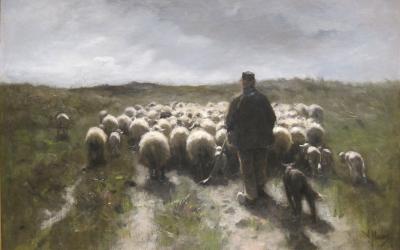
Shepherd_and_Sheep'_by_Anton_Mauve

This call to worship originally appeared in "The Lord, Our Shepherd—Lent 4: Even though I walk through the valley of the shadow of death..."Call to WorshipCome, let us sing for joy to the Lord.Let us shout aloud to the rock of our salvation. Let us come before him with thanksgiving, and extol him with music and song.For the Lord is the great God, the great king above all Gods. Come, let us bow down in worship,Let us kneel before the Lord our Maker;For he is our God, and we are the people of his pasture, the flock under his care. —Psalm 95:1–3, 6–7 NIVRevised Common LectionaryYear A: Lent—Third Sunday in LentYear A: Season after Pentecost—Reign of Christ—Proper 29 (34)

Read The Article
For What Did Your Church Pray

This gathering litany originally appeared in "The Lord, Our Shepherd—Lent 1: The Lord is my shepherd, I shall not be in want."Litany of Response:When the advertisements offer us everything, if we only have the money;and you offer everything if only we do without,Lord, help us to say “no” to the world and “yes” to you. When the easier way to succeed means we lose our integrity, but the harder waymeans we lose our pride,Lord, help us to say “no” to the world and “yes” to you. When society wants us to conform and be nice, and you want us to rebel and be real,Lord, help us to say “no” to the worldand “yes” to you. When our friends don't respect what we count as important,but you call us to persist and overcome, Lord, help us to say “no” to the world and “yes” to you. When we feel alone and forsaken by youand are tempted to forsake you in turn,but you have promised your enduring presence even when we don’t feel it,Lord, help us to say “no” to our doubtsand “yes” to you. When we have come to a crossroads and we don't know where to turn,but you call us to walk in faith with you, Lord, help us to say “no” to our doubtsand “yes” to you. Jesus Christ, the Son of God, who has been preached among youis not one who is “yes” and “no.”He is God’s “yes”—For it is he who is the “yes” to all God’s promises. —David Koll © 2002 ReformedWorship.org CC BY-NC-SA 4.0

Read The Article