

Please wait while we generate your results...
“Churches and families vary greatly in how they handle children being present in communal worship. Some families, like my own, have already been worshiping alongside their children for several years. For other families, the idea of having their children in the service can bring about feelings of anxiety and dread. Wherever you find yourself, be encouraged that God can use you to help build the faith of children…Inviting children into corporate worship may require a big culture shift for many congregations. We have to stop thinking of worship as a grown-up activity that kids aren’t ready for and stop viewing kids who are present as an inconvenience. Instead, we must embrace worshiping with our children as part of our God-given role in discipling them. We need to let them know that they are a valuable part of the church and that including them in our services is vital.”
—Lindsey Fescoe, “Welcoming Children into Communal Worship,” © June 2022, ReformedWorship.org, CC BY-NC-SA 4.0.
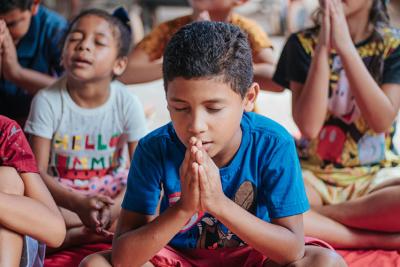
Your church may wish to develop a resource like the one presented here. This material was designed to aid parents and members of the congregation in making room for children in worship. The concepts and ideas for this folder were adapted by Christ Memorial Church in Holland, Michigan, from a brochure developed by the Children Committee of Central Reformed Church, Grand Rapids, Michigan. (Reprinted by permission.) These brochures were initially placed inside the hymnals with just the top part visible, so that parents would take notice and take them home. They now sit in the pew racks by themselves as a reference tool and an offering to visitors.Feel free to adapt the following text for your own context. If you are willing, please submit your own versions so we can add to this resource. Welcome to WorshipChildren at Christ Memorial Church are very much a part of our worshiping community. Their presence here is based on the biblical tradition and Reformed conviction that children are members of the covenant community.Worship is one of the basic ways people learn what it means to be Christian. Children learn to worship by worshiping with the congregation Sunday after Sunday.Children gain the following from worshiping with the community of faith:They learn that they belong to Christ and are welcome to Christ's church.They come to know, through repetition, the Lord's Prayer, the Doxology, the Gloria Patri, and other frequently used responses.They build memories of shared experiences of Christian community.They are enriched by the beauty of music and art as creative expressions of human praise to God.They hear stories from the Bible read and interpreted, and begin to experience worship as one place where God may speak to them.They witness the drama of baptism and the Lord's Supper—both visible signs of God's grace.They discover that they are valued as persons by God and by God's people.The Preschool ChildParents may wonder at the wisdom of including preschool children in worship. They can be restless and distracting to those around them. Their behavior can sometimes be embarrassing to their parents.The preschool child comes to worship with a rather limited attention span, seemingly endless energy and a growing curiosity about everything. While these ingredients can combine to test a parent's patience, there are several things parents can do to make the preschooler's worship experience (and their own) more relaxed and enjoyable:Sit near the front where children can have a clear view.Prepare children for the various parts of the worship service, explaining special events ahead of time and answering questions that need an answer "right now" in a quiet whisper.Allow children to place your offering in the plate or let them bring their own coins.Encourage children to use the children's worship activity bulletin (available from the ushers), inviting them to draw or color in these bulletins.Allow children to bring a favorite stuffed animal, colored pencils, or crayons along, or help them check out a book from the church library before the service.Encourage children to bring their own Bible storybooks.A sensitivity to the preschooler's abilities and needs can help make worship a pleasant experience for everyone.The Primary ChildThe school-age child brings some new abilities to worship: a greater capacity for attentive listening, an increasing ability to read, and the ability to organize and memorize information.Parents can help the primary child toward greater participation in worship as these capacities develop by using the following suggestions:Help children memorize the Lord's Prayer, Gloria Patri, and the Doxology.Review the bulletin with children to identify new or difficult words, previewing together those parts where the congregation responds by reading and speaking.Encourage children to put their own offering in the plate.Invite children to follow the reading of the Scripture lesson in the Bible; encourage children to bring their own Bibles.Encourage children to locate hymns in the hymnal, and go over the words; place book marks at each hymn in advance.Encourage children to listen to the sermon for stories, answers to questions, or important thoughts.Talk about the sermon after church and ask the children what they remembered best about the sermonFor this age group, some parts of the regular worship bulletins will be meaningful.ABC's for Parents and Friends of ChildrenArrive in time to find a good place to sit.Sitting near the front will provide younger children with a better view of the chancel.Bring colored pencils or crayons.These tools can be used for coloring the children's worship activity bulletins. The ushers will be happy to provide your children with one as you are seated.Clue in children to what will happen next in worship.Children who can read will want to go over the printed Prayer of Confession and find hymns in the hymnal. They like to be prepared.Discuss worship at home.This will give children time to ask questions and receive answers concerning worship. It will also help prepare them for any special events or services of worship (i.e., the Lord's Supper, baptism, or special commissioning).Express your joy in having children in worship.During the Greeting be sure to welcome the children near you. Include them in your conversations before and after worship to let them know they belong.Free yourself from worry about children's behavior.Be open to receiving their ministry to you.Children Worshiping in Other Ways at Christ Memorial ChurchWe make room for children in worship by providing these other options:quality child care and Sunday school during worship for infants and for toddlers through age twoan opportunity for toddlers to "walk-out" to the Care Center during the second hymnchildren's worship for ages three through second grade; these children leave with "walk-out" during the second hymn (summer walkout is for three-year-olds through kindergartners only)opportunities for children to participate in holiday celebrations and sacramentsthree children's choirs (Cherub Choir: kindergarten through second grade; Carol Choir: third through fifth grade; and Praise Choir: sixth and seventh grade)worship-activity bulletins for children, available from our ushersMission in the Marketplace—a summer Bible school experience for preschoolers through fifth gradeSunday School for three-year-olds through senior high

Hallelujah, Praise the Lord!All insects and birds,cute puppies and cats,the fish in the sea,and yes, even me: Hallelujah! Praise the Lord!All planets and stars,grass, trees, flowers, too,the rivers and streams,and yes, even me: Hallelujah! Praise the Lord!For toys and fun times,the place we call home,the food that we eat,and yes, even me: Hallelujah! Praise the Lord!Come, all who have breath,those near and those far, our old friends and new,and yes, even you! Hallelujah! Praise the Lord!—Diane Dykgraaf, alt. Joyce Borger © 2025 Calvin Institute of Christian Worship, Creative Commons AttributionNonCommercial-ShareAlike. Used by permission. Suggestions for Including Motions and Sign LanguageMotions and sign language offer excellent opportunities to use our bodies along with our voices in worship. Encourage the following movements during this litany of praise:Hallelujah! Clap hands once in front of you, then make two circles upward with each hand.Praise the Lord! Clap hands twice as you move your hands upward in front of you. Then form an L with the thumb and forefinger of your right hand and move it from your left shoulder to your right waist. Praise the Lord! Another option is to clap the hands twice in an upward motion and then reach both hands up to heaven in praise. I prefer this option because it opens our bodies to a posture of praise and worship to God and leaves our bodies in an expression of surrender, love, and adoration. If you are using this type of praise and response with children in your worship center or classroom, encourage the children to write their own verses. Ask what they would like to praise God for today, and use their responses to praise God. Some children may like to create a picture or art piece of the praise they would like to express.
My husband and I moved eight times in the first seven years we were married. Our early marriage was marked by a kind of instability and precariousness that had been foreign to both of us before. Once we moved states so that my husband could work at a new job, which he ended up losing just nine months later. We were blindsided and reeling from grief and fear.One night, a friend texted us that his five-year-old had prayed for our family at dinner. “He prayed that you’ll remember your baptisms,” the friend wrote. This memory still can move me to tears. We were so young and scared. We were feeling deep rejection from the community we had moved to join, and there were so many practical things to worry about: our three young daughters, groceries, a place to live, and new jobs. That five-year-old’s prayer was a gift. In the midst of some of the worst circumstances our family had yet faced, we were reminded of our belonging—to God and to God’s people. Our baptisms remind us that our belonging depends upon Jesus, not on our worthiness or our efforts. Though my husband and I were still very unsure of what our future would hold, we were reminded that we were, in a deep and unchanging way, beloved by God and a part of his family. BelongThe first question of the Heidelberg Catechism asks, “What is your only comfort in life and in death?” The answer begins with belonging: “That I am not my own, but belong—body and soul, in life and in death—to my faithful Savior, Jesus Christ.” That we belong to Jesus is a foundational truth of Christian identity. In the Reformed tradition, because we believe that this belonging is not contingent on our behavior or even our consent, we baptize our infants, declaring with both our words and our actions what is true about them even before they are able to declare it for themselves. At their baptisms, we commit to helping children experience this belonging and to understand the gospel story, and we pray that they will choose to participate in God’s work in the world.But how do we actually live these promises as a community? Whether or not we baptize our children as infants, how do we continue to communicate to the children in our churches this message of belonging? Are we sending mixed or confusing messages to the children in our churches about who belongs among the people of God, whom worship is for, and what a child’s place is among God’s people? If we are honest, children are probably some of the last people we think about when we plan a worship service. In many churches, children are not even present for the worship service. However, there is not a single time in Scripture when God’s people worship God in age-segregated groups. When God’s people worship, they do it all together. In many churches today, instead of treating age segregation as a contextual consideration that we must navigate as the people of God, we often elevate it to a foundational position of our church (Holly Allen and Christine Lawton Ross, Intergenerational Christian Formation, 2012, p. 114.). To put it another way, we often assume age segregation based on our cultural position rather than allowing our theology to shape the way we gather to worship. But if we believe that in worship God’s people gather to rehearse the story of Scripture and respond to the God who calls us to himself, then it makes sense that we would want children to be present with us. Who knows the language of story better than children, and what better way for them to learn a story than to live it—to experience it with all of their senses?Yet even if children are present in our services, we rarely think about them when we plan our worship services, and the idea of having children help us plan or lead our worship services is completely foreign. We are not suggesting here that worship services be changed to be more appealing to children. We are instead suggesting that children can learn to appreciate a worship service and, even more, that it is the job of parents and churches to help them do so. Furthermore, because of the way God made them, children offer unique gifts to congregations that are willing to see, include, and learn from them as they rehearse God’s story together. When we age-segregate our worship services, well intentioned as we may be, there are consequences for every generation.Resources for Intergenerational WorshipIt can be difficult for a church to locate resources designed to help multiple generations worship together. More resources are becoming available that are created to appeal to the strengths and interests of children while also encouraging adults to exercise childlike faith, to remember that play can be a part of worship, and to practice coming to Jesus as little children. At Word & Wonder (wordandwonder.org), we’ve created resources that we hope will help your church and families enjoy entering into worship across generations in rich, authentic ways.Our Advent Cards provide an opportunity for households to gather together, use wondering questions to reflect on Scripture and on an image, and pray in response. This simple weekly practice can help people of all ages slow down and wait during this season of preparation. Each card has an image on one side and Scripture and suggested prayers on the other. The cards also suggest a weekly hymn and a practice or activity to help people of all ages engage with the themes of Advent. These are available to download at wordandwonder.org/shop/free-advent/.The Gospel Story Hymnal organizes a collection of more than 150 hymns by the movements of the gospel story. It is intended to help churches welcome children into the sanctuary and to provide households with a beautiful way to share the story of Scripture as told through hymns. It includes beautiful illustrations, child-friendly and family-focused hymn notes, and a three-year plan for working through the hymnal in weekly family worship. More information can be found at wordandwonder.org. Our prayer is that these tools would serve you and the households in your church as you take the next step toward encountering God as people of all ages. Planning Worship with Children in MindFor some of us, imagining intergenerational worship is difficult. The idea of planning worship with children in mind seems gimmicky at best and downright chaotic at worst. But what if planning intergenerational worship isn’t about gimmicks or catering to different age groups, but instead about telling the gospel story and helping people find their place in it? We would want to think about what kinds of accommodations will help the people in our churches experience the story of the good news of the gospel and offer their response to God together.This doesn’t necessarily mean that our liturgy will change. In my experience, children respond very well to a set liturgy that is predictable and has lots of parts they can memorize. Dr. Robbie Castleman has pointed out that for children who are exposed to worship from a young age, church becomes like a familiar bedtime story (Dr. Robbie Castleman, interview with Lindsey Goetz and Dr. Ahyuwani Akanet, The Child in Our Midst, May 6, 2024, pod.link/1738960877). What an image! Isn’t that what we want for everyone in our churches—to so identify with the flow and feel of worship that we can somehow both relax into familiar rhythms, remain poised for what is next, and just know when something gets skipped? If children aren’t experiencing the story of scripture in our worship, something has gone wrong. We ought to help everyone in the congregation enter into the story week after week. This can be a daunting task. Many Christians admit to not reading the Bible regularly. The worship leader’s job is a big one. However, collaboration is key. Who are the people in your congregation who can help you consider the ways that people in different life stages and social locations will most naturally enter the gospel story? The idea for intergenerational worship is “something for everyone,” not “everything for everyone” (Sarah Bentley Allred, “An Introduction to Intergenerational Worship,” Intergenerate, May 24, 2021). We are formed as we worship, and a part of that formation is recognizing that we are gathered up among people who are different from us.Belonging is also a vital part of worship, and it is important that the implicit messages we send as we gather to worship tell everyone that they belong and that they are beloved by God. Including people of different generations and abilities in worship planning can help us create worship services that authentically engage people of all ages. We can also think carefully about the scripture passages we choose, how we present them, the way our spaces are set up, and what the environment communicates. How are we showing hospitality to the people in our churches, both young and old? Practical SuggestionsSpecial seasons of the church year are excellent times to experiment with intentionally intergenerational congregational and family worship. Certain seasons of the church year just feel different, and we can use that to our advantage. The colors of the church calendar, special symbols, and stories from the life of Jesus can fuel a child’s imagination. And some seasons are only a few weeks long, making experimentation a bit easier. We can put up with almost anything for four weeks! These seasons also offer us a chance to become like the children among us as we watch and learn from the wonder and awe they bring to these stories of salvation history. During Advent, for example, a church might choose to focus on different characters in the Christmas story. At our church, we chose four narratives, in part because narratives are easier passages of scripture for children to connect with. These passages were assigned to the four weeks leading up to Christmas and were included in a guide for households worshiping at home. They also dovetailed with an intergenerational Sunday school class in which participants reflected on and engaged with the narratives in different ways each week. The idea is not for your church to replicate what happened at our church, but to imagine what it could look like for a group of people to collaborate—to include representatives from different age groups in the planning of worship and learning experiences. The synergy that can come from a group of people thinking ahead about sermon series, education, and household discipleship resources for a focused period of time can bear great fruit in the life of a church.One of my favorite services of the church year is our church’s family Christmas Eve service. It’s a very light version of a Christmas pageant. There are no rehearsals and no lines. We sing short parts of several carols, and we hear the Christmas story. Throughout the service, children wearing very simple costumes picked up on their way into the sanctuary slowly walk to the chancel to create a living nativity. Sometimes I read the narration; sometimes older children in our church do it. In all the years I have read it, I have never made it through the story without crying. This service is chaotic, but the gospel never seems truer to me than when I’m reading that the congregation will “find Jesus in the streets, in their homes, and in their hurts and broken places” while I’m sharing the stage with the children I have come to love and worship with Sunday after Sunday. I’ve never felt more commissioned for weekly work than when the children process out of the sanctuary carrying the baby Jesus and charging us to “Go Tell It on the Mountain” or when the service ends with the words of Revelation 21 read in a booming voice: “I am making all things new.” Every year, these children help us remember the Christmas story in a truly authentic way. Both of these examples are just the beginning of the fruitful worship that can occur when a group of people at a church collaborate to plan a season of the church year, intending to make their worship accessible to everyone in the congregation.
More Children and Youth Resources

Connect
Reformed Worship Resources in Your Inbox
Sign up for the newsletter to receive the latest Reformed Worship resources and other news.
