

Please wait while we generate your results...
“Sturdy worship is deepened by knowledge about worship…Worship is so powerful partly because we do it with our entire being. Our first responses to worship tend to be somewhat visceral; our ‘gut’ guides our engagement. When that visceral response is partly shaped by an awareness of the biblical foundations of worship, its historical unfolding, the purposes of the various parts of the liturgy and the complementary ways in which different generations and varying temperaments enter into worship, that response will tend to be less reactive and hold a greater capacity for integrating one’s personal response within a corporate response.”
—Syd Hielema, “Reflections on Worship Education (part 1),” © June 2015, ReformedWorship.org, CC BY-NC-SA.
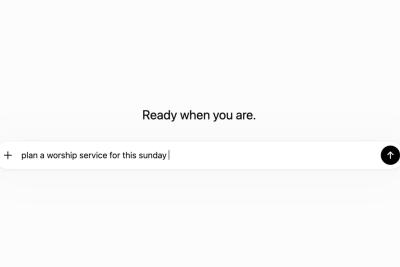
Liturgical historians may well mark the 2020s as a decade of cultural disruptions that accelerated conversations on worship and technology. Issues once thought fringe or experimental, including virtual worship, livestreamed participation, and videoconferenced sacraments, are now post-pandemic realities. And with the public release of ChatGPT in 2022, the widening access to artificial intelligence (AI) tools presents yet another moment for reflection.TERMS TO KNOWArtificial intelligence is an umbrella term, often applied in whatever way seems most convenient or exciting (the latter known as AI-washing). Machine learning (ML) is a subfield of AI that develops algorithms (a set of instructions) to learn how to make intelligent, human-like decisions without being explicitly programmed. We have become familiar with generative artificial intelligence (GenAI), in which ML trains models to generate content (text, images, videos, audio) based on prompts.GenAI applications are known for relying on large language models (LLMs), extensive datasets trained on online media, books, and other sources. Popular GenAI applications include chatbots (think ChatGPT, Claude, or Gemini) that generate media outputs based on responses to prompts entered in a chatbox.Over just a few years, churches and congregations—across geography and theology—have witnessed an explosion of the use of artificial intelligence in worship. In 2023, a 37-minute service at St. Paul’s Evangelical Lutheran Church in Fürth, Bavaria, was planned by AI applications and conducted by avatars on a screen, rather than human clergy. In 2024, the United Church of Christ reported on a Long Island minister who used ChatGPT to write an entire service liturgy, even adjusting it to account for that week’s breaking news. In 2025, in the weeks following the death of conservative activist Charlie Kirk, videos circulated on social media in which an audio imitation of Kirk plays in the service of Prestonwood Baptist Church in Plano, Texas. The AI-generated voice addresses this megachurch sanctuary in a manner similar to preaching or exhortation, assuring parishioners that “I’m fine, not because my body is fine, but because my soul is secure in Christ.”Companies persuade today’s worship leaders that they have an AI-powered tool to prepare nearly everything needed for a worship service: Asaph can take your Scripture passage and Planning Center database, and then generate a song list that fits the assigned text. Sono can take a brief prompt to generate lyrics and an audio recording of a worship song in the style of Elevation Worship. SermonAI can draft your sermon manuscript, suggest illustrations, and create discussion guides. ChatGPT and Gemini can write calls to worship, prayers, and hymn texts. Midjourney can generate artwork for bulletin covers and ProPresenter slide decks.The Question of Worship and TechnologyAs disruptive as AI might seem, I would argue that it continues the same line of questioning about worship and technology that the church has already been wrestling with—it just takes it in new directions. It electrifies an existing conversation that arose from pandemic-necessitated worship.When it came to online worship, the question was whether humans can use technology to mediate an existing physical, embodied service shared through virtual channels. This time, though, the question reaches further: whether technology itself can contribute genuine liturgical content that humans use in their worship services, physical or virtual.No longer is the question merely, “Can we use Zoom to help us celebrate Eucharist?” but “Can we use ChatGPT to generate the words of prayer that will help us celebrate Eucharist?”Back in 1994, Susan White forecasted that technology would play a dominant role in thinking about worship in the new millennium. And Zac Hicks rightly points out that worship has always been technological, insofar as it embraces material resources to facilitate a divine-human encounter, from the shining bronze serpent to prayerbooks to stained glass windows to LED stage lights.True enough, Christian worship is not inherently anti-technology, because it is not anti-material. In our services, God welcomes the fruits of a good created world, including tools that human hands steward to lead congregations in encountering the glory of the Lord. A Christian theology of creation resists the notion that entering worship means ascending to some detached, immaterial realm.How, then, should we talk about technology for the purposes of worship?Evangelical worship is well-noted for embracing pragmatism: doing what works. This spirit—submitting to biblical principles rather than regulative prescriptions—has led many churches to incorporate many new technologies into services, most recently generative AI. This may be done in a desire to feel relevant or caught up, or perhaps it is done “to become all things to all people” (1 Corinthians 9:22).However, I think we are right to be concerned when technological hype outpaces critical reflection. At worst, it can express one of the temptations that Henri Nouwen suggests Jesus faced in the wilderness: the temptation to be relevant. That doesn’t mean that we should dismiss the means of worship technology on the grounds that technology does not belong in worship—or that worship should be non-technological. Even “lower-tech” or “higher-liturgy” congregations must acknowledge that their use of microphones, mass-copied bulletins, livestreaming, or Western instruments embraces technology to some extent.If it’s not a question of means, then could it be a question of motivation? I wonder if we could approach issues of AI in worship by examining two intentions that motivate our acceptance (or rejection) thereof.The Priestly Intention: Reducing Barriers or Cutting Corners?First, let me suggest that worship leaders can examine their motivations for using AI-powered liturgies through the lens of their priestly intentions: how does AI help or hinder the calling of pastors to mediate an encounter between God and the priesthood of believers? Put another way, to what extent does AI-generated liturgy facilitate the “full, conscious, and active participation” of worshipers? (adapt. Pope Paul VI, Sacrosanctum Concilium, 1963 para. 14). Congregations have demonstrated that they can deploy AI to reduce a legitimate barrier to liturgical participation. For instance, AI assistants can provide live translation during worship services for non-native speakers or for those who benefit from sign language interpretation. Or, Asaph’s worship song analysis tool, which uses AI to suggest emotional contours through a congregation’s song repertoire, can be an insightful starting point for considering how sung prayers balance formative and expressive language. Pastors and musicians could use these reports as one tool for nurturing a healthy diet of song.With proper motivation, it seems possible that worship leaders can wisely use AI to foster accessible, meaningful participation. But when we ignore this priestly intention, we shift the motivation behind using AI in service planning or leading, from reducing pastoral barriers to reducing practical inefficiencies.Of course, there is a welcome place for technology to make tasks more efficient. Likely, none of us would consider it wrong to use a copy machine, which both supports participation by ensuring wider access to printed service orders and saves valuable time. Perhaps we might even find a biblical warrant: Following the friends lowering a man from the roof, worship leaders can use their available resources to “find a way” to help people come closer to Jesus (Luke 5:18–19).There is a problem, though, when we leverage technology to shortcut, not support, the priestly work incumbent on worship leaders.With a short prompt, we can use AI to generate that prayer of confession that seems like too much work to write, or to suggest a punchy conclusion for that sermon you just don’t have any more time or energy left to write. When we use AI to generate the sung or spoken liturgical elements of a service, we take a shortcut. We claim that it makes us more efficient and (ideally) frees us for other worthy ministry tasks.In reality, what happens is we allow the voice of artificial intelligence—not of the people whom God has called, chosen, and equipped—to take a priestly position: to guide service order, mediate prayer, and stand between God and the assembly.Such thinking abandons a priestly vision in favor of a productivity mindset. Using generative AI for service planning substitutes the hard but holy task of wrestling with the scriptures, of bringing a word from the Lord to bear on a congregation entrusted to our care. It encroaches on the pastoral calling by claiming to produce this word from God, by organizing prayer, by placing words of confession on our lips and promises of assurance on our hearts. It uses algorithms instead of spiritual wisdom to dictate the formational language of our sacred conversation with the living God.Alison Gerber is correct: ChatGPT and other LLM-generated content “can’t replace prayer-soaked preaching” (or any part of a worship service, for that matter). Chatbots, known for hallucinations, remain an unreliable facilitator of dialogue between God and humans. Where is that Spirit-led guidance and “prayer-soaked” leadership when we push AI’s potential for accessibility too far—when we go beyond reducing barriers to cutting corners?The Aesthetic Intention: Fruitful Multiplication or Deceptive Duplication?Second, we can examine our motivations for using AI in worship by their aesthetic intentions. That is to ask, to what extent does AI-generated liturgy fulfill the cultural mandate and contribute to a renewed imagination of beautiful worship?Our Reformed faith passes down an emphasis on God’s directive to “be fruitful and multiply, and fill the earth and subdue it” (Genesis 1:28). God invites humans to cultivate creation—to build culture and community in a way that glorifies the Creator. That work involves engaging all parts of creation, “subduing” and bringing them under the authority of God.Indeed, to fulfill this mandate is to bear the image of God in its functional dimension. When we exercise dominion, care, and creativity over creation, humans represent God’s rule and contribute to blessing God’s beloved world with good gifts toward its ongoing beautification.Thus, as we discern wise and careful stewardship, especially with newer technologies like AI, we should ask ourselves whether such usage contributes to fruitful multiplication or deceptive duplication. Are we choosing to “fill the earth” with the fruits of intentional creative activity, or with falsified, imitated potential?Like the fig tree cursed by Christ, we might call some things alive, even while they cannot bear true fruit (Mark 11:13). I worry that AI-generated content approaches this territory. Machine learning can simulate human activity, but it cannot replace it. As such, AI cannot fulfill this functional dimension of the image of God.Pope Leo XIV, who urged Catholic priests to resist using AI in homily writing, puts it plainly: “Renouncing creativity and surrendering our mental capacities and imagination to machines would mean burying the talents we have been given to grow as individuals in relation to God and others.”An LLM could likely generate a theologically accurate and liturgically appropriate hymn text, or a convincing sermon series graphic. It’s even more likely that you can get away with it—most congregants won’t notice or care.But what is the consequence?When we choose to fill the earth with AI-generated content, we deprive humans of opportunities to contribute original, creative gifts for our Father’s world. We spoil the spirit of leitourgia: liturgy as the “work of the people.And we deceive worshipers. We suggest that sacred space can and/or should be filled with non-creative objects posing as genuine fruit. We conflate vapid slop with true beauty.Yet God has expectations for what we offer as stewards of creation. Scripture’s opening pages warn us with the story of Cain and Abel (Genesis 4) that an acceptable offering to God arises from the fullness of our grateful hearts, not with a deceptive motivation.If our Creator has given us the opportunities (and capabilities!) to fill the earth with good gifts, why would we contribute deceptive slop and deepfakes? Could the church offer a compelling, countercultural witness by choosing a different way, by refusing a carte blanche, wholesale acceptance of hype, by choosing temperance over indulgence?Can Church Leaders Lessen Reliance on AI?Thus far, I have been asking questions of how: How can worship leaders use AI as faithful stewards of creation? But beyond this question of how is a question of why: Why do we turn to AI? Why do we feel this interest in powering our ministry with this new technology, whether as a flirty curiosity or a dangerous overreliance?It may come from another one of Nouwen’s temptations: not only to be relevant, but to be spectacular.The fear that “Sunday always comes”—perhaps with each service, sermon, and song set more creative than the last—can produce a crushing pressure. We feel the limitations in our time and abilities. When we stare down a blank Word document, it becomes easier to consider the promise that AI could help “the lift” and make things as creative as possible.Consider some of the marketing pitches: Asaph calls itself “built for worship leaders who don’t have time to waste.” SermonAI boasts, “We remove every obstacle standing between pastors and the pulpit.”The late-week crunch will come, and with it, the temptation to be spectacular—the haunting obligation to outdo that church across town, to outdo that worship collective on Instagram, or to outdo that version of yourself from last week. Ultimately, AI is a convenience tool, joining a long line of products promising to make work easier. It suggests that inspiration is instant, like a powdered sports mix to shake up some electrolytes in a water bottle. And like most quick fixes, its effects don’t last.Could AI be a tool to organize thoughts, revise existing material, facilitate brainstorming, or suggest ideas for improvement?Sure.But perhaps there is something better to be found in deeper reliance—not on the voice of artificial intelligence, but on the voice of the Holy Spirit, whose wisdom speaks through the community of a faithful worship planning committee, a sermon feedback group, or a pastoral colleague. When we find ourselves overwhelmed by the temptation to be relevant or spectacular, we can turn to God, who offers himself in Jesus as our hope for wisdom, creativity, and energy.So says the apostle Paul: “This is what we speak, not in words taught us by human wisdom but in words taught by the Spirit, explaining spiritual realities with Spirit-taught words” (1 Corinthians 2:13).Human-trained wisdom provides convenient, on-demand answers. But no LLM can train “Spirit-taught words.” Through lives of earnest prayer, we can listen to and learn from the Spirit so that, as worship leaders, we might model this faithful devotion in our liturgy.Like all technology, there is neither an immediate, unqualified “yes” nor “no” when it comes to generative AI in worship. We will need to “discern the spirits” to see what is from God (1 John 4:1). And if our goal is to discern how God allows us to lead others to encounter the crucified, resurrected, and ascended Jesus in his proper and deserving honor—his beauty in a sea of AI slop, and his glory in a cloud of AI hallucinations—then this is a worthwhile task.Questions for DiscussionWhere do you fall on the spectrum of AI acceptance in worship (or more broadly, of technology in worship)? Consider two extremes: total enthusiasm or total restriction.Some in the Reformed tradition invoke the Belgic Confession’s rejection of “all human innovations…in our worship of God” (Art. 32) to restrict technological use in the church. How would you reconcile that concern with the author’s claim that “Christian worship is not inherently anti-technology”? And how do we hold to that statement while utilizing amplification, lights, airconditioning, heat and myriads of other human innovations in our worship? Is there a line to be discerned? To what extent do you think the “priestly intention” and “aesthetic intention” apply outside of worship and ministry settings? Put differently, do you think the author’s positions on AI ethics could/should be applied in other areas (e.g., journalism, computer science, education, art)?Prompt an AI tool to help you with an existing task for an upcoming service. You could ask it to organize a service around a text/theme, generate a sermon illustration, outline, or manuscript, or write a hymn text. With your worship committee (or other group), reflect on that experience. What felt comfortable? What felt unsettling? How do you evaluate that work considering the priestly and/or aesthetic intention?For Further ReadingFor a historical overview on technology in worship: Lovin’ on Jesus by Lester Ruth and Lim Swee Hong (see the section in ch. 3, “Technological Advancements in Contemporary Worship”)For an introduction to the relationship of worship and technology: Christian Worship and Technological Change by Susan WhiteFor a recent advanced discussion of virtual worship: @ Worship by Teresa BergerFor practical wisdom: AI Goes to Church by Todd KorpiFor an accessible introduction: Introduction to Generative AI by Numa Dhamani and Maggie EnglerFor another perspective consider the encyclical letter Magnifica Humanitas by Pope Leo XIV

I had never heard a woman preach, yet I had made the bold decision to go to seminary to become a pastor. Not everyone agreed with my decision. One person questioned the need for more education. “All you need is Jesus!” they exclaimed. “Who is Jesus?” I responded in jest. Yet I found that seemingly simple question was at the core of much of my seminary education.This question was also at the center of many theological discussions and controversies throughout the history of our church, even to the present day. Yes, we know that salvation is in Christ alone, but who is this Christ that we worship? Christ is Lord, but what does that mean in our everyday life? What does being a Christ follower look like? These struggles and questions were as alive in the early church as they are today. The need for clarity arose from wanting to know God and to honor God. In the early 300s, the church was struggling with the question of how best to talk about the Father God, Jesus the Son, the Holy Spirit, and their relationality. What are the right words to use? How do we balance the seemingly conflicting truths that the Father is God, the Son is God, and the Spirit is God, yet there is only one God? There is a Father and a Son, which suggests a generational timeline, but one didn’t come before the other. How does this all work? Arius, a pastor from Alexandria, Egypt, thought it didn’t work. Out of the right desire to protect the holiness of God the Father, Arius argued that God could not have become an unholy human; therefore, Christ is not God incarnate. Arius demoted Jesus Christ to a created being, though still a divine being. John 3:16 says that “God so loved the world that he gave his one and only Son.” If Jesus was begotten from God the Father, doesn’t that suggest that there was a time he didn’t exist—that he came into being after God the Father? Meanwhile, across town, a pastor in training, Athanasius, was teaching that God the Father and Christ the Son were equally divine. Hearing this, Arius cried heresy, and quite a row erupted, with church members quickly choosing sides. This disagreement soon spread beyond Alexandria. “We Believe” or “I Believe”?The beginning of the Nicene Creed was originally written in Greek in the first-person plural: “We believe.” When translated into Latin, it became credo: “I believe.There isn’t a right or wrong choice when using the creed today. If the creed is used liturgically as a statement of unity, “We believe” is appropriate. If it is functioning as a personal statement of faith, “I believe” may be the better choice.Constantine, the Roman emperor and a fairly new convert to Christianity, was worried about the political fallout of the growing division. He summoned more than a thousand Christian leaders to Nicaea for a meeting that lasted from May through July of 325. Around three hundred of the attendees were bishops active in the debates about the nature of Christ. At this three-month meeting, participants made a variety of decisions, including when to celebrate Easter and when people were permitted to kneel in prayer. Of most significance, though, was the formulation of a new statement regarding the divinity of Christ; this became known as the Nicene Creed. In 381, at the First Council of Constantinople, the creed was expanded to include additional clarification around the Holy Spirit, finishing the work begun at the Council of Nicaea. The significance of this council’s work and of the resulting Nicene Creed cannot be overstated, even if few of our congregations make regular use of the creed in worship. FILIOQUE CLAUSEWhile it may have seemed that the councils of Nicaea and Constantinople put an end to Arianism, which denied the divinity of Christ, the reality was that this heresy continued to plague churches in the West, particularly in Spain. To combat the heresy, Western churches wanted to make Christ’s divinity very clear. They did so by adding “and the Son” to the section on the Holy Spirit, insisting that the Holy Spirit proceeds from “the Father and the Son.” In Latin, “and the Son” is expressed as the single word filioque. The addition of the filioque clause is one of the reasons given for the split between the Orthodox Church of the East and the Roman Catholic churches of the West in 1054. The Eastern church thought the clause implies the Holy Spirit is a lesser member of the Trinity; the Western church believed it didn’t change the creed’s meaning. Today, most theologians from the Eastern Orthodox and Roman Catholic traditions no longer see the filioque clause as a reason for division, understanding that they are professing the same truth in different ways. The Nicene Creed . . .. . . is ecumenical: The basic truths affirmed in this creed are held in common by Christians around the globe. Whether we say the creed often or not, Christian churches of all denominations—small and large, rural and urban, Eastern and Western, from the Northern and Southern hemispheres, with all kinds of worship styles—fundamentally agree with what is claimed in this creed. Given all we disagree with each other on, this is no small feat and should be what unites us as the siblings in Christ that we are. When we say “We believe,” we can truly say “we” to mean “all Christians.”. . . embraces trinitarian mystery: Ambiguity might make scientists anxious, but the Nicene Creed has no problem with mystery and contradictions. It’s able to do what Arius wouldn’t: affirm the divinity of Christ. Christ is “of the same substance” as the Father, and coeternal with him. The creed outlines Christ’s work of salvation through his incarnation, crucifixion, resurrection, and ascension—all four equally important. The Nicene Creed also affirms the profound mystery of the three-in-oneness of the Trinity—three persons, yet one essence. These theological truths are foundational to our Christian faith—a faith built on mystery and truth, a faith worth declaring boldly. I don’t regret my time at seminary exploring answers to the question “Who is Jesus?” My faith continues to deepen as I pursue that question and grow in my desire to know Jesus. Still, difficult times come, and as I journey through life, I find that the creeds serve as anchors in seasons of doubt or challenge. And it’s both powerful and heartbreaking to know that these same words are being proclaimed each week by Christians in Gaza and Jerusalem, in Russia and Ukraine, Ethiopia, Sudan, Syria, Iraq, China, Haiti, and along the southern border of the United States. Together in the face of opposition, in times of unimaginable grief and suffering, immense joy, unshakeable faith, and even seasons of doubt, together we declare, “We believe!”

There’s a big difference between the “Christmas spirit” of today and the original Spirit of Christmas. We can see the Holy Spirit’s work throughout the story when we remember and celebrate the Incarnation in this season. It’s the beauty of our Triune God - Father, Son, and Spirit - in collaboration.

Connect
Reformed Worship Resources in Your Inbox
Sign up for the newsletter to receive the latest Reformed Worship resources and other news.
