This is part of the worship series,
"Grounded and Growing—Journeying from Lent to Easter”
Series Introduction | Ash Wednesday | Lent 1 | Lent 2 | Lent 3 | Lent 4 | Lent 5 |
Palm/Passion Sunday | Maundy Thursday | Good Friday | Easter
Leading Prayers of the People During Lent | A Communion Liturgy for Lent
Also in this year-long, Grounded and Growing series: Advent and Christmas | Epiphany
Good Friday is a day of holy restraint, a service shaped by absence and diminishment. There is no sermon. There is no celebration of the Lord’s Supper. Instead, we listen to the story of Christ’s passion and allow it to take root.
This service draws on two ancient Christian traditions. One is the typically Roman Catholic Stations of the Cross, in which the church walks slowly through the final hours of Jesus’ life. The other is Tenebrae, a service of shadows, in which light is gradually withdrawn as the Passion story unfolds. In this service, these traditions are woven together. The passion according to the Gospel of Mark is told in a series of narrative sections. We provide a robust distribution of pericopes and descriptors (“Shadow of ________”), but you are free to adapt for your own context. After each reading, a candle is extinguished and the room grows darker.
Throughout this central portion of the service, music plays quietly beneath the readings. It rises briefly during the silences between them. The visual and auditory elements are not decorative, but formative. They help shape a space of attention, reverence, and witness.
There is no commentary on the readings. Scripture itself is the proclamation. Silence is part of the prayer.
The extinguishing of each candle marks a shadow in the story: the shadow of betrayal, of condemnation, of humiliation, of death, of burial. Near the end of the service, the sanctuary is fully darkened (insofar as that is possible), and the Christ candle is carried from the room. Only then is the final shadow/text (burial) read.
Throughout this season we have reflected on what it means to be grounded and growing—to trust that God is at work even when the soil is hard and the landscape bare. Good Friday brings us to the place where the seed falls into the earth. The story presses us down into the ground with Christ, into the silence and the waiting. It asks us to trust that even here—in loss, in grief, in apparent failure—God is still at work beneath the surface, preparing life we cannot yet see.
The service concludes in silence, though not without hope. At the very end, a single flame returns, hinting at what is yet to come.
See additional notes following the service regarding logistics.
Service Outline
GATHERING
Call to Worship
The Lord be with you.
And also with you.
This week we follow Jesus
as he turns his face to Jerusalem
where he will be betrayed,
arrested,
tried,
beaten,
mocked,
and crucified.
We follow him step by step,
rooted in his story,
standing where he stood,
watching where he walked.
Silent reflection
Let us fix our eyes on Jesus…
…on Jesus,
the author and perfecter of our faith.
Who for the joy set before him endured the cross,
scorning its shame,
and sat down at the right hand of God.
Let us consider him who endured such opposition
from sinful people
So that we will not grow weary and lose heart.
—Hebrews 12:2–3 NIV 1984
Opening Song
“When I Survey the Wondrous Cross” (st. 1–3) Watts
WORD
Scripture Readings
What follows is ONE way to tell the Passion story from Mark’s gospel. For each portion of the story we’ve provided an adjective: Betrayal, Devotion, Abandonment, etc. However, you can use whichever adjectives seem good to you. Working in your own context, for the sake of timing or other considerations, feel free to skip verses, combine pericopes, even gently edit if it keeps the story moving. Even bring in verses from other canonical gospels.
More detail is given below, but note that during this section, the music of “Jesus’ Blood Never Failed me Yet” Bryars plays quietly beneath the readings. It rises briefly during the silences between them. The extinguishing of each candle marks a shadow in the story: the shadow of devotion, betrayal, etc. Near the end of the service, the sanctuary is fully darkened and the Christ candle is carried from the room. Only then are the two final texts read.
Note: Use pastoral sensitivity as you prepare your congregation for what to expect in this portion of the service. People may experience strong emotional reactions to the sensory portions of the service (ie the growing darkness and auditory effects at the strepitus).
Shadow of Devotion
Mark 14:3–9
The anointing at Bethany—costly love in the face of death.
Shadow of Betrayal
Mark 14:10–11
The plot to kill Jesus. Judas agrees to hand him over.
Shadow of Covenant
Mark 14:12–25
The Passover meal. Bread broken. Cup poured. A kingdom promised.
Shadow of Abandonment
Mark 14:26–31
Jesus predicts desertion. Peter swears loyalty.
Shadow of Agony
Mark 14:32–42
Gethsemane. Prayer. Sweat. Surrender.
Shadow of Arrest
Mark 14:43–52
Judas’ kiss. The mob. The disciples flee.
Shadow of Denial
Mark 14:66–72
Peter disowns the one he loves.
Shadow of Condemnation
Mark 15:1–15
Jesus before Pilate. The crowd chooses Barabbas.
Shadow of Humiliation
Mark 15:16–20
The soldiers mock the “king.”
Shadow of Procession
Mark 15:21
Simon carries the cross.
Shadow of Crucifixion
Mark 15:22–32
Jesus is nailed to the cross and mocked.
Shadow of Dereliction
Mark 15:33–36
“My God, my God, why have you forsaken me?”
Shadow of Death
Mark 15:37–39
Jesus breathes his last. The curtain is torn.
[After the reading:
- Music fades completely
- Lights go fully dark
- A single cymbal roll begins and grows in intensity.
- Candle snuffer approaches Christ candle.
At cymbal climax:
- Christ candle is extinguished (preferably wet-pinched for audible sizzle).
- The Christ candle is carried out slowly.
This moment is the strepitus.]
Shadow of Witness
Mark 15:40–41
The women watch from a distance.
[The second last candle is snuffed out. The next reading is spoken in darkness so best memorized.]
Shadow of Burial
Mark 15:42–47
Jesus is laid in the tomb.
[Final candle is extinguished.]
Silent Meditation
[After about 90 seconds of silence, a solo instrument plays the melody to “When I Survey”. At the same time, a liturgist slowly and reverently brings the Christ candle, now re-lit, back into the sanctuary (preferably from a different spot from where it was brought out).]
Response
“When I Survey the Wondrous Cross” (st. 4) Watts
SENDING
Jesus turned his face to Jerusalem
where he was betrayed,
arrested,
tried,
beaten,
mocked,
and crucified.
Dismissal
May Jesus Christ
who for our sakes became obedient unto death,
even death on a cross,
keep you and strengthen you.
Amen.
The people leave in silence.
Logistical Notes
The Movements
The service proceeds in three major movements:
GATHERING: Opening liturgical section
WORD: Tenebrae (Passion readings with shadows)
SENDING: Closing section with return of the Christ candle
Visual Design and Art
There should be one candle for each reading and they should be placed where they can be seen. The Christ candle should stand out in size or color and be placed in a prominent position.
You may chose to print the images from "The Stations of the Cross: A Visual Journey" or "Images for Maundy Thursday and Good Friday" that connect with the readings from Mark, put them in frames, and then place them in the front of the sanctuary with one candle associated with each image. Alternately, you may choose to project those images during the reading, moving to a black screen when the candle is snuffed out before moving to the next reading and image.
Audio Design
During the Tenebrae section, a portion of the recording “Jesus’ Blood Never Failed Me Yet” by Gavin Bryars plays continuously under the readings.
The volume is:
Low during scripture readings (audible but unobtrusive),
Raised slightly during silence and candle-snuffing transitions.
After the “Shadow of Death” reading:
Music fades completely to silence.
A live cymbal roll (felt mallets) is used for the strepitus.
Lighting Design
Sanctuary lighting begins at normal worship levels.
After each shadow reading, lights dim slightly.
After the “Shadow of Death,” lights go completely dark and remain so for the final readings.
During closing hymn, Christ candle re-enters the space, gently bring lights up.
Candle Choreography
During Tenebrae:
– Scripture is read.
– Approximately 20 seconds of silence follows.
– Music rises slightly.
– Candle snuffer walks to the candle station.
– Candle is extinguished.
– Candle snuffer returns to seat.
– Lights dim slightly.
This sequence repeats for each shadow.
Final Note
This structure assumes close coordination between:
– Presider
– Readers
– Candle snuffer
– Audio technician
– Lighting technician
– Projection operator
– Musician (cymbal)
A full run-through is strongly recommended.
Musical Note
About “Jesus’ Blood Never Failed Me Yet”
In 1971, Gavin Bryars was working on a film about people living rough in the area around Waterloo Station, London. In the course of being filmed, some people broke into drunken song—sometimes bits of opera, sometimes sentimental ballads—and one, who in fact did not drink, sang a religious song "Jesus' Blood Never Failed Me Yet." Gavin recorded it, not sure of its use.
When he got home, he found that the singing was in tune with his piano, and he improvised a simple accompaniment. He also noticed that the first section of the song—13 bars in length—formed an effective loop, which repeated in a slightly unpredictable way. He took the tape loop to the University of Leicester, where he was working in the Fine Art Department, and copied the loop onto a continuous reel of tape, thinking about perhaps adding an orchestrated accompaniment to it. The door of the recording room opened on to one of the university’s large painting studios, and he left the tape copying, with the door open, while he went to have a cup of coffee. When he came back he found the normally lively room unnaturally subdued. People were moving about much more slowly than usual, and a few were sitting alone, quietly weeping.
He was puzzled until he realized that the tape was still playing and that they had been overcome by the old man's singing. This convinced him of the emotional power of the music and of the possibilities offered by adding a simple, though gradually evolving, orchestral accompaniment that respected the man's simple faith.
About the Series Image and Permission
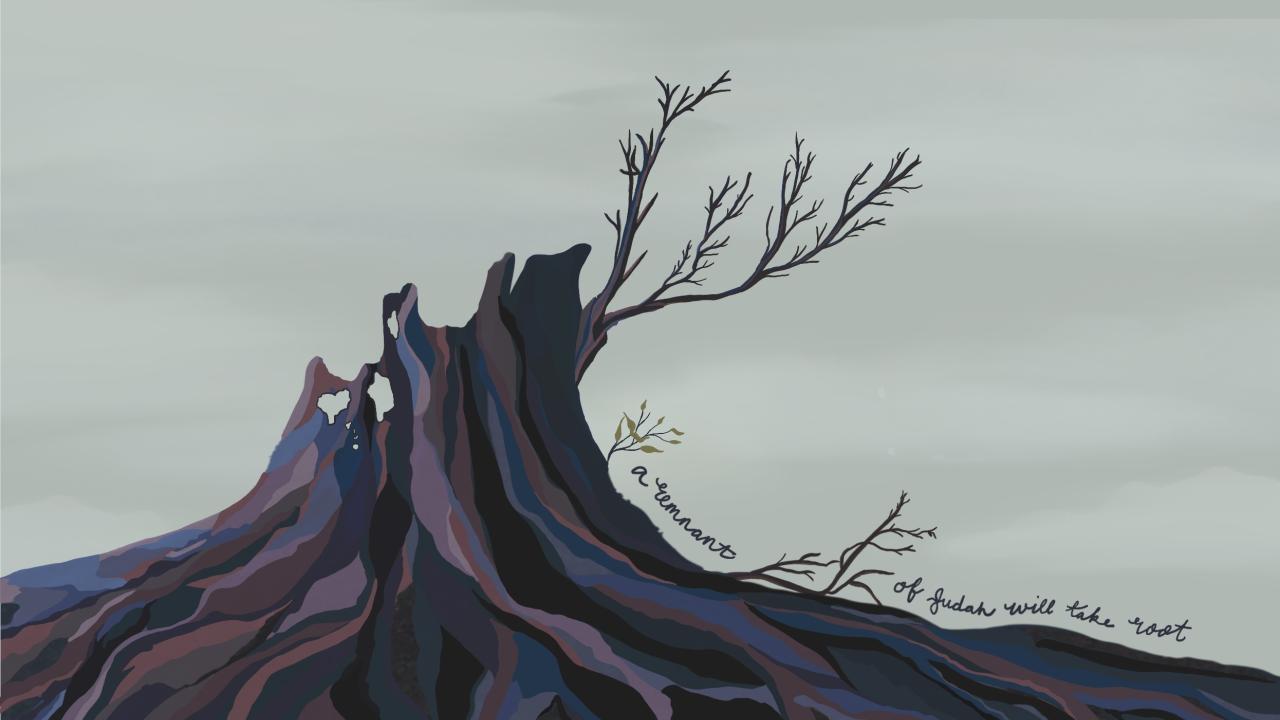
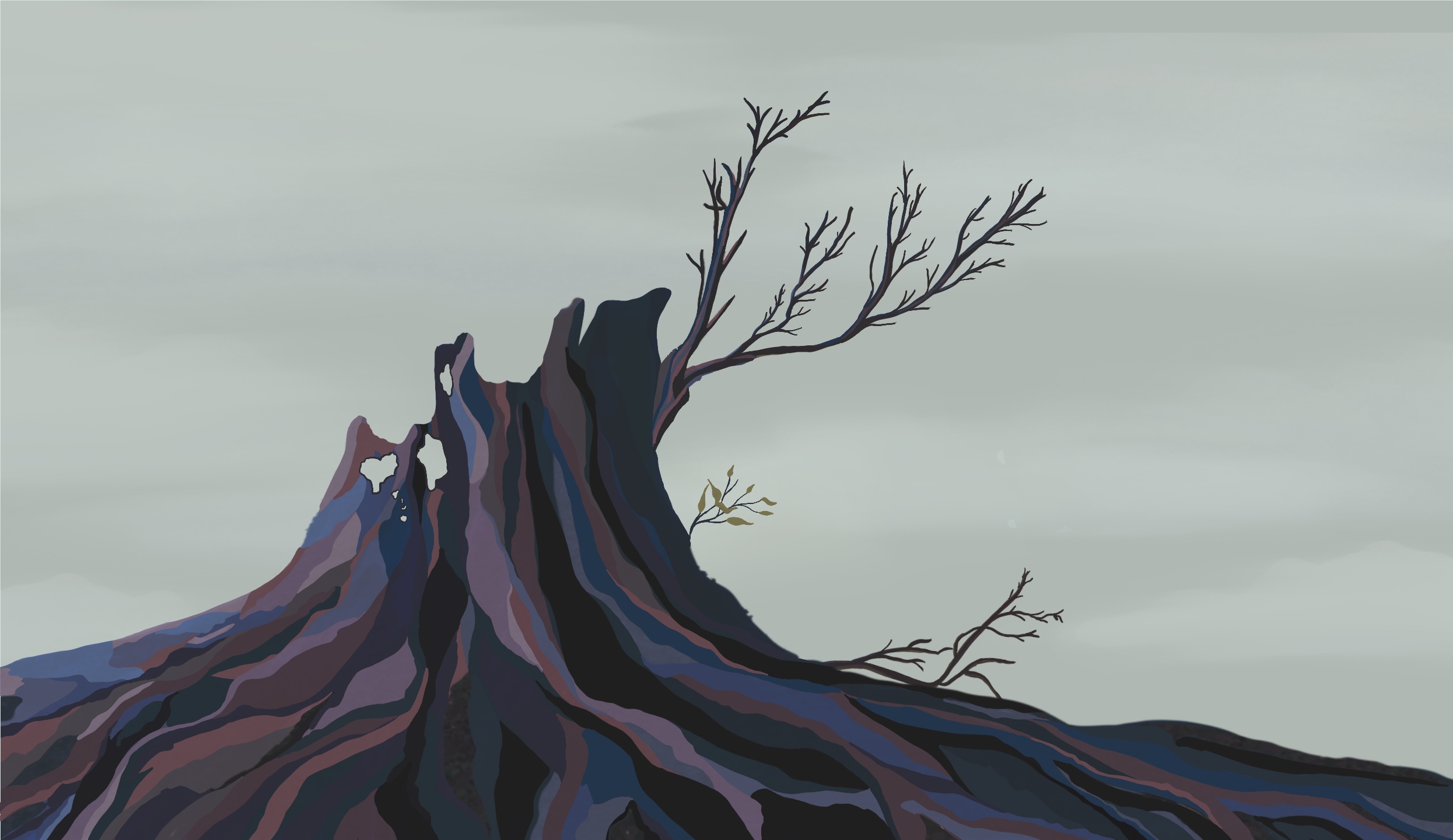
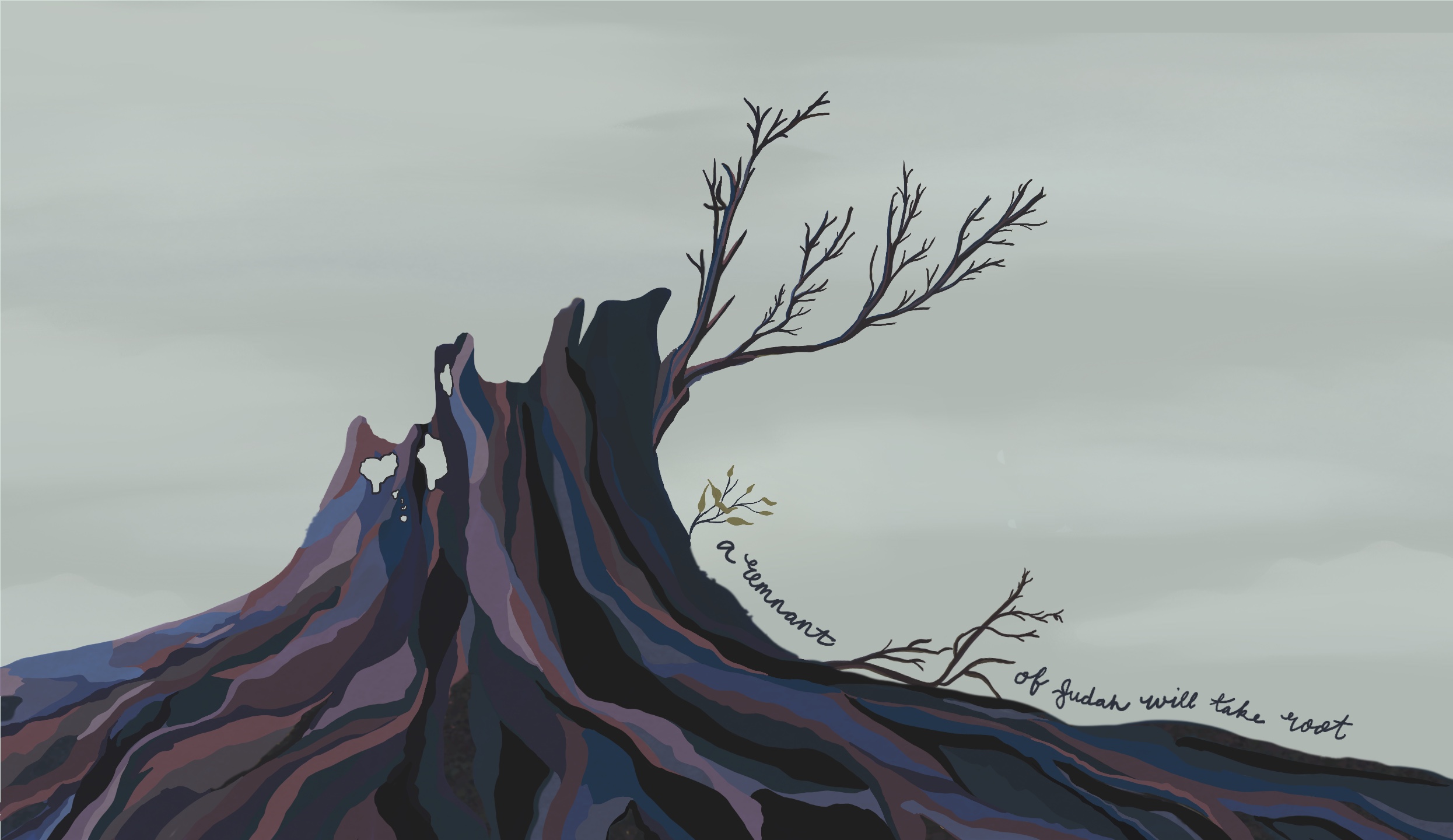
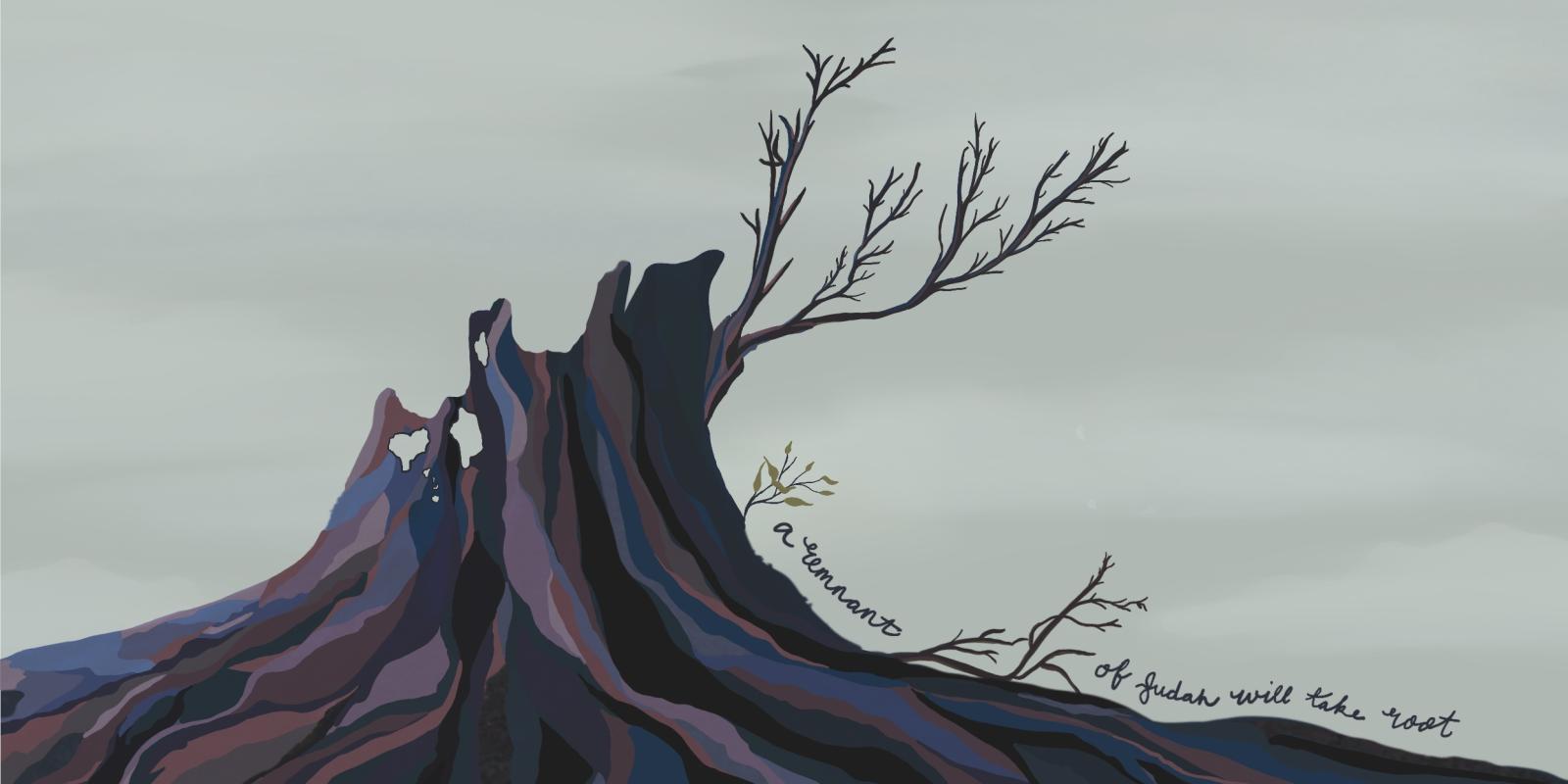
More information on the series image can be found in the series introduction. Two versions of it are available in the resource section below, one with the phrase "a remnant of Judah will take root" and one without. The image can be adapted to fit your needs for bulletins, social media, or projection.
This artwork is made available under a Creative Commons Attribution. You are free to share and adapt the work for non-commercial purposes, provided you include the following attribution:
Emma Oehler © 2026 ReformedWorship.org, CC BY-NC-SA 4.0. Used by permission.
Revised Common Lectionary
Year B: Lent-Liturgy of the Passion