This is part of the worship series,
"Jesus and the Devil”
Series Introduction
Week 1 | Week 2 | Week 3
WEEK 1
Stones or Bread?
Call to Worship
O come, let us sing to the Lord;
let us make a joyful noise to the rock of our salvation!
Let us come into his presence with thanksgiving;
let us make a joyful noise to him with songs of praise!
For the Lord is a great God
and a great King above all gods.
In his hand are the depths of the earth;
the heights of the mountains are his also.
The sea is his, for he made it,
and the dry land, which his hands have formed.
O come, let us worship and bow down;
let us kneel before the Lord, our Maker!
For he is our God,
and we are the people of his pasture
and the sheep of his hand.
—Psalm 95:1–7 NRSVUE
Litany of Confession
In the beginning of human history,
our first parents walked with God.
But rather than living by the Creator’s word of life,
they listened to the serpent’s lie
and fell into sin.
Fallen in that first sin,
we prove each day
that apart from grace
we are guilty sinners:
we fail to thank God,
we break God’s laws,
we ignore our tasks.
Looking for life without God,
we find death;
grasping for freedom outside the law,
we trap ourselves in Satan's snares.
All spheres of life—
family and friendship,
work and worship,
school and state,
play and art—
bear the wounds of our rebellion.
Sin is present everywhere—
in pride of race,
arrogance of nations,
abuse of the weak and helpless,
disregard for water, air, and soil,
destruction of living creatures,
slavery, murder, terror, and war,
worship of false gods,
the mistreatment of our bodies,
and our frantic efforts to escape reality.
We become victims of our own sin.
In all our striving
to excuse or save ourselves,
we stand condemned
before the God of truth.
But our world,
broken and scarred,
still belongs to God,
who holds it together
and gives us hope.
—Arranged by Bethany Besteman, "Our World Belongs to God" st. 13–14, 16–17 © 2008, Christian Reformed Church in North America, Grand Rapids MI. www.crcna.org.
Prayer of Confession
God of exodus and wilderness,
God of refuge and help,
hear us now as we make our confession to you.
In times of temptation
we forget what you have done for us.
You give us everything we need,
yet we often remain unsatisfied;
you trust us to care for creation,
yet we often abuse that trust
and spoil what we have been given.
You show us the way we are to follow,
yet we often continue on the path
of self-indulgence and self-centeredness.
Forgive us, we pray.
[Silence]
We ask for your direction, your patience, your love,
in the name of Jesus Christ,
who, in spite of his temptations,
was faithful to your saving Word. Amen.
—Nancy E. Hardy in Celebrate God’s Presence (pp. 154-155). © 2000, United Church Publishing House. Used by permission.
Prayers of the People
[Be sure to include prayers for those facing temptations; here is one example. See also pages "Our Father in Heaven" for prayers based on the Lord’s Prayer.]
You are holy, O God of majesty,
and blessed is Jesus Christ, your Son, our Lord.
As one of us, he knew our joys and sorrows
and our struggles with temptation.
He was like us in every way except sin.
In him we see what you created us to be.
Though blameless, he suffered willingly for our sin.
Though innocent, he accepted death for the guilty.
On the cross he offered himself, a perfect sacrifice, for
the life of the world.
By his suffering and death, he freed us from sin and
death.
Risen from the grave, he leads us to the joy of new life.
[Intercessions for the church and the world may be included here.]
Lead us, O God, in the way of Christ.
Give us courage to take up our cross
and, in full reliance upon your grace, to follow him.
Help us to love you above all else
and to love our neighbor as we love ourselves,
demonstrating that love in deed and word by the power
of your Spirit.
Give us strength to serve you faithfully
until the promised day of resurrection,
when, with the redeemed of all the ages,
we will feast with you at your table in glory.
Through Christ, all glory and honor are yours, almighty
Father,
with the Holy Spirit in the holy church, now and forever.
Amen.
—Donald Wilson Stake and Harold M. Daniels; rev. Marney Ault Wasserman, alt. in Liturgical Year. The Worship of God: Supplemental Liturgical Resource 7 (pp. 145-148). © 1992, Presbyterian Church (U.S.A.). Used by permission of Westminster John Knox Press. (TWS K.4.4.3)
Scripture
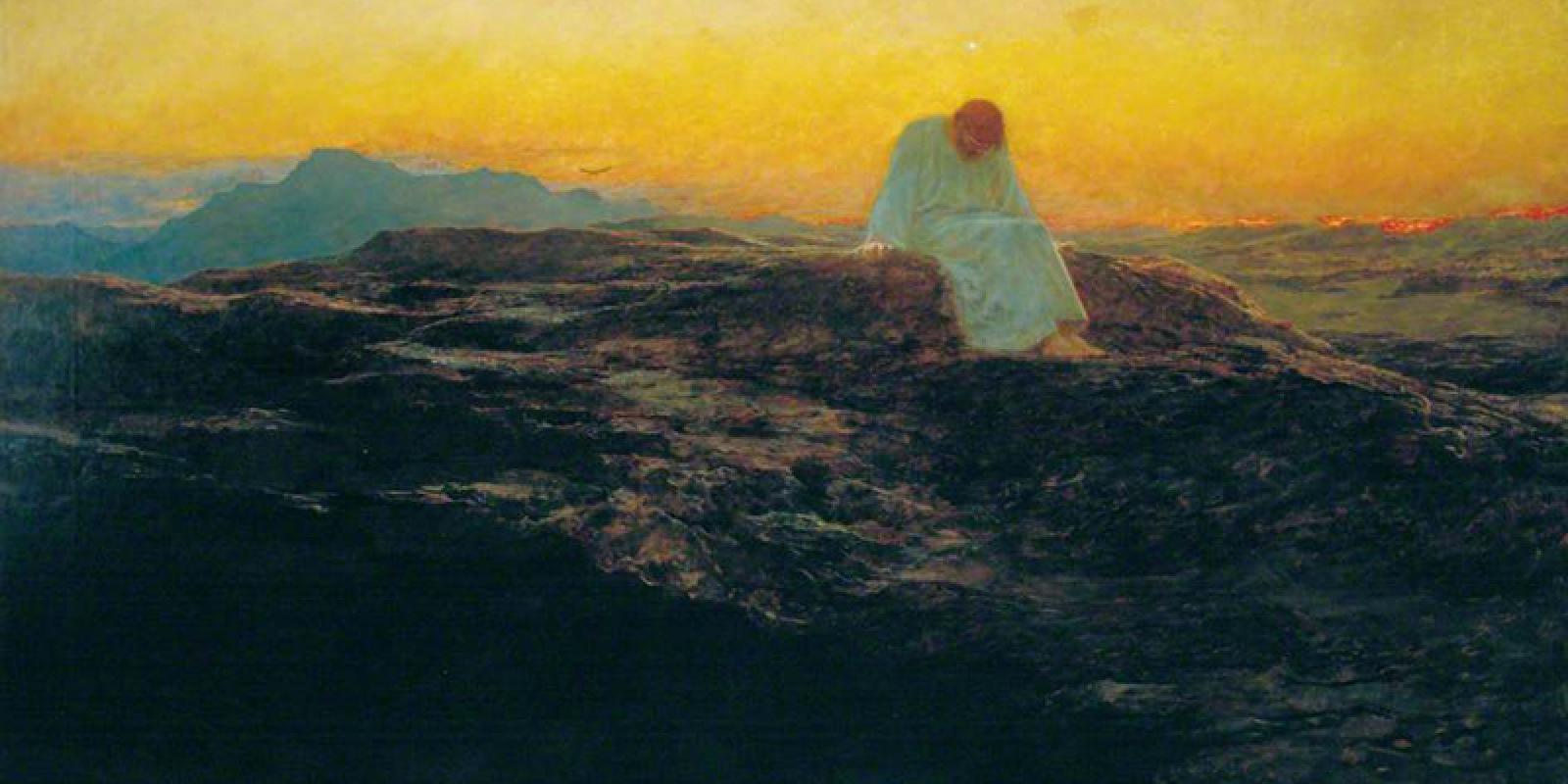
Matthew 4:1–4
Sermon Notes
- The idea that drives this temptation is that the devil offers a trivial use of power or ability for self-gratification.
- Connecting with John 1, Jesus, the pre-existent Word, created the world. To make a meal for himself would be a petty use of his power, distracting Jesus from his mission to defeat sin and make all things new.
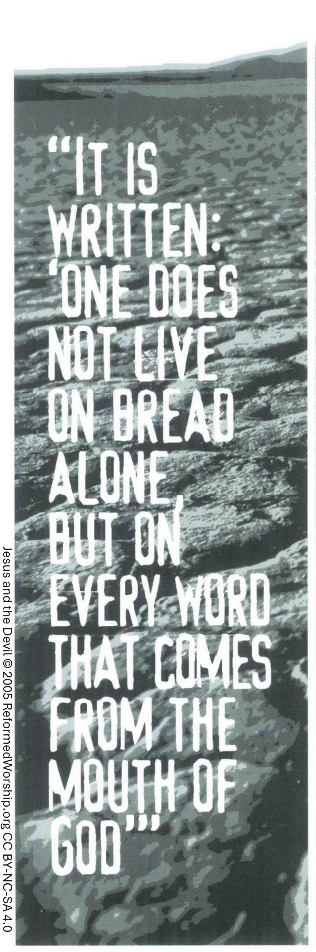
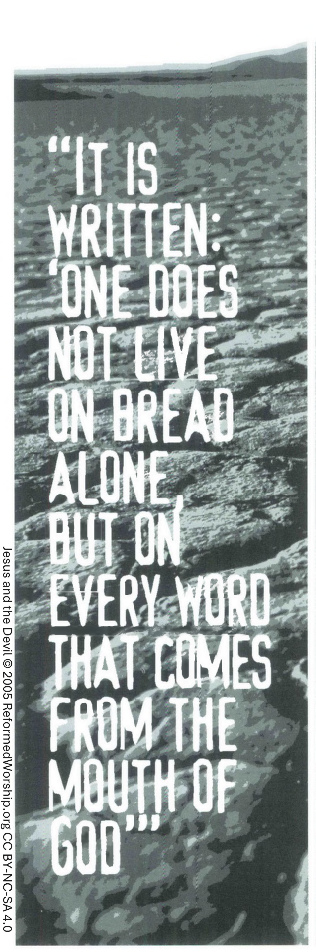
- How did Jesus face the devil? He responded not on his own strength, but with the history and power of the Word of God: “It is written: ‘We do live on bread alone, but on every word that comes from the mouth of God.’” The quote comes from Deuteronomy 8:3, where Moses told Israel they would not live by bread alone. They were in the desert too, tempted to return to Egypt where they had food. Yet God fed them manna for forty years so they could learn again to be God’s dependent people.
- What might this first temptation sound like in our language today? The devil tempts us to waste our powers and gifts on ourselves, becoming less than the generous people whom God made in his own image, splitting us from God and others.
Possible examples: Our civilization could grow enough to feed the world twice. We could arrange transportation and develop basic education to teach hungry people how to grow food. Instead our world spends billions more on weapons and war or dithering and entertaining distractions than on food production, education, and health. That makes us less than God made us to be.
Revised Common Lectionary
Year A: Lent—First Sunday in Lent