Resources by Kathryn Ritsema Roelofs

Purple and pink candles

This is part of the worship series, "Be Not Afraid”Series Introduction and Prelude  Advent 1 | Advent 2 | Advent 3 | Advent 4 | Longest Night | Christmas Eve | Epiphany 1 | Epiphany 2  Advent 1The Hopes and Fears of All the YearsWe Wait and We HopeChoral Introit “Comfort, My People” CallananAdvent Candle Lighting: Hope On this first Sunday of Advent, we light the candle of hope. [Light candle.] Isaiah gives us a vision of a kingdom yet to come where everything has been made new and where creation is at peace. “A shoot will come up from the stump of Jesse; from his roots a Branch will bear fruit. The Spirit of the Lord will rest on him—the Spirit of wisdom and of understanding, the Spirit of counsel and of might, the Spirit of the knowledge and fear of the Lord—and he will delight in the fear of the Lord” (Isaiah 11:1–3). We light this candle of hope as a sign of our waiting and expectation for the coming Christ.Song “Lo, How a Rose E’er Blooming” GermanResponsive Reading I wait for the Lord, my soul waits,and in his word I hope;my soul waits for the Lordmore than those who watch for the morning.We wait and we hope. O Israel, hope in the Lord!For with the Lord there is steadfast love,and with him is great power to redeem.We wait and we hope. Glory to God the Father, to Jesus the Messiah, and to the Holy Spirit.We wait and we hope. Amen. —adapted from Psalm 130:5–7, NRSVUESongs “Christ, Be Our Light” (vs. 1, 2, 4, and 5) Farrell“Here I Am to Worship” HughesPrayer of Confession We wait and we hope. For many of us, Christmas feels like a time in which we do neither. The season has become one of parties and extra activities, plans with family, year-end deadlines, and purchasing gifts. There is not much space for us to wait and feel hopeful. So this morning we begin our time of prayer by carving out some space for silence, for silent prayers to God or maybe just for silence before God.[Silence]Emmanuel, God with us, in this Advent season, we confess how difficult it is to slow down. We don’t want to wait patiently for anything, and instead we buy into the busyness of the season, leading many of us to feel a lack of joy and a lack of hope. When we look at the world around us, it’s hard to feel hopeful about the world, about our nation, about ourselves. We are surrounded by death, destruction, and pain, and we long for a day when your promised kingdom comes to make all things new. Give us hope that this day is indeed coming, and help us to rest in this because your promises are always true. Amen.Assurance of Pardon Our hope for a new creation is not tied to what humans can do, for we believe that one day every challenge to God’s rule will be crushed. His kingdom will fully come, and the Lord will rule. Come, Lord Jesus, come.—Our World Belongs to God, para. 55, © 2008, Christian Reformed Church in North America, Grand Rapids MI. www.crcna.org. Used by permission.Song “Eternal Weight of Glory” KimbroughWe Rest in God’s WordScripture Reading Isaiah 11:1–10Message “The Hopes and Fears of All the Years”Prayer of Response Eternal God, for whom all people wait and search, open our eyes, closed by fear and blinded by self-pity, that we may see clearly the anxieties and uncertainties that beset our days. These are the very circumstances that make us impatient for your return.—Adapted from John T. Ames, Let Us Pray; Reformed Prayers for Christian Worship. Edited by Martha S. Gilliss. © 2002, Geneva Press. Used by permission.Refrain: The hopes and fears of all the years are met in thee, O Christ. (“O Little Town of Bethlehem,” adapted Brooks)For all those whose fears cause them to fight, who are caught up in conflicts or escalating tensions; for people and nations who bait and taunt one another, who threaten violence, who begin and perpetuate wars: teach us vulnerability to name our fears, to experience hope, and to trust in you.RefrainFor all those whose fears cause them to fly, who cannot name or feel or know the depths of their own sorrow or anger, who are so hidden they cannot even find themselves, who pretend when the work of holiness demands honesty: teach us vulnerability to name our fears, to experience hope, and to trust in you.RefrainFor all those whose fears cause them to freeze, who feel stuck in patterns and behaviors they know are not healthy or wise but do not know how to do or to be anything other than what they’ve always done and always been; for people and nations stuck in the way things have always been, who are afraid to imagine a new way forward: teach us vulnerability to name our fears, to experience hope, and to trust in you.RefrainRemember your church, O Christ; send your Spirit of unity, courage, and holiness. Give joy to all your faithful servants; have mercy on all who suffer persecution for your name’s sake; uphold them by your strong Spirit. Bring an end to divisions between Christians; gather us in one visible communion. Teach us vulnerability to name our fears, to experience hope, and to trust in you.—Adapted from an ecumenical prayer from France RefrainWe pray for all who are leading the nations. Give them a sense of what is right, that they may work toward peace, the common good, and human flourishing for all. Call each of us as we enter our workplaces, communities, and homes to bring your presence with us, bearing signs of your light in dim and dark places. Teach us vulnerability to name our fears, to experience hope, and to trust in you.—Adapted from an ecumenical prayer from FranceRefrainEternal God, ever faithful to your promises, the earth rejoices in hope of our Savior’s coming and looks forward with longing to his return at the end of time. Prepare our hearts to receive him when he comes, for he is Lord forever and ever. Amen.—Adapted from Baker’s Worship Handbook: Traditional and Contemporary Service Resources. Paul E. Engle. Baker Books, a division of Baker Book House Company, 1998. © 1998, Paul E. Engle. Used by permission. bakerpublishinggroup.com. 

Read The Article

There are no songs in my hymnal written for government contractors. At the church I formerly served in Washington, DC, as my first Labor Day weekend there approached, I wanted to plan a service focused on the “work of the people.” I was disappointed—but not at all surprised—that there was no specific language for this congregation’s specific vocation. The same was true for my colleague who served in Houston. There aren’t hymns for oil workers. The more I dug, the more I realized that the songs in most churches’ repertoires that are tangentially related to “work” refer mostly to farming. They speak of plowing fields, tilling soil, and cultivating growth. There are many churches, of course, where these words reflect the daily living of many of their congregants as they grow and produce the bounty that lands on our tables each day. But for those not directly involved in farming, work-related hymns are slim pickings.That first Labor Day would turn into a second, and a third, and eventually a sixteenth before I took another call. In those years, I learned the importance of vocationally conversant language not only in preaching, but in liturgy and in song. Worship not only allows for honest recognition of our daily lives, but welcomes it. We hear God’s call to worship, and we respond with our fullest selves. We don’t fragment our lives and bring only that which is spiritual or deemed “appropriate” for church. But too often—and with good intentions—pastors and worship leaders make the mistake of welcoming people to worship by inviting them to leave behind their work weeks. Forget about the stress. Don’t think about what tomorrow will bring. This is a time to worship God.What a missed opportunity! At God’s gracious invitation, we are welcomed to worship by the One who is present in our worship and in our daily lives. We are received by a God who not only cares about our week, but has been present with us throughout it. “Leaving it at the door” potentially rejects an integral part of ourselves and what God created us to be: image bearers and beloved children.If we as leaders want to walk with congregations, to bridge the gap between Sundays, we need not only the tools, but the pastoral imagination to create something contextual. So, unless you’re a prolific hymn writer, it’s a matter of being creative with what’s already available. Below you will find a few songs with work-specific themes. Some of these might be familiar; some might be new. Each song is tied to a specific liturgical moment, and I’ll offer some suggestions on how to use it. There are many ways to frame a song well to address a worker’s daily life—but it does take practice, awareness, and a willingness to try.Day by Day LINKThis beautiful, simple song names several vocations (farmer, lawyer, teacher, nurse) and blesses the work they are called to do so that God’s kingdom may come and on earth God’s will be done. The refrain “Lord, be close to us. Lord, have mercy on us. Lord, please put your hand on us day by day” could easily be sung by the congregation even if the rest of the song is not accessible. Consider having someone sing the verses and then include everyone on the refrain. Intersperse prayers specific to your congregation between refrains. If you have never tried naming specific vocations, this would be an easy way to begin. Here are some examples: Prayers for Use with “Day by Day”God, we praise you for the gift of accountants,who work with the books to ensure equity and fairness. Their accuracy and intelligence blesses society’s systems in ways most of us never notice. God of numbers and order, we give you thanks for accountants. Sung refrain:Lord, be close to us. Lord, have mercy on us.Lord, please put your hand on us day by day.God, we praise you for the gift of plumbers, who make sure our buildings are sanitary and safe. Their expertise identifies problems and creates welcome solutions. God of well-working systems,we give you thanks for plumbers. Sung refrainGod, we praise you for the gift of retirees, who bless us by their very presence—with wisdom and support offered to family and community members and time given to prayer, for their volunteering roles, and their willingness to do tasks large or smallthat bring you and others great delight. God, who created seasons of life and blessed them,we give you thanks for retirees. Sung refrainGod, who calls each of us to be faithful day by dayas retirees, students, employers, employees, caregivers, or those who receive care, send your Holy Spirit to go before us,and move in and through us so that God’s kingdom may come and on earth God’s will be done. Amen. —Katie Roelofs © 2024 Creative Commons Attribution-NonCommercial-ShareAlike. Work Be Our PraiseLINKOld tune, new text! Hunter Lynch has given us new words to sing to the familiar tune ASSURANCE, composed by Phoebe Knapp. This song works well for framing offerings or tithing. When COVID-19 shifted many of our churches to online-only giving, offerings became more of a monthly bill to pay instead of a meaningful and formative part of our worship services. We have forgotten the theological significance of bringing our firstfruits before the Lord as an offering and a gift. The concept of “firstfruits” has, of course, changed; we don’t bring livestock or baskets of produce into worship. But how can we preserve the idea that, as a grateful response to God’s word, we should offer to the Lord our very best? Imagine a time of offering in your service that includes bringing modern things to worship and offering them to God in thanksgiving. Imagine a pile of stethoscopes, briefcases, packing tape, laundry baskets, and homework, all signifying an offering of the work of our hands. If this song wouldn’t work in your context, how could you use some of the same language to write an offertory prayer? Consider adapting this prayer: An Offering Prayer Lord, we offer up our firstfruits and the work of our hands. In and through our daily work, may you be honored and glorified. Use these gifts of money. Use the skills you have equipped us with. We offer our lives in gratitude to you. Amen.—Katie Roelofs © 2024 Creative Commons Attribution-NonCommercial-ShareAlike. ADDITIONAL RESOURCESAudio recordings and other resources related to the songs in this article can be found at these websites by searching with the song title: • “Day by Day,” praisecharts.com• “Work Be Our Praise,” worshipforworkers.com• “Before You I Kneel,” praisecharts.com • “Breastplate of Saint Patrick,” worshipforworkers.com• “Cloister Song: Steadfast Love,” worshipforworkers.comFor the following resources related to work and worship go to ReformedWorship.org and search with the article’s title in quotations. Reformed Worship:• “Prayers of the People for the Work of the People” • “The Heart of Worship”• “Sunday’s Prayer and Monday’s Work” • “The People Had a Mind to Work: A Service for the Sunday before Labor Day”• “Everyday Church-Iglesia Cotidiana” OTHER HELPFUL RESOURCES • Worship for Workers: worshipforworkers.com• Made to Flourish: madetoflourish.org• “Work and Worship: Reconnecting our Labor and Liturgy,”    by Matthew Kaemingk and Cory B. Willson, © 2020, Baker Academic,        workandworshipbook.com. Before You I Kneel (A Worker’s Prayer)LINKWritten by Keith Getty, Kristyn Getty, Jeffrey J. Taylor, and Stuart Townend, this hymn artfully weaves the melody of “Sleepers, Awake!” throughout and is a wonderful song for a commissioning or dedication. Its flexibility makes it a useful addition to your church’s repertoire. You could use this for: an installation service of staff or church leaders.blessing youth as they head back to school.a service of anointing people’s hands and saying, “May God bless you and the work of your hands.”  Prayer Calendar for WorkersTake inventory of your congregation’s professions and create a prayer calendar (I recommend the skill mapping tool made by our friends at Made to Flourish (madetoflourish.org/what-we-do/skill-mapping)). Then put together a “commissioning calendar” around particularly significant times of the year for workers in your church, such as:praying for mental health professionals near the winter solstice.praying for firefighters near the anniversary of September 11 (or a similar significant event in your context).praying for nurses on the anniversary of COVID-19 being declared a global pandemic.praying for your accountants during tax season.praying over university students before exams. Be intentional about praying over your people’s work and daily living—and include “Before You I Kneel” when you can! Having a violin or flute play the introduction makes this song especially lovely.  Breastplate of Saint PatrickLINKSome congregations have grown more adept at offering regular prayers of lament. Others need on-ramps to begin using this essential prayer language. Many in your church have positive work experiences. They generally like their jobs. They feel satisfied and receive a paycheck that covers the bills. But that certainly is not the case for everyone. Are you giving your congregation words with which to lament the painful and challenging parts of their daily lives, including their work? Think about the unemployed and those who are unable to make ends meet. Think about the parishioner who was laid off or passed over for a promotion they deserved. Think about the foreign service officer whose entire week was spent dealing with a humanitarian crisis overseas. These are worthy of lament, not only individually, but corporately. Corporate worship and corporate prayer are covenantal reminders that we are part of the body of Christ. Teach your congregation to pray for and lament with one another in the midst of challenges and pain.This powerful song by Wendell Kimbrough and Dan Wheeler, centered around the Lorica of Saint Patrick, gracefully holds in tension our laments and hopes. The text allows us to express sorrow, frustration, and disappointment, but then covers those emotions with the “promise of God that I’m never alone.” This song is easy to sing, and I guarantee it will run through your head throughout the week when you least expect it. It can be sung as a call and response, with the congregation directly quoting Saint Patrick. For all the joys and challenges, what a grace to put these words on people’s lips: “Christ above me, Christ beneath me, Christ behind, and Christ before.” Cloister SongLINKOra et labora—pray and work. The songs I’ve included here all help workers bring their daily living into worship and offer it to God in grateful prayer. What are some other ways that Sunday’s worship can carry over into Monday’s work? Has your church spent time developing spiritual practices that help people continue worshiping and being mindful of God’s presence long after they leave the church building? Are there familiar short songs or refrains in your repertoire that are easy to learn, easy to remember, and accessible to all ages? How might you give people ways to weave one of these simple songs into their workdays prayerfully and intentionally? Could you develop a way to “pray the hours” using these songs? Praying the Hours in SongThe simple “Cloister Song” uses Psalm 90 as a framework for praying the hours (morning, daytime, evening). It could be introduced in worship and woven into corporate prayers, and the text could go home with members on small cards to keep in prominent locations such as a desk, a dashboard, a bathroom mirror, or a bedside table.Invite people to intentional moments of prayer throughout the day. You could use a song you already know and love, or you could write a short refrain of your own! The goal is to give words that will continue to come to mind and draw people to prayer and a recognition of God’s presence—God with us. ConclusionRegardless of the work your congregants do, vocationally-conversant worship is not out of reach. Worship leaders can beautifully contextualize worship practices to speak to the daily realities congregants face during their work weeks. Write down three songs your congregation already knows and sings well. How could you use a spoken introduction or scripture to frame these songs so that they communicate a message that will reverberate far beyond the sanctuary walls? What short sentence will encourage worshipers to recognize God’s presence in their work, school, and home contexts from Sunday to Saturday? These kinds of small changes are like planted seeds: they’re almost unrecognizable at first, but with patient nurturing, they grow and flourish.

Read The Article

This series was designed to be a flexible focal point during the summer months when family schedules were less predictable and many people, including our pastor, took vacation. By using Psalm 23, one of the most familiar passages in Scripture, as our summer theme, the worship team hoped people would feel a sense of continuity even if they had missed a service or a guest pastor was preaching. We sent an email each week inviting reflection on that week’s verse and providing prompts for additional engagement. Each children’s message was centered around the week’s verse, and we taught the congregation how to sign the psalm. Lorelai Reiffer, a talented young artist in our congregation, contributed artwork each week that we featured in our bulletin and on social media. Several other congregation members offered testimonies or reflections as the summer progressed. Psalm 23’s flexibility was proved as it coordinated well with two different sermon series and two services led by guest pastors over twelve weeks. We chose to use the New King James Version’s rendering of the psalm for this series because we felt it was more poetic and would tap into more people’s early memories. On the next pages you will find outlines for the first five services of the twelve-week series. A link to the remaining weeks can be found at tinyurl.com/RW147Psalm23Series.   Week 1 God’s Work in Ordinary Time “The Lord is my shepherd; I shall not want” (Psalm 23:1). After Pentecost, the long season of the church known as Ordinary Time begins. The mountaintop experiences of the liturgical calendar are past, and the church enters into the everyday to experience God’s sanctifying work amid the ordinary. Ordinary Time corresponds at least in part with summertime, a season in which school finishes, travel happens, graduations are celebrated, and transitions are anticipated. If this is a time of change in your daily schedule, celebrating Ordinary Time can offer stability and grounding.  Ordinary Time is a good time to return to well-loved and well-known Scripture—passages so well ingrained in us that we don’t remember when we memorized them, as if we’ve always known them. Psalm 23 is one such passage, and its first verse is one of the best known verses in all of Scripture: “The Lord is my shepherd; I shall not want.”  What needs do you see met in your everyday life? Imagine your daily routine as a pasture you are being guided through. How does your shepherd care for you as you wake up? As you make coffee? Get the kids dressed? Get to work? Run errands? Make dinner? Get ready for bed? In the ordinary moments of your day, remember that God is your shepherd and that God takes care of you. Sermon: Luke 15:1–10, “What’s So Great About a Shepherd?”  Sermon notes by Rev. Chelsey Harmon are available from the Center for Excellence in Preaching (tinyurl.com/Luke15CEP). Children’s Message [Display or project a picture of a shepherd so that all the children can see it. If you choose, distribute small cards of the image and the blessing found below for the children to take home. You can also print more for congregants to pick up on their way out of the worship space.] [Spend time wondering together using questions like these.] Does any of you have a special name that only your family calls you? Or do you sometimes shorten your name a little and just use a part of it? Some people have lots of names. In the Bible, God has lots of names. Can you think of some of God’s names? There is one name for God that we are going to be thinking about a lot this summer: shepherd. What does a shepherd do? I wonder why sometimes the Bible says that God is our shepherd? How is God like a shepherd? [Possible answers: he protects us; he watches over us; he helps us do the right thing.] Yes, and that’s why sometimes we call God our shepherd. This summer we are going to be thinking a lot about how God is our shepherd because we are going to be thinking about Psalm 23.  The first verse of Psalm 23 says, “The Lord is my shepherd; I shall not want.” Another version of this verse says “ God, my shepherd! I don’t need a thing” (Psalm 23:1, MSG). Of course we still need some things, like food and water, but the psalm writer is telling us that we can trust God always to be with us and care for us. Isn’t that incredible? God—the Creator of the whole universe!—loves and cares for each of us, and because God takes care of us we can trust God with everything. When you pray to God you can call him God, Shepherd, or [one of the other names the children came up with]. Different names remind us of different things about God. When we pray to God and call him “Shepherd,” we are saying that God is someone we can trust. God is there for us, protects us, and is always with us even if we don’t see him. Let’s pray to our shepherd God now.  [The children’s message can end here, or you can continue with the text below if you want to make use of the optional handout.] Optional Handout [Ahead of the service prepare a handout with a picture or line drawing of a Shepherd and the blessing found below. Make extra copies for older children and adults to pick up at the end of the service.] As I was thinking about this name for God, I was reminded of a blessing sometimes given at the end of the worship service. I put it on these cards with a picture of a shepherd, and I’m going to give one to each of you so that you can read it or have a grown up read it to you every day this week. Listen to what it says: God goes before you to lead you,  God goes behind you to protect you,  God goes beneath you to support you,  God goes beside you to befriend you.  Do not be afraid.  May the blessing of God the Father, Son, and Holy Spirit be upon you. Do not be afraid.  Go in peace to love and serve the Lord. Amen. —Source unknown I hope that you will take this home with you and remember that God is always with you.  You don’t have to be afraid about the future because God’s already there. You don’t have to be sad about what happened in the past because God is in the past as well. You don’t have to worry about the present because God is with you today too. I hope that helps you as much as it helps me. Song Suggestions “The King of Love My Shepherd Is” Baker, LUYH 824, GtG 802, SSS 359 “He’s Got the Whole World in His Hands” Anonymous, LUYH 26 Prompts for Reflection During the Week Journaling: Make a list of all the ways a shepherd meets the needs of a sheep. Then extend the metaphor: what might God be doing in your life like a shepherd does in a sheep’s life? For example, a shepherd makes sure that a sheep receives food; in what ways does God make sure you are fed, both physically and spiritually? Faith Practice: Gratitude Sensory: Using an old egg carton, start a sensory journey through the psalm. Each week, put something small into one of the egg holders that reminds you of that week’s verse. For example, perhaps this week you put a cotton ball in the first spot to give you a sensory memory for the idea of being a sheep in God’s flock. By the end of the twelve weeks you will have developed sensory memories associated with Psalm 23. This prompt will work well with young children who are just beginning to memorize Scripture, but it may also be a meaningful way for someone who has already memorized this psalm to experience it with more than just our eyes or our ears. Think of some creative ways to decorate your egg carton to reflect Psalm 23.  Weekly Devotions: Spend time this week with the many different passages of Scripture that consider the metaphor of God as a shepherd, especially Isaiah 40, Ezekiel 34, Luke 15, and John 10. How do these passages shed light on the Psalm 23 meditation on God as our shepherd? Which passages use the metaphor to show God’s gentle and caring side? Which passages use the metaphor of shepherd to show God’s protective and defending side? Faith Practice: Engaging Scripture   Week 2 Green Pastures and Still waters “He makes me to lie down in green pastures; He leads me beside the still waters” (Psalm 23:2). What are the green pastures and still waters in your life that God has blessed you with? What blessings bring you peace and rest? Do you have a favorite corner of the couch that you curl up on? Is there a neighborhood coffee shop you feel at home in? Is there a friend who calms you down every time you are in their presence? Praise and thank God for these green pastures and quiet waters. If this verse doesn’t feel true for you this week—if life feels filled with deserts and rough seas—maybe spend some time remembering what God has done for you in the past and allow that to comfort you in the present moment.  Sermon: Ephesians 1:3–14, “Blessings” Sermon notes by Rev. Stan Mast are available from the Center for Excellence in Preaching (tinyurl.com/Ephesians13CEP). Children’s Message Last week we talked about God the shepherd, and we mentioned a few different ways God is like a shepherd: God corrects us when we sin, God guides us, and God is all around us when we need him or when we feel sad or lonely. This week we are focusing on a different way that God is like a shepherd. Today’s verse tells us that God “makes me to lie down in green pastures” and “leads me beside the still waters.” Green pastures are places where there is soft green grass and where the water is quiet.  [Spend time wondering together, asking questions such as the following.] I wonder what it would be like to lie down in a green pasture—to lie down on soft, green grass. Do you have any ideas about what that would be like? What about lying beside quiet waters? I wonder what that would be like. Have you ever lain down by a small stream? I wonder what quiet water sounds like. Would you like to go somewhere that had green grass and quiet waters?  Where are some places you don’t want to go?  Today we are going to be talking about how God brings us to good places like green pastures and quiet waters—places that are safe and comforting. I wonder what some of the safe and comforting places in your life are.  How might we thank God for the safe and comforting places in our life? I wonder what we could do right now in our time of worship to praise God for the good things God gives us. [If one of the children says “pray” or “sing a song,” use that to transition into the next part of the service.]  Song Suggestions “God Is So Good”  Makai, LUYH 777, GtG 658, SSS 461 “Ten Thousand Reasons” Redman, LUYH 559, SSS 440 “Savior, Like a Shepherd Lead Us” Thrupp, LUYH 330, GtG 187, SSS 538 Prompts for Reflection During the Week Poem: Make an acrostic poem. Write a word or words from the verse vertically on a piece of paper and, for each letter, name a blessing that begins with that letter. Faith Practice: Celebrating Artwork: Take a piece of paper and draw a stream down the center of it lengthwise. On one side of the stream write down ways God has blessed your body; on the other side of the stream write down ways that God has blessed your mind. In the stream itself write down ways that God has blessed your soul. You can make this more creative by using green and blue pencils or pens to write or by making the lists on green construction paper with a blue stream cut out and glued in the center. Faith Practice: Remembering Activity: Find time this week to go for a walk with a notebook and pen near a stream or by a field. Find a place to sit. Breathe in while saying to yourself, “He makes me to lie down in green pastures.” Breathe out while saying to yourself, “He leads me beside the still waters.” Repeat for a few minutes, and then sit in stillness, inviting the Holy Spirit to speak to your heart. After listening, you can spend some time journaling, either recording what God says to you or writing a letter back to God after you’ve listened to him. Faith Practice: Listening   Week 3 Restoration “He restores my soul” (Psalm 23:3a).  If something must be restored, it is in a state of imperfection. The table that needs restoration has been scratched and stained; the garden that needs restoration is overgrown with weeds. Your soul is precious to God and worth the time, effort, and sacrifice its restoration requires. What scratches and stains is God lovingly undoing? What weeds are God lovingly removing?  Sermon: Luke 7:11–17, “Restored”  Sermon notes by Rev. Scott Hoezee are available from the Center for Excellence in Preaching  (tinyurl.com/Luke7CEP). Children’s Message [Spend time wondering together, asking questions and reflecting on the idea of restoration.] In Psalm 23 we are reminded of this promise: God restores my soul. I wonder what “restores” means. Do any of you have any ideas?  Have you ever brought a broken toy to a bigger person and asked them to fix it, and they gave it back to you all fixed? They restored your toy; they made something broken perfect again. Restored is another way to say “fixed.” [If you have a broken toy that is fixable, show them how it is broken; after you fix it, talk about how it is restored.] God promises that he will restore the whole world. When something is broken it doesn’t work right or maybe doesn’t look right. The Bible calls those problems “sin.” What are some things in the world that aren’t right, that are broken? I wonder what the world will look like when it is all fixed.  God also promises that he will restore you and me. The Bible says that there are things in our lives that are not right, that are broken. The Bible calls those things “sins” too. I wonder what the world would look like if there wasn’t any sin in it, and people were filled with love for each other and creation. Would you like to live in a world like that?  You know what’s awesome? God promises us that one day we will get to live in a world where nothing is broken, nothing ever breaks, and everyone is full of love. Isn’t that amazing?  Song Suggestions “God, Be Merciful to Me” LUYH 622, SSS 508 “Create in Me a Clean Heart, O God” Green Prompts for Reflection During the Week Artwork: Draw a picture of something that is beautiful or precious or deeply meaningful to you. Cover your picture with a piece of wax paper or parchment paper and secure it with a piece of tape so that you can lift the paper to reveal your original drawing beneath. On the top paper, trace or redraw the original image, but represent it as stained or broken or degraded in some way. If you want, write what in your soul is in most need of restoration on this top piece of paper (if you use wax paper, permanent markers may work best for this task, but be sure to let the ink dry so it doesn’t smear). Now, every time you lift the top paper you have an image of God’s restoring work. Allow this image to inspire you to be grateful for all that God has done in your life. Faith Practice: Gratitude Activity: With family or friends, visit a park or trail and spend some time picking up trash (with all safety precautions observed). Think or talk about the ways our souls become littered and in need of God’s restoration work. By working to restore a small part of creation, you are joining in the work that God is doing, restoring the whole world. Faith Practice: Justice and Mercy Journaling: In a journal entry, use your senses to explore the concept of restoration. What might restoration taste like? If you could touch restoration, what would it feel like? If you could hear it, what would it sound like? What does restoration look like? If it were a scent, what would it smell like? Faith Practice: Wonder   Week 4 The Way of Righteousness “He leads me in the paths of righteousness For His name’s sake” (Psalm 32:3b). God leads us toward blessings, as we contemplated two weeks ago (green pastures, still waters), but God also leads us to live up to his moral and ethical standard: righteousness. What does it mean to walk in the way of righteousness? In the Bible, the idea of righteousness is almost always about being in right relationship with God and with our fellow humans. How is God helping you walk paths of right relationship this week? How is God helping you to be right with him? With your neighbor?  Sermon: Isaiah 5:1–7, John 15:1–17, “Justice and Righteousness”  Sermon notes by Rev. Stan Mast are available from the Center for Excellence in Preaching (tinyurl.com/Isaiah5CEP). Children’s Message [Spend time wondering together, asking questions and reflecting on being right with God. If you used a toy with the children’s message last week, use the same toy this week.]  Last week we talked about how God restores us. He fixes the things in us that are broken. Imagine that I let you use my toy and you broke it. You brought the broken toy to me and told me you were sorry. What should I say to you if you really are sorry? Should I say “I forgive you”? I should, shouldn’t I?  Well, the cool thing is that I know how to fix the toy, so I restore it, and then I let you play with it again. This time you play really rough with my toy. You stomp on it and break it again. If you were me, what would you do? Should I let you play with my toy again even though you keep breaking it? What if I could teach you how to play with my toy without breaking it? If you knew how to play with it gently, should I let you play with my toy again? Could I trust you to play nicely with it?  I wonder how you think you would feel knowing that I had fixed the toy, taught you how to play with it, and then gave it to you to play with. I wonder how you would feel if I let you play with all my toys even though you had broken some before. If it were me, I think I’d be pretty thankful, and I’d think you were a really good friend to trust me like that. And if I wanted to keep being your friend I’d want to keep playing with your toys in the right way, wouldn’t I?  Did you know that God has given us this whole world to play with and have fun in, and God gave us lots and lots of people to love and be friends with? Sometimes we break God’s world, though. We leave our garbage around, for example, or we aren’t always kind to other people. What do you think we should say to God when we realize that we aren’t playing with God’s world the way he wants us to? We should probably say we’re sorry, shouldn’t we? I wonder what you think God would say to us if we told him we were sorry. God would forgive us, wouldn’t he?  But God doesn’t just forgive us for all the bad things we do. God also teaches us how we should behave. That’s what we mean when we say God “leads me in the paths of righteousness for his name’s sake.” God shows us how we should live in this world—how we are to love God, creation, and all the people on earth. Is this easy to do? No, of course not; that is why we need God, our good shepherd, leading us. Even when we are thankful that God has forgiven us, we still are going to mess up. But God says he will keep helping us learn and get better at living how he wants us to, one step at a time.   Song Suggestions “I Will Rise” Reeves, et al., LUYH 468 “The Lord, My Shepherd, Rules My Life” Idle, LUYH 732   “Lift Up Your Hearts unto the Lord” LUYH 844, SSS 685 Prompts for Reflection Activity with Scripture: Take a walk on a trail this week. As you walk, meditate on Psalm 23:3b or any of the following verses from Psalms that talk about the paths God leads us on and what helps us stay on them. Faith Practice: Engaging with Scripture “You will show me the path of life; In Your presence is fullness of joy; At Your right hand are pleasures forevermore.”  (Psalm 16:11) “You enlarged my path under me, So my feet did not slip.” (Psalm 18:36) “All the paths of the LORD are mercy and truth, To such as keep His covenant and His testimonies.”  (Psalm 25:10) “Your word is a lamp to my feet And a light to my path.” (Psalm 119:105) Artwork: Draw a path, either a bird’s-eye view or a path that recedes into the distance using a vanishing point. If this is the path of righteousness, what will you encounter along it? Wonder about what the journey into righteousness will look like. Draw or create a collage of things cut out from magazines of what you imagine you will find along the path of righteousness. They can be symbolic (a bird to represent the Holy Spirit, for example). Faith Practice: Wonder Journaling: Journal a timeline of your life as a progression along the path of righteousness. What events in the past has God used to grow you in righteousness? What is happening right now that shows God is leading you in the path of righteousness? What do you hope will happen in the future? Faith Practice: Remembering   Week 5 The Shadow of Death “Yea, though I walk through the valley of the shadow of death, I will fear no evil”. (Psalm 23:4a)  So far Psalm 23 has described us being led to green pastures, still waters, and paths of righteousness. Now the psalmist imagines a more sinister road: a shadowy valley where the threat of death lurks behind boulders. The sheep and shepherd walk a path that reminds the sheep how close life and death are. How does the shadow of death appear in your life? Are there broken relationships, physical ailments, withered hopes, or livelihood insecurities? The sheep in this verse remarkably faces the shadow of death and says, “I will fear no evil.” How does your shepherd give you the courage to look at the shadows around you and say the same? Sermon: Psalm 23, “Everyone Needs a Shepherd”  Sermon notes by Rev. Scott Hoezee are available from the Center for Excellence in Preaching (tinyurl.com/Psalm23CEP). Children’s Message [Spend time wondering together, asking questions and reflecting.]  Do you remember where God, our shepherd, leads us? “The Lord is my shepherd; I shall not want. He makes me to lie down in . . . [green pastures]; He leads me beside . . . [the still waters].” Do you remember wondering what it was like to lie down in green pastures and lie beside quiet waters? Then we talked about how God leads us on paths of righteousness. That just means that God teaches us how we are to treat the world around us and everything and everyone within it. But now the Bible teaches us that God leads us in scary places too. It says, “Yea, though I walk through the valley of the shadow of death, I will fear no evil” (Psalm 23:4a). I wonder what the valley of the shadow of death is like? It sounds like a scary place, doesn’t it? Are there places that scare you? The Bible is saying that even if we are in the scariest place ever we don’t need to be afraid. Why do you think that is? [Because God is with us.] We don’t have to fear because God is there! Next week we will think some more about how wonderful it is that God is always with us.  Song Suggestions “Don’t Be Afraid” Bell, LUYH 429, SSS 293 “Abide With Me” Lyte, LYUH 466, GtG 836, SSS 475 “Precious Lord, Take My Hand” Dorsey, LUYH 465, GtG 834, SSS 336 Prayer of Lament  [The following prayer is interspersed with singing portions of “My Soul in Stillness Waits” Haugen, LUYH 63, GtG 89, SSS 75, RW 53:26.] Throughout this prayer, after I pray the words “We wait and hope for you to banish these shadows,” we will sing together the chorus to “My Soul in Stillness Waits.” We will end the prayer with the first verse and chorus together.  Even though we know we don’t need to fear the shadows of death, that doesn’t mean we have to ignore them or pretend they don’t exist. Let’s come to God this morning, lamenting the shadows and praying for the light. Please pray with me. Creator God, out of the darkness you spoke, and there was light; you banished the first shadows with the power of your Word. But humanity rejected partnership with the Light in favor of the shadows. We see the way shadows now darken your good creation: polluted waters, decimated forests, species extinction, and unbalanced ecosystems.  Lord, we lament these shadows, and we confess our part in them. Show us how to care for your creation so we can be bringers of light. We wait and hope for you to banish these shadows. For you, O Lord, my soul in stillness waits; truly my hope is in you.  God, ruler of all the world, we trust in your sovereignty over the nations, but we lament the shadows of death that loom large in wars, oppression, terrorism, and corruption across the world. We pray in faith and hope for an end to these shadows, and we beg that the light of truth, justice, and peace would shine among the nations of our world. We wait and hope for you to banish these shadows. For you, O Lord, my soul in stillness waits; truly my hope is in you.  King of kings and Lord of lords, we look closer to home and see shadows here too. We lament the shadow of partisanship that divides much of this nation and seems increasingly bitter. We pray for the men and women we elect to be guided by your light so they might promote the flourishing of all life. We wait and hope for you to banish these shadows. For you, O Lord, my soul in stillness waits; truly my hope is in you.  Holy Spirit, our guide and comforter, whose coming heralded the dawn of the church, be with your church now. The same shadow of partisanship that affects our government has crept into your church in North America, dividing communities. Shadows of abuse, theological disunity, and idolatry creep into our sanctuaries. We beg you to bring your church into the light so it can be the light it is meant to be to a shadowed and dying world. We wait and hope for you to banish these shadows. For you, O Lord, my soul in stillness waits; truly my hope is in you.  Father God, who cares for his children as only loving parents could, here in this space there are people walking through the valley of the shadow of death. Shadows of illness, broken relationships, bereavement, isolation, exhaustion, and despair threaten us. We lament these shadows in this room today. We pray against them and ask for your light. We wait and hope for you to banish these shadows. For you, O Lord, my soul in stillness waits; truly my hope is in you.  God of light, in whose light we see light, bring us to the end of the valley of the shadow of death and into the radiance of your glory. Amen. For you, O Lord, my soul in stillness waits; truly my hope is in you. O Lord of Light, our only hope of glory, your radiance shines in all who look to you.  Come light the hearts of all in dark and shadow. For you, O Lord, my soul in stillness waits; truly my hope is in you. −Bethany Beteman, 2022 © Creative Commons Attribution-NonCommercial-ShareAlike. Prompts for Reflection Music: Listen to the hymn “Abide with Me,” which uses much of the same symbolism as Psalm 23:4. Each hymn verse goes deeper into the dark of night before the final verse, which brings us to the dawn. Reflect, journal, and pray about the ideas the hymn considers. What does it mean for God to abide with us? How does God’s presence help you deal with people letting  you down? With change? With pain? With sorrow? Spend time in prayer, in the abiding presence of God. Faith Practice: Prayer Artwork/Activity: Make a memento mori (Latin for “remember you have to die”). Sometimes, when life is going great and we aren’t walking through any shadowed valleys, we have a hard time remembering that we are dependent on God for everything. The early Christian practice called memento mori, in which one meditated on death or kept a visual reminder of it, helped combat this forgetfulness. The point of the memento mori is not to become constantly focused on your own death or keep you from being happy with life. The point is to remember that God holds both your life and your death in his hand, and for that reason you don’t need to fear. Symbols for death included a skull, an hourglass, or wilted flowers.  You can do some art journaling and choose one of these symbols to draw. Or you can buy or pick some flowers and hang them upside down to dry. Once they’ve dried you can put them in a vase without water somewhere you’ll regularly see them to remember we flourish like a flower of the field  (Psalm 103:15). Faith Practice: Remembering For weeks 6–12, see: tinyurl.com/RW147Psalm23Series.

Read The Article

I love doing jigsaw puzzles, whether it’s a 1,500-piece Thomas Kinkade painting spread across my in-laws’ dining room table at Christmas or a 15-piece Thomas the Tank Engine puzzle with my child on the kitchen floor. There’s something so satisfying about the way each piece has been crafted for a particular location, and as you examine shapes and shades you find a way to build something whole and beautiful piece by piece. Do you have moments when you sit down at your desk, open up a blank Google document or new week on Planning Center, and feel like you’re about to start assembling a jigsaw puzzle? There are the standard components in your worship service that don’t change from week to week. Put those pieces in. Then there are the seasonal elements for holidays, holy days, or denominational days. Add those pieces to your pile. Will you be having the Lord’s Supper or a baptism this week? Put in the piece. Has something happened in your community or elsewhere in the world that needs attending to? Is it a meaningful Sunday to the church, either for celebration or for grieving? Leave ample space for those pieces because they are often last minute and always important. Will there be people worshiping online, listening on the radio, or watching a recording? Make sure there are pieces to include them as well. By the time you’ve identified all those pieces, sometimes all you can do is find a way to connect some of them and vow to incorporate the leftover pieces another week. I want to affirm you and tell you that you are doing hard and holy work. The fact that each week God’s people are gathered for worship and the Holy Spirit is present in the worship of your community is a testament to God’s faithfulness at work within your planning efforts. Whether it was a week you barely pulled it together or a week where you were energized and ready to go, God’s name was praised. There are many puzzle pieces that might never have been taken out of the box. During the pandemic years, some of us discovered new pieces and were able to try them out; others of us ended up putting well-worn and even beloved pieces back in the box because they just didn’t fit. And now many of our congregations are trying to figure out what pieces are necessary to make their worship feel right and complete once again. As many of our churches begin to evaluate some of these pieces with new eyes, I want to encourage you to think about how to include our children not just as worshipers, but as worship leaders. This puzzle piece is vitally important for them and for you. Children and youth need to be reminded that their presence matters. The church laments the time when we weren’t able to gather in person with people of all ages. We didn’t just miss the cute Christmas pageants with children in sheep ears and angel halos. We missed the children themselves. We missed their wonder, their curiosity, and their life. We missed them as our brothers and sisters in Christ who bear God’s image. We missed them as those who experience and engage worship every bit as meaningfully as we do, who often open our eyes to see the ways God is working in the world through a whole new lens. We missed them as fellow worshipers whose voices join in to mirror the resounding praise in heaven above. When we intentionally involve them in church life and leadership, we communicate that their presence with us as equal worshipers matters. Children and youth need to be reminded that their leadership matters. Of course we did actually miss the children acting in pageants and singing Sunday school songs. But their participation isn’t just about making cute videos to send to grandparents. When our children lead us in worship—as a group, as a family, or on their own—they are not performing for recognition. They are worshiping! God’s call to worship is every bit as much for them as it is for adults. We want them to worship in ways they can understand and engage with their young bodies and minds. We want to honor what the Holy Spirit is doing in and through them and how God might be using them. We do this best when we involve them as leaders—when we mirror what they are doing instead of always expecting them to follow us. Their worship is genuine and real, and there are times we need to follow them. Children and youth need to be reminded that their perspectives matter. I wonder what it would look like if you sat down on the metaphorical kitchen floor with a child of your congregation and started building the puzzle together? And what if we did that from the posture of “What can I learn about worship and about God from you?” instead of from a posture of teaching the “right” way to worship? I wonder how the past two years have affected our younger minds and how they might want to lament the brokenness and the pain they’ve experienced in their lives. I wonder what questions or memories they have when they hear water pouring into a baptismal font and over a forehead. I wonder what they wonder. As both a parent and a worship planner, I know that giving children and youth leadership responsibilities in worship takes extra work. It is easier to hand off a Scripture reading to an adult who can practice on their own. It is simpler to ask someone who has an email address and doesn’t need additional permission to participate so you can put one more piece securely in its place as Sunday draws closer. It is far less stressful to have a predictable soloist who won’t need extra rehearsals and multiple sound checks. But I urge you to consider recent worship shifts from a child’s perspective. How confusing it must have been to lose the stability and rhythm of Sunday worship, instead being at home with a bowl of goldfish crackers or in a sanctuary sitting far apart from other worshipers! What have they learned and observed about church, about worship, and about God? Now is the time to ensure that their presence and participation in church is not just tolerated, but fully embraced as a vital part of worship. These pieces might require additional time to fit into the puzzle, but including children where they rightly belong brings us one step closer to a fuller picture of God’s grace and God’s presence in our worship each week. Each piece matters. Praying that every person in your church find their place in this glorious picture, A fellow worship leader and planner

Read The Article
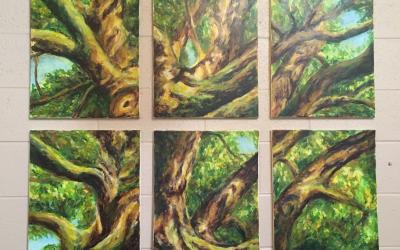
Tree in six panels

This is part of the worship series, "Rooted and Established in Love”Introduction  Week 1 | Week 2 | Week 3  | Week 4—World Communion Sunday   Week 5 | Week 6 | Week 7 | Week 8—All Saints /Reformation SundayWeek 9 | Week 10 | Week 11 | Week 12—Christ the King SundaySeries IntroductionWashington, DC Christian Reformed Church presented a twelve-part fall worship series titled “Rooted and Established in Love.” Using a tree as a metaphor, the series led the congregation through the journey of God’s creation, the brokenness of humanity, redemption in Christ, and the call to mission. Reformed Worship chose to publish this series because of its clear connection to faith practices. To help strengthen that connection, we have included a faith practice note for each service. We hope the notes will help inform the message, but they can also be adapted for bulletin notes, to prompt reflection time following the sermon, or for individuals, households, or small groups to discuss together.Series Outline ScriptureTitleFaith PracticeWeek 1:Genesis 2:4–25"The Living Tree” Formation Week 2: Genesis 3“The Dying Tree” Forgiveness and Grace Week 3:Exodus 3“The Calling Tree” Obedience and Discipleship Week 4:Judges 4“The Justice Tree” Community, Unity and Solidarity Week 5:Isaiah 55“The Witness Tree” Witness/Evangelism Week 6: Luke 13:1–9, 18–21“The Patient Trees” Patience Week 7: Luke 23:26–49“The Saving Tree” Sacrifice and Storytelling Week 8: Hebrews 11"The Family Tree” Spiritual friendship/Mentoring Week 9: Psalm 1“The Giving Tree” Generosity Week 10: Galatians 5:16–26“The Fruitful Tree” Rule of Life Week 11:John 15“The Abiding Tree” Rootedness Week 12: Revelation 22:1–6“The Healing Tree” HopeVisuals Two artists from our congregation helped us envision ways to integrate visual components into this series. One taught a painting class during church school and used the tree theme to inspire students’ pieces. We hung the paintings on one wall of the sanctuary.The other artist created a piece based on photographs of her “family tree.” This piece was also hung in the sanctuary, and the artist shared its story with us on All Saints / “Family Tree” Sunday.The front of the sanctuary during this series featured greenery. a basket of leaves, and a thematic banner in addition to the usual liturgical furnishings.Also appropriate would be an adaptation of the ideas for projection described in  “Worshiping with the Psalms” that features an image of a tree. An Invitation: If you make use of this series, we would welcome your submission showing how you adapted it for your setting and what resources you developed. We may choose to add those new resources to this series, making it even richer for those who make use of it in the future. How to Submit Resources to ReformedWorship.org. 

Read The Article

As pastors and worship leaders, we do our best to live into the gospel that we proclaim from week to week. It’s a gospel big enough to contain both our laments, our cries, our hopes, and our joys. It’s a gospel that recognizes and acknowledges the brokenness of our world and still finds a way to offer the hope of Easter morning.

Read The Article
Purple and pink candles

This is part of the worship series, "Be Not Afraid”Series Introduction and Prelude  Advent 1  | Advent 2 | Advent 3 | Advent 4 | Longest Night | Christmas Eve | Epiphany 1 | Epiphany 2  We—pastors, worship leaders, congregations —are afraid. Recent years have seen the rise of a global pandemic, job loss and economic depression, and overwhelming prophetic anger at racial injustice, not to mention all of the uncertainties and losses of being human on a planet desperately in need of restoration and renewal. Advent is a season of waiting on God’s promises for a redeemed creation. As we wait, we offer up our fears to God and hear God’s comfort in angel voices: “Do not be afraid.”For Advent, Pastor Meg Jenista Kuykendall preached the instances throughout the Christmas story where the words “do not be afraid” are spoken. We dug into what each character’s particular fears might have been as they were told that they had been chosen for a greater purpose. We looked at the many ways God’s promises of God’s presence were steadfast even in times of doubt and confusion.Prelude to AdventFear as the Beginning of WisdomGod Calls Us to WorshipScripture Reading Psalm 111Songs“O God Beyond All Praising” (choir sings st. 1, all sing st. 2–3)Perry“Immortal, Invisible, God Only Wise” (st. 1, 3, and 4)Smith We Confess Our Fears and Are Assured of God’s Presence With UsSong “Still, My Soul, Be Still” GettyPrayer of Confession Lord, we are a fearful people. It is not easy to rest in you alone, and it is not easy to feel secure in a world that is shifting beneath our feet. We fear for our jobs, our country, our own health, our families, and all those we love. Fear is a language we speak fluently, and we confess this. Lord, we need faith in your wisdom and in your providence that, no matter what it is we fear, you in your wisdom are guiding us and walking with us.Choral Assurance of Pardon “Child of God” De VriesGod Speaks to Us a Word of Grace and Sends Us Out With God’s PresenceSong “Be Thou My Vision” IrishScripture Proverbs 1:1–7Message “The Fear of Wisdom, the Wisdom of Fear”Sending Song “God of Grace and God of Glory” (st. 1, 2, and 4)FosdickAdditional Services for This SeriesTwo previously published services that would fit well with this series, also by Pastors Kathryn Roelofs and Meg Jenista Kuykendall:- Longest Night: A Service of Christmas Mourning, RW 125:25- Be Not Afraid: A Service of Scripture and Song for a New Year, RW 133:30 

Read The Article