Resources by Tony Maan

Vincent Van Gogh Mulberry Tree

This is part of the worship series, "Pictures of the Kingdom”Series Introduction Week 1  | Week 2 | Week 3 | Week 4   Week 5 | Week 6 Sixth WeekParable of the Good Samaritan: Neighboring—Luke 10:25–37 The ParableA traveler makes his way from Jerusalem to Jericho and is beaten up, stripped, robbed and left half-dead. In time three travelers come upon him. The first two, a priest and a Levite, pass him by for reasons not given. The third pilgrim, a Samaritan, upon seeing the assaulted man is moved with compassion and stops to help. He dresses the victim’s wounds, carries him on his donkey to an inn, and provides care until he recovers.Picturing the StoryMost illustrations of this story in art history depict the moment when the Samaritan is on his knees helping the unfortunate traveler. Rembrandt’s etching The Good Samaritan (1633) departs from this tradition. He pictures the moment when the Samaritan is negotiating with the innkeeper for the care of his beneficiary. The artist may be hinting that caring for our neighbor may involve more than a one-time helping hand prompted by a momentary stab of pity. The good neighbor is in it for the long haul, committed to see his newfound friend back on his feet. It’s difficult not to notice the dog defecating in the forefront of the frame. What could Rembrandt possibly have been thinking? Impossible to say for certain. However, one could speculate that the artist was prompting the viewer to reflect on the messiness that can be involved in helping those in need.Applicatory ThoughtsThe question that prompts Jesus to tell this tale—perhaps the most well-known story ever told—was the question “Who is my neighbor?” In a day of globalization, the clash of cultures, building walls, religious and ideological tensions, and online bullying, this question indeed seems as pressing and pertinent as ever. While implicitly answering the original question in the parable (any human being in need is my neighbor), Jesus additionally challenges the lawyer who asked the question (and all who hear the story) with the call to be a neighbor. As the mongrel in the etching reminds us, doing so can be messy; it may and probably will entail getting our hands dirty. We may find ourselves answering a desperate phone call at 2 a.m., giving up “me time” to visit a lonely person, anguishing at the bedside of a cancer patient, helping a friend survive substance abuse, kneeling to wash dirty feet, or trying to pray with someone who has just suffered the untimely death of a spouse. When we have these encounters we experience the kingdom of God. Even more, we encounter the King (see Matthew 25:44–45). Suggested Songs“They’ll Know We Are Christians” Scholtes“Jesu, Jesu, Fill Us with Your Love” Colvin“Take Us as We Are, O God” Daw Jr.“You Are Lord” KauflinRevised Common LectionaryYear C: Season after Pentecost—Proper 10 (15)

Read The Article
Vincent Van Gogh Mulberry Tree

This is part of the worship series, "Pictures of the Kingdom”Series Introduction Week 1  | Week 2 | Week 3 | Week 4   Week 5 | Week 6 Fifth WeekParable of the Talents: Stewardship—Matthew 25:14–30 The ParableA landowner plans to be away from his estate and entrusts three of his servants with varying amounts of money. On his return he calls each into his office and asks how they fared with the responsibility. The first two report good returns for their efforts of investment and in turn are welcomed to share in the master’s happiness and given more responsibility. The final servant did not invest and in turn is reprimanded for his laziness and permanently cast out of the master’s presence.Picturing the StoryThe late-medieval Italian artist Giotto di Bondone has illustrated the call to serve the master, Jesus, in a painted portrayal of St. Francis of Assisi, St. Francis Receiving the Stigmata (c. 1295–1300). In this case, the seriousness of the call to invest one’s life in Christ is evidenced by stigmata, the wound marks of Jesus on the body of the saint. As the apostle Paul remarked that he bore in his body the marks of Christ (Galatians 6:17), so Giotto interpreted the call of the believer to involve a radical call to suffer with and for our Lord. Giotto’s vision of discipleship was somewhat revolutionary and indeed was a factor in the nascent Italian Renaissance. In contrast to Byzantine icons depicting Jesus as the sovereign ruler of the universe (Pantocrator), striking reverential fear and some emotional distance in the believer, Giotto’s portrayal of Christ and his followers conveys a more intimate and personal connection. We invest in the kingdom because we love the Master with intimate affection, and we can’t wait for his return! Applicatory ThoughtsThe three eschatological parables recorded in Matthew 25 leave us with little doubt that when Jesus returns he will be asking us what we have been doing with ourselves while he has been away. His question includes stewardship of the material possessions we have been entrusted with. Jesus spoke of money on a regular basis. He spoke of matters of the heart, and apparently felt that mammon—material things—was close to most people’s hearts. But Giotto reminds us that this parable about the second coming ultimately keys in on our relationship with the Master. While the third servant felt distance from him and thus did not invest (compare with Matthew 25:24–25), so the first two knew the master closely and were eager to serve and please him. Is it evident not only in the way we manage our money, but in all aspects of our lives—our words, actions, decisions, relationships, lifestyles—that we have been marked by the personal presence of Jesus?Suggested Songs“Take My Life and Let It Be” Havergal“God Whose Giving Knows No Ending” Edwards“We Give Thee but Thine Own” How“Establish The Work Of Our Hands” Keyes, McCracken, and WardellRevised Common LectionaryYear A: Season after Pentecost—Proper 28 (33)

Read The Article
Vincent Van Gogh Mulberry Tree

This is part of the worship series, "Pictures of the Kingdom”Series Introduction Week 1  | Week 2 | Week 3 | Week 4   Week 5 | Week 6 Fourth WeekParable of the Unmerciful Servant: Forgiveness—Matthew 18:21–35The ParableA servant owes a king an incalculable amount of money but unexpectedly finds himself forgiven the complete amount thanks to the benevolence of the king. Also unexpectedly, the same servant soon demands a debtor repay him a paltry sum and shows no mercy when asked for more time to pay the debt. Once word came to the king that this servant had clearly missed the implications of being forgiven, the king summons the servant and holds him to account until the last penny could be paid.Picturing the Story Jan Sander van Hemessen depicts the parable in detailed, realistic style in Parable of the Unmerciful Servant (1556). The clutter of ledger books, writing instruments, records, coins, and money bags convey an interest in keeping a record of wrongs, underscoring the major transgression of the first servant. In the background an individual is being cast into a dungeon and the prominent finger of the king allows the viewer no mistake in perceiving that this parable is about the consequences of not forgiving. One of Gerard Dou’s depictions of forgiveness is more focused on the power of forgiveness than the consequences of living with an unforgiving spirit. Old Woman Reading (1631) pictures an elderly figure dressed in a cape of rich red, a color that in traditional iconography represents the blood of Christ and forgiveness. Her hand is exquisitely defined as it touches the text. She has absorbed the Word in a tangible way, received its message of forgiveness by the atoning blood of Jesus, and rests in full redemption, as suggested by the golden headdress that may allude to the helmet of salvation. Applicatory ThoughtsThe point this parable makes is hard to miss: Having been forgiven such an incalculable debt of our sins by a forgiving God (2 Corinthians 5:19), we in turn are called to exemplify the same spirit of forgiveness towards others (Ephesians 4:32). The challenge comes in putting it into practice. There is truth in the proverb “to err is human, to forgive divine.” The ability to genuinely forgive someone who has offended or hurt us requires supernatural strength. It is a divine act that manifests the reality that we have indeed been forgiven by God through Jesus. Authentic Christian community is possible only when we are able to forgive; without it we find ourselves in isolated, private prisons of begrudging resentment, anger, and guilt. To forgive as we have been forgiven opens the way to flourishing communion. Notice the communal context in which the Apostles’ Creed places the doctrine of forgiveness: “I believe in . . . the holy catholic church, the communion of the saints, [and] the forgiveness of sins.”Suggested Songs“Forgive Our Sins as We Forgive” Herklots“How Blest Are They Whose Trespass” Psalter 1912“Oh, qué bueno es Jesús/Oh, How Good Is Christ the Lord” Puerto Rican“A Debtor to Mercy” Kauflin“Broken Vessels (Amazing Grace)” HillsongRevised Common LectionaryYear A: Season after Pentecost—Proper 19 (24)

Read The Article
Vincent Van Gogh Mulberry Tree

This is part of the worship series, "Pictures of the Kingdom”Series Introduction Week 1  | Week 2 | Week 3 | Week 4   Week 5 | Week 6 Third WeekParable of the Friend at Midnight: Prayer—Luke 11:5–13 The ParableThe arrival of a guest late at night finds a host without food to offer his guest. This prompts the host to go to his next-door neighbor and ask for bread. Although the neighbor appears reluctant due to the late hour, he nonetheless gives his supplicant a few loaves. But is the neighbor as reluctant as we often assume? If so, what does this say about God when it comes to our petitions?Picturing the StoryEugene Burnand’s drawing of this parable, The Importunate Neighbour (1908), follows the common understanding of this story: that the sleeping neighbor is reluctant, even resistant, to help his late-night visitor. The windows are barred, the door is closed, and a single vine represents the scarcity of the homeowner’s benevolence. Consequently, the individual making the request is a timid, bowed figure who barely manages to knock on the door. In contrast, Jan Luiken’s portrayal, Parable of the Friend at Midnight (published in Bowyer’s Bible, 1795) depicts a neighbor who is eager to share. The door is open; illuminated by a candle, friend and neighbor are speaking face to face; not one but three loaves of bread are being offered; and a lush, bountiful tree adorns the doorframe. The artist evidently believed the parable depicted a friendly and generous God who is eager to answer the prayers of his children.  Applicatory ThoughtsIn the Middle Eastern culture of the first century, to resist a request for food to help feed and entertain a guest is offensive. As Jesus tells the story, he says, “Suppose the one inside says, ‘Don’t bother me.’” The word “suppose” is key. Jesus is asking his audience to imagine a scenario they knew was unthinkable. Of course the friend would get up and give his neighbor bread—lots of it (compare with Luke 11:8, “as much as you need”). If this is so, how much more is your heavenly Father eager to answer your needs? In fact, he gives far beyond our requests. Luke tells us that God gives the Holy Spirit to all who look to him. He gives us the Comforter, the Counselor—he gives us himself. We ask for daily bread, and he gives us the bread of life. So never hesitate! Pray with persistence! Knock, and the door will be opened.Suggested Songs“What a Friend We Have in Jesus” Scriven“God Is So Good” Traditional“Come, Holy Ghost” Maurus/Benedict“Bread of the World” WellsRevised Common LectionaryYear C: Season after Pentecost—Proper 12 (17)

Read The Article
Vincent Van Gogh Mulberry Tree

This is part of the worship series, "Pictures of the Kingdom”Series Introduction Week 1  | Week 2 | Week 3 | Week 4   Week 5 | Week 6 Second WeekParable of the Vineyard Workers: Grace—Matthew 20:1–16The Parable A landowner hires workers to labor in his vineyard. Some he hires early in the morning, others at noon, and still others late in the day. When the day is finished and the workers gather to pick up their pay, each worker receives exactly the same amount. Understandably, this upsets those who have worked for the full twelve hours. When they complain to the landowner of this ostensible injustice, he answers them in a way that reveals a key characteristic of the kingdom of God.Picturing the StoryRembrandt van Rijn’s Parable of the Labourers in the Vineyard (1637) captures the moment the disgruntled employees are bringing their complaint. The benevolent owner is seated at the center of the painting, highlighted by rays of light streaming in from the window. His hands help tell the essence of the story: One is over his heart, the other open and giving, indicating the payment he has generously distributed to all employees. The workplace is filled with soft, warm, glowing light that reveals a place of blessing and prosperity for all who are part of it. This is the atmosphere of the kingdom, grounded in the owner who sets the tone for all the rest. From his heart emanates a prevailing spirit of benevolent grace. Rembrandt may have implied some humor in the story. Look closely at the facial expression of the owner. He seems a little surprised at the complaint being brought forward, as if to say, “I don’t understand your problem. I’m just being generous! Who would have a problem with that?” He seems to take delight, even glee, in being extravagant. Applicatory ThoughtsThe unexpected feature of this story is that all workers receive the same remuneration no matter their hours of effort. This clearly is not how one would run a successful business in the real world. But the point of the parable is just that: The kingdom of God is not like anything in the real world of business, ledgers, payrolls, time clocks, or pay commensurate with work rendered. Things are completely different in the kingdom. In Matthew this parable is bracketed by Jesus saying, “The last will be first, and the first will be last” (Matthew 19:30; 20:16). This tells us, among other things, that the kingdom of God operates on truths foreign to human logic and the workaday world. In a phrase, we live in a place of grace. Our entrance into and citizenship in the kingdom has nothing at all to do with our efforts, work, or intentions; rather, it is based solely on the perfect person and work of Jesus and originates in the loving and benevolent heart of the Father, the owner and master of the kingdom.Suggested Songs“By Grace We Have Been Saved” Edwards and Whitfield“What Grace Is This” Gauger“My Hope Is Built on Nothing Less” Mote“Cornerstone” Hillsong“Covenant of Grace” WallaceRevised Common LectionaryYear A: Season after Pentecost—Proper 20 (25)

Read The Article
Vincent Van Gogh Mulberry Tree

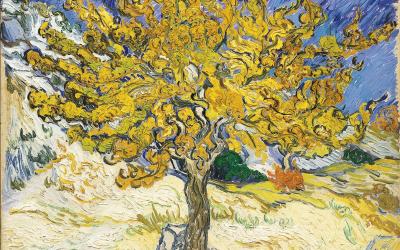
This is part of the worship series, "Pictures of the Kingdom”Series Introduction Week 1  | Week 2 | Week 3 | Week 4   Week 5 | Week 6 First WeekParables of the Growing Seed: The Kingdom—Mark 4:26–32The ParablesThe growing-seed parables launch the series by narrating the foundational truth of God’s kingdom: Like seeds scattered over the earth that grow into large plants, so the Word goes out from God’s heart into the world and will not fail to accomplish its purpose: his just and gracious rule over all the earth. Picturing the StoryAlthough Vincent van Gogh never painted an actual mustard tree, he did paint over thirty images featuring a sower. He also painted a striking image of a tree similar to a mustard plant in The Mulberry Tree (1889). (All images can be found by searching Google Images.) It is a riot of brilliant colors—olive green, taupe, cobalt, pale yellow, butter yellow, blue, blue-green, sea green, chartreuse. It appears to be on fire and seems to radiate a living entity. In his many letters to his brother Theo, van Gogh expressed his deep faith in a God who had created the natural realm and who made his presence known through it. The kingdom is present in nature. We know that the artist was emotionally fragile, lived with a mental illness, struggled in his relationships, and was challenged financially his whole adult life (a prolific painter, only one of his paintings was bought commercially in his lifetime). In fact, The Mulberry Tree was created when van Gogh was a patient at a mental asylum. Not in spite of but through his struggles the artist believed he saw the kingdom all around in nature, and in his life he sensed the glory of God. In God’s providence, today thousands of people reap the benefits of van Gogh’s vision through his vibrant kingdom images. Applicatory ThoughtsThese two little stories hold within them a number of lessons about the kingdom. It begins small and grows large, beyond expectation. Who would have imagined that the life of a carpenter from Nazareth who died on a cross as a criminal would eventually bring salvation and transformation to billions of lives, affecting the course of history? The kingdom also grows gradually, from seed to germination, stalk, head, and kernel. We witness the kingdom over the centuries reaching many people groups across the globe. Also fascinating is that the kingdom grows automatically. In Mark 4:28, “all by itself” comes from the Greek automaton, a combination of autos (self) and memaa (to eagerly desire). Jesus never tells his followers to bring in the kingdom. He does entreat us to pray for it to come, to receive it, and to proclaim it when and wherever we see it.Suggested Songs“No hay dios tan grande/There’s No God as Great” Spanish traditional“The Kingdom of Our God Is Like” Webb“O Word of God Incarnate” How“Hear the Call of the Kingdom” Getty“Build Your Kingdom Here” Rend Collective“How Great Is Our God” TomlinRevised Common LectionaryYear B: Season after Pentecost—Proper 6 (11)

Read The Article
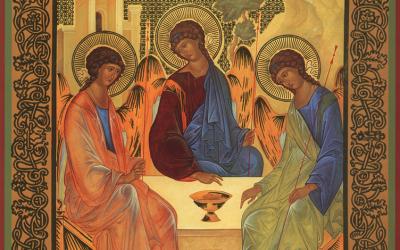
Painting which depicts the Father, Son and Spirit

This prayer originally appeared in "God in Three Persons—Trinity Sunday: The Triune God."PrayerTriune God, Father, Son, and Holy Spirit, you know the futility of our fumbling attempts to comprehend you. Time and again we are left exhausted by our finite minds’ endeavor to grasp your infinite Being. We are humbled and thankful you have revealed so much of yourself to us: a Father who creates and provides, who reaches out in electing love and embraces us. A Son who shares in our humanity, who died and rose that we may reign with him. A Spirit who opens our minds and hearts, who brings us into trinitarian truth. Lead us to own this mystery. Teach us to live the Trinity. Amen.

Read The Article
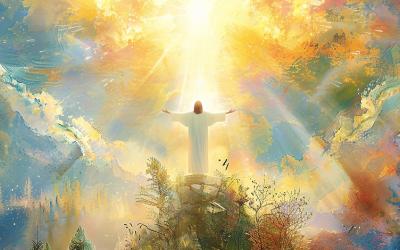
Jesus' arms stretched wide in the sunlight

This prayer originally appeared in "God in Three Persons—Ascension Sunday: God the Son."PrayerDear Jesus,Your head that once was crowned with thorns is crowned with glory now;a royal diadem adorns your mighty victor's brow.The highest place that heaven affords is yours, is yours by right—the King of kings, Lord of lords, and heaven’s eternal light;the joy of all who dwell above, the joy of all below,to whom you manifest your love and grant your Name to know.To us the cross with all its shame, with all its grace, is given;your Name, an everlasting Name; our joy, the joy of heaven. Amen.—Adapted from Thomas Kelly’s hymn, “The Head That Once Was Crowned with Thorns,” public domain.

Read The Article
Title Image Christ Preaching, Rembrandt

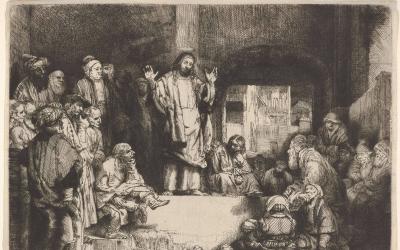
This is part of the worship series, "God in Three Persons"Series Introduction Week 1 | Week 2 | Week 3 | Week 4 Trinity SundayThe Triune GodScriptureJohn 16, 17Sermon-Building IdeasHave you ever found yourself in this position? You are surrounded by a catechism class of eager eighth-graders. In an attempt to teach the concept of the Trinity, you quote the creedal statement: “So the Father is God, the Son is God, and the Holy Spirit is God; but there are not three Gods, but one God.” Invariably you are confronted with the puzzled faces of teens who secretly wonder if you are mathematically challenged. To regain their confidence and understanding, you try a few analogies. You might compare the Trinity to water (three forms as vapor, liquid, ice, yet one substance) or the flags of many nations (three colors, one flag) or the triangle (three separate sides, yet one geometric figure).Naturally we try to grasp the concept of the Trinity mentally so we can understand God’s nature. Yet in the Bible this God, who wants to be known by us, never really seeks to explain that triune nature. God is simply there. The greater priority is that we know God experientially and love him with mind, heart, and body. This biblical truth was not lost on Rembrandt. Although we are unable to see the Father with the physical eye, God is actively among us through the visible Christ by the insightful work of the invisible Holy Spirit. The triune God is revealed throughout the Bible, and his presence and work is interwoven through the daily living of our faith.Jesus’ prayer conveys the intricacy involved in the relationship of the three persons of the Trinity and the believers’ close attachment. John frequently uses the term abide in to express this proximity. The prayer indicates that serious indwelling is going on. The Father is in the Son, the Son is in the Father, believers are in the Father and the Son, and the Son and Father are in the believer(s). All this happens because of the subversive yet essential work of the Holy Spirit, (cf. John 14:26). The bonds are so complex as to be inseparable, yet all parties retain their own distinctive identity. Simultaneously, identity is defined through relationship to each other.Attempting to analyze these complex interrelationships leads us into mystery. Exhort God’s people to worship and celebrate the triune God as they witness the signs of his presence. Like a panoramic view and surround sound, the Trinity is all around, revealed in the Word and in our worship:in Genesis 1:1-3 and John 1:1-18; Genesis 1:26-27 and Genesis 2:18-25; Isaiah 61 and Luke 4:14-21; Luke 1:26-38; Mark 1:9-11; 2 Corinthians 13:14in the letters written to the seven churches (Rev. 1:9-3:22)in the blessing that comes from God via a pastor’s benedictionin hymns like “Holy, Holy, Holy,” “Of the Father’s Love Begotten,” “Father, I Adore You,” “Now Thank We All Our God”in our unison confession of the Apostles’ and Nicene creedsin the call that invites us to respond to the Great Commissionin our celebration of the Lord’s Supperin the Word proclaimedin the opportunity to witness a baptismin our seeking to live as baptized peopleInvite the community to participate in trinitarian life—more proclaiming, less explaining.We engage in the triune nature of God in the unity and diversity of the faith community: in Spirit-inspired praise to the Father for the love shown in Jesus ; in a handshake or a hug of a beloved sister or brother in Christ; in the fellowship of a potluck lunch in the church basement. Or how about on the basketball court or in a game of pick-up hockey? Where else does the trinitarian nature of God reveal itself? All around, in the mundane yet supernatural ministry and life of God’s people.Do we have the faith-eyes to see the triune God among us? Some of us still may have a tough time trying to see that three-dimensional image in the magic-eye picture. Good thing our lives don’t depend on it. Our lives do depend on eyes to picture ourselves seated with the crowd in Rembrandt’s etching, compelled by the Holy Spirit to receive the Word of the Father’s love through the voice and hands of Jesus. Sung PrayerHoly God, we praise your Name;Lord of all we bow before you.Saints on earth your rule acclaim;all in heaven above adore you.Infinite your vast domain;everlasting is your reign.Holy Father, holy Son,Holy Spirit, three we name you,Though in essence only one;undivided God, we claim youand, adoring, bend the kneewhile we own the mystery.—Te Deum, 4th cent.; vers. Ignaz Franz; c.1774; tr. Clarence A. Walworth, 1853, alt. public domain. PrayerTriune God, Father, Son, and Holy Spirit, you know the futility of our fumbling attempts to comprehend you. Time and again we are left exhausted by our finite minds’ endeavor to grasp your infinite Being. We are humbled and thankful you have revealed so much of yourself to us: a Father who creates and provides, who reaches out in electing love and embraces us. A Son who shares in our humanity, who died and rose that we may reign with him. A Spirit who opens our minds and hearts, who brings us into trinitarian truth. Lead us to own this mystery. Teach us to live the Trinity. Amen.SongsMost hymnals include songs on the Trinity as a separate section and/or in a listing in the topical index. Choose a trinitarian hymn for the opening hymn, as a response to the sermon, and as a doxology. Consider introducing a doxology that will be sung throughout the summer months. Here are some suggestions:“Holy God, We Praise Your Name” Unknown“Come, Thou Almighty King” Anonymous  (stanzas 1-3 at the beginning of the service; stanza 4 as a doxology)“Father, We Love You” Adkins “Abide with Us, Our Savior" Stegmann   Revised Common LectionaryYear C: Season after Pentecost—Trinity Sunday

Read The Article
Title Image Christ Preaching, Rembrandt

This is part of the worship series, "God in Three Persons"Series Introduction Week 1 | Week 2 | Week 3 | Week 4 Pentecost SundayGod the Holy SpiritScriptureJohn 16:12–15; Acts 2; (Joel 2:28–32, included in Acts reading); Psalm 143Sermon-Building IdeasHow about this for a sermon idea? On Pentecost Sunday, standing in the pulpit about to begin your message, you point your finger to the back of the sanctuary and, eyes wide with surprise, shout, “FIRE! FIRE!” Once all the head turning and commotion has settled down, you go on to explain that the coming of the Holy Spirit with tongues of fire created quite a stir in the Jerusalem crowd as well. . . . Nah. Something about this idea tells me it wouldn’t fly.Actually, the work of the Spirit generally does not cause a commotion. The Spirit is the most clandestine of the divine trio, working powerfully yet quietly behind the scenes. The ministry of the Holy Spirit is Christocentric. Jesus explained that the Holy Spirit “will not speak on his own; he will speak only what he hears. . . . He will bring glory to me” (John 16:13-14) He serves to uncover the life and work of Christ. In a sense he acts like a spotlight. Hidden behind a rock or bush, a spotlight shines forth and illuminates a building. It does not draw attention to itself, but rather helps the eye see something other than itself. Not that the role of the Spirit is inferior. Who would Jesus be to us if it were not for the Spirit? He would either be a really good guy we should listen to for some helpful advice or, considering his claims, he would be a person with serious mental deficiencies. Only the Holy Spirit can enlighten and convict us that Jesus is not only much more, but much different—he is God incarnate, whose life and sacrificial death means reconciliation with God the Father for all who believe.Sensitive to the hidden fashion of the Spirit’s operations, Rembrandt has pictured the Holy Spirit accordingly. Where is the third person in this etching? The visual manifestation Rembrandt has chosen to depict the Holy Spirit is the people gathered to hear Jesus. They have come because the Spirit has brought them together. If the church is a fitting analogy for the Trinity, as Jesus has expressed in his prayer, the Holy Spirit is surely represented by those who gather to hear and respond to the Word. The Holy Spirit is the glue that binds the richly diverse members of the church to be the one body of Christ. Consider the variety of people sitting around you in the pew every Sunday. Consider the eclectic group gathered around Jesus. Notice how the two groups are quite similar: an elderly man standing to receive the blessing; a teen with a slightly cynical expression; a toddler paying little or no attention; a mom cradling an infant; a stalwart religious leader keeping his distance; and an intellectual scratching his chin in thought. How is it possible that a group of such wide backgrounds and experiences can work together, serve together, with such unity and cooperation? The only possible answer is the Holy Spirit.Signs of the Paraclete surround us, leaving evidence as the invisible wind conveys its presence through the motion of trees. Moving messages, changed hearts, transformed minds, healed bodies, reconciled relationships, met needs, jubilant song, and poignant prayer are all evidence of the Spirit’s active presence as well as our intimate relationship to the Trinity. The new community formed by those baptized on Pentecost in Jerusalem shared in the abundant provision of the Father, heard the good news of Jesus’ resurrection, and responded by the power of the Spirit.PrayerAlmighty and Holy Spirit, the comforter, pure, living, true—illumine, govern, sanctify me, and confirm my heart and mind in the faith, and in all genuine consolation; preserve and rule over me so that, dwelling in the house of the Lord, all the days of my life, I may behold the Lord and praise him with joyful spirit, and in union with all the heavenly Church. Amen.—Philipp Melanchthon, 1497–1560, public domain. Songs“For the Gift of God the Spirit” Clarkson “Lord, Listen to Your Children Praying” Medema (Sing as a frame around the congregational prayers of intercession.)“Like the Murmur of the Dove’s Song” Daw, Jr. “Come Lord Jesus, Send Us Your Spirit” HaasRevised Common LectionaryYears A, B, C: Easter—Day of Pentecost

Read The Article