This is part of the worship series,
"A Lively Look at the Seven Deadly Sins”
Series Introduction
Week 1 | Week 2 | Week 3 | Week 4
Week 5 | Week 6 | Week 7 | Week 8
Introduction
I’ll admit that I’m not too fond of sin. I’m speaking, of course, as a pastor and a preacher describing a bias in my preaching that I’ve carried for years. Too often in my experience the church has been a “guilt-giving culture,” and I have committed myself to preaching grace.
Sure, I’ve done occasional sermons on the first five Lord’s Days in the Heidelberg Catechism. Certainly we need to know our misery before we will appreciate our salvation. But I’ve always believed people know they are miserable. In seminary I read Berkhower’s book Sin, along with all the other books in his systematic theology series. Yet, to be honest, it always irked me that Sin was the thickest book in the series. I’ve always wanted to be someone other than the stern, dark-suited preacher who reminds people of the obvious: “We are sinners.”
So it took a lot of grace to get me to prepare an eight-part series on the seven deadly sins. Perhaps it took twenty years of pastoring in this broken world. Perhaps it took twenty years of maturing and recognizing the continual nature of my own frailties. Certainly Neal Plantinga’s wonderful book Not the Way It’s Supposed to Be played a key role in developing my thinking. Whatever the influences, the series was received with genuine appreciation, and there was a persistent sense that God had something to say as we walked through the topic together.
Although we used this series in January and February, I believe these services would work extremely well as a Lenten series with only minor modification. Over and over the season of Lent calls us to repentance, and to recognizing the need for the divine sacrifice for human sin. This series provides such a focus.
The “enemy” certainly attacks disciples as much today as he always has. It is my prayer that this series will stimulate congregations to discover, as so many others have discovered in so many ways, that God’s grace is more than sufficient for all our sins.
Including Children
One of my commitments as a pastor is to present a children’s message at least every other Sunday morning. Most often the message relates to the sermon of the morning. With a good degree of creativity and commitment, it is possible to present each of the seven deadly sins, and their positive alternatives, in a memorable and appropriate way for children.
I particularly enjoyed a children’s message on gluttony. Holding up a series of two objects, I asked the children which they would choose: not surprisingly they chose the giant chocolate bar over the mini chocolate bar; the giant cookie over the apple; the potato chips over the carrot sticks. As so often happens in children’s messages, the adults got the point just as much as the children. We talked about the option of “seeking to be fed by Jesus,” recognizing that we need to learn what that means. This simple message served both to include the children and to set the stage for the message that was to come.
Another way we include children in worship is to invite them to read Scripture, and to have them serve as a “praise team” on occasion, leading the congregation in song. The season of Lent offers numerous classic texts with which children are familiar enough to read publicly. And the rich music of this season becomes even richer when children lead us in singing!
Series outline
| Theme | Scripture | |
| Week 1 | Sin | Luke 5:27–32 |
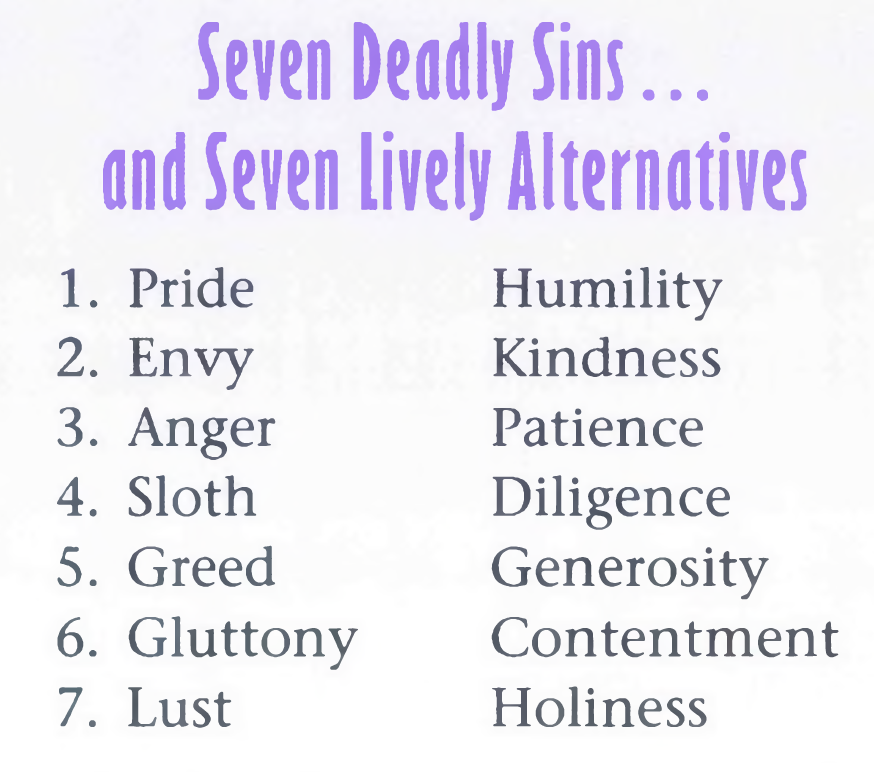
| Week 2 | Pride | Genesis 3:1–7 1 Peter 5:5b–6 |
| Week 3 | Envy | Genesis 4:1–12 Ephesians 2:6–7 |
| Week 4 | Anger | Numbers 22:21–34 |
| Week 5 | Sloth | Proverbs 26:13–26 Hebrews 6:9–12 |
| Week 6 | Greed | Luke 12:15–21 |
| Week 7 | Gluttony | Proverbs 23:1–3 |
| Week 8 | Lust | Proverbs 5:1–6 1 Peter 1:13–16 |
Series Image
The bulletin cover image that appears above with this article can be downloaded from the resource section below and used with the following copyright line: Seven Deadly Sins © 2003 ReformedWorship.org CC BY-NC-SA 4.0.
For Further Reading
For a topic as old and well-known as the seven deadly sins, books and articles are surprisingly rare. Quoted in this article are books by Fairlie and Plantinga:
- Henry Fairlie. The Seven Deadly Sins Today (University of Notre Dame Press, 1979) In this fine series of essays, Fairlie offers a wonderful analysis and critique of culture. Available in paperback.
- Neal Plantinga. Not the Way It’s Supposed to Be: A Breviary of Sin (Eerdmans, 1995) A compelling, provoking analysis of sin as a topic we too easily avoid. The five-page preface alone is worth the purchase price of the book!
Other sources worth consulting include the following:
- Angus Wilson et al. The Seven Deadly Sins (Morrow, 1962) Out of print, but may be available at libraries and in used-book markets. This tempting appetizer into the theme, first published in the London Sunday Times, offers essays by such stellar English critics and writers as Angus Wilson, Edith Sitwell, Evelyn Waugh and W.H. Auden, with a Foreword by none other than spy-writer Ian Fleming. These witty essays are not so much theological reflections as sharp notes and comments by able people. Their breadth and depth of humanistic observation also help enlighten 21st century preachers.
- Finally, almost as if to remind us that we will always have sin with us Oxford University Press and the New York Public Library have combined to publish a new series of “meditations on temptation” on the seven deadly sins. Envy by Joseph Epstein, Gluttony by Francine Prose, Lust by Simon Blackburn, and Greed by Phyllis A. Tickle, Pride by Michael Eric Dyson, Sloth by Wendy Wasserstein, and Anger by Robert A. F. Thurman.
—James C. Dekker
Other Worship Resources
- Sing! A New Creation (CRC Publications, 2001, in cooperation with Reformed Church Press and the Calvin Institute of Christian Worship) This song and worship book provides many fresh hymn texts, contemporary songs, and readings and prayers for worship. Many of the song suggestions for the series come from this book. I would also recommend for this series the section on Confession and Assurance (note the Prayers of Confession, pp. 52-55) and the songs for Lent and Easter.
- Stages on the Way (GIA Publications, 2000) This worship resource for Lent, Holy Week, and Easter comes out of the Iona Community in Scotland. This collection of prayers, responsive readings, and dramatic readings has enhanced the last two years of our Lenten worship, and we’ve only begun to use the resources in it!
- Prayer for Each Day (GIA Publications, 1998) The Taizé Community has prepared this paperback book as a tool for worship throughout the year. The readings and prayers in the Lent and Holy Week section (pp. 53-89) provide useful “ready-made” presentations for lay involvement in worship accompanying this service series. After this series, you’ll still have the rest of the book to use during the seasons of Advent, Easter, and Pentecost.