This is part of the Advent and Christmas worship series
"Remembering the Future"
Series Introduction
Advent 1 | Advent 2 | Advent 3 | Advent 4
Christmas
THIRD SUNDAY IN ADVENT
Service Elements
Gospel Reading
Luke 3:7–18
Call to Worship
Show us your unfailing love, O God, our Savior
And grant us your salvation.
Listen to what the Lord our God says:
He promises peace to his people,
who are his beloved saints.
The Lord will indeed give what is good.
Righteousness goes before him
and prepares the way for his steps.
—based on Psalm 85 NIV
May the Lord make his holy face
to shine upon us in this time of Advent worship.
May we see God’s face and so know peace.
Amen.
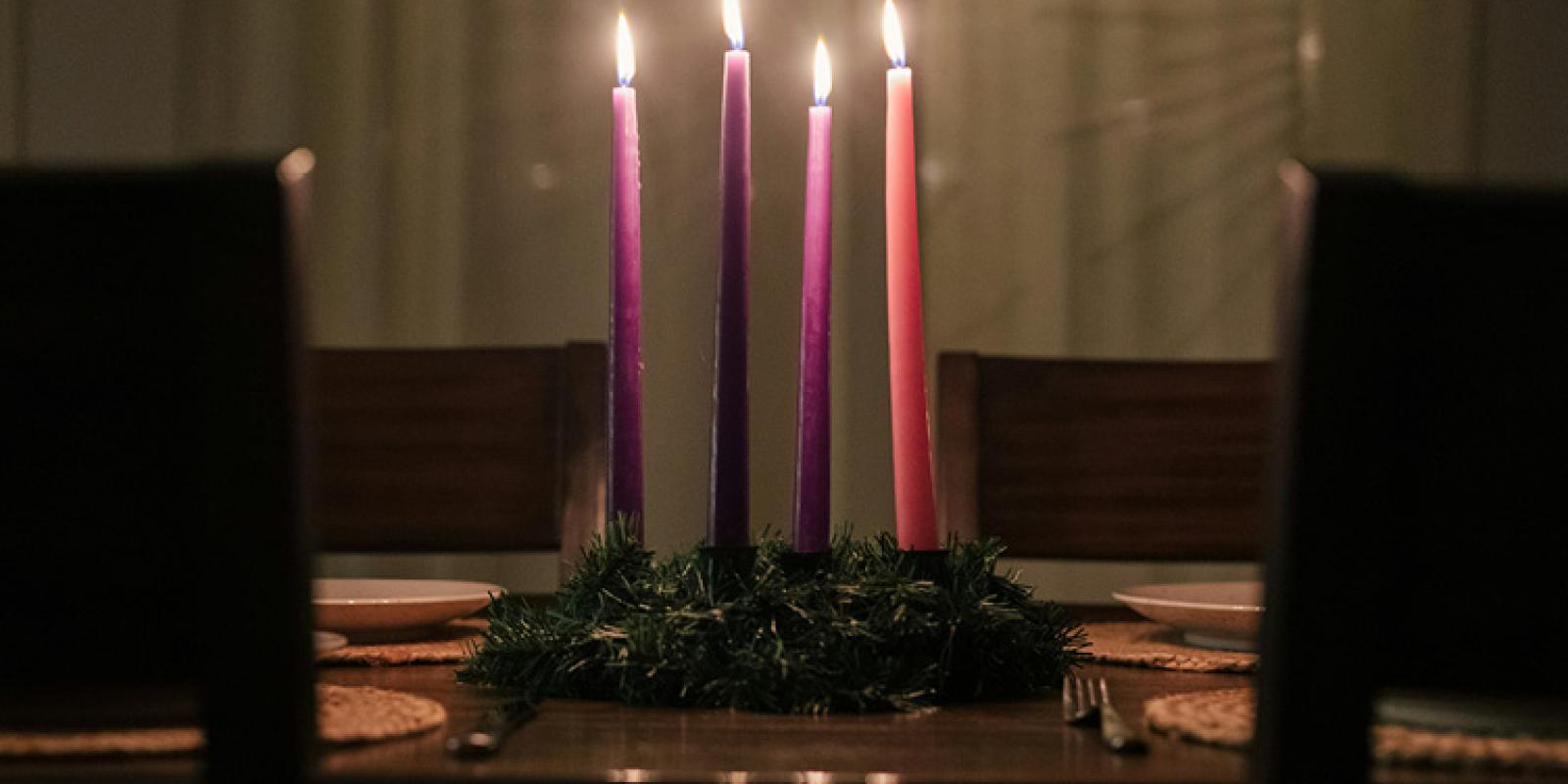
Advent Wreath
Song
“People in Darkness Are Looking for Light” Carlson
The children’s choir sings stanzas 1 and 2, plus the additional stanza provided for the second Sunday in Advent.
Reading
Today we light the candle of love because we know that Jesus is love, and he teaches us how to love each other. In 1 John 4:7 John wrote, “Dear friends, let us love one another, for love comes from God. Everyone who loves has been born of God and knows God.”
Prayer
Dear God,
we love you because we know
that in Jesus you loved us first.
As we light this candle,
make us love each other more and more,
and help us to tell about the love of Jesus
to the whole world.
Amen.
Sermon Sketch
Many of us bristle at what could be called the “saccharinization” of Christmas. The generic sentiments of Hallmark cards seem wide of the Advent mark as the message of “peace and joy” gets neatly divorced from the One who is the source of peace and joy. The holidays have become associated with generalized feelings of goodwill and charity. There is no escaping all those sugary holiday movies and TV specials that reduce Christmas to a time when you help your neighbors a little more or when Scrooge wakes up a changed man and sends Bob Cratchit a goose.
But all such stories, sentiments, and movies neatly leave out the Christ of Christmas. The ACLU never threatens to have “A Christmas Carol” banished from airwaves the way they try to remove crèches from public spaces. What would be the point? This kind of “Christmas spirit” is about as wispy and insubstantial as the ghosts who visit Ebenezer Scrooge in the night. Preachers who want to help their congregations resist such a stripping down of the season do well to focus on themes like those that have emerged in the lectionary passages of the past two weeks: themes of Jesus coming again in judgment and of John the Baptist’s call to repent.
So how striking it is to discover in today’s reading some sentiments that end up sounding strangely similar to Hallmark-like reductions of the season to a bit of charity and goodwill! John the Baptist got the attention of the people of his day. His zany attire and shrill preaching brought out the crowds. John did all that he could to offend people in the hopes that in the throes of such offense the people might be rattled enough to change and repent.
It worked. Verse 10 has the people crying out in apparent desperation, “What should we do then?” In answer John encourages the cultivation of what could be called “Advent fruit.” Amazingly, however, John does not suggest holy pilgrimages or a more earnest prayer life. Instead, his advice veers quite close to the kind of neighborly goodwill often associated with a nonreligious Christmas. “Share your things with others!” His words could serve equally well as the slogan for a Toys-for-Tots campaign. “Be honest in your jobs! Don’t overcharge customers!” This too could be seen as general advice for good citizens. “Be content with what you get paid; be kind to others.” Ann Landers could not have said it better.
Be honest. Be good. Be content. Be nice. How simple! This is not the kind of Advent fruit you might expect John to cultivate. Yet perhaps the mundane nature of John’s advice tells us something about the Jesus whose birth we celebrate. Too often, even for Christians, the entire story of Jesus, starting with his birth, can seem so otherworldly. It contains events, portents, and miracles the likes of which we’ve never experienced.
Yet John brings Advent and Christmas down to street level. The flip side of John’s advice to the penitent people at the Jordan River reminds us that some things never change: the world is filled with temptations to be greedy and stingy, to exploit others for our own gain. These ugly facets of reality never change, and they are exactly why the Christ of God came. No one who came to John with the question, What should we do then? ever heard John reply, “Well, let’s see here... Why, I really cannot think of a single thing you need to change! You’re all set!”
Alas, no. The ordinary circumstances of even the most typical of lives usually contain any number of characteristics or habits that could be changed for the better. The story of Jesus is not far removed from anyone’s experience—the application of Advent’s message is as near to us as the choices we face every day.
“What should we do then?” we cry. Share. Exercise kindness. Lift up the weak in justice. Be content and resist the incessant restlessness of mindless consumerism. Much of what it means to follow Christ into better ways of living seems so very mundane. But then, the word mundane comes from the Latin word mundus, which means “world.” God so loved the mundane that he sent his only begotten Son. Here is where Christmas comes home to us all—but not just for December. Instead, we follow our Lord everywhere, every day, nurturing Advent fruit on the branches of our lives long after the rest of society thinks such fruit is not in season.
Music Suggestions
Organ Music
- “Wachet auf”Berthier
- “Wake, Awake, for Night Is Flying” by Max Sedio, Seven Hymn Reflections for Organ (AMSI OR-20, 1995)
- “Wachet auf, ruft uns die Stimme”Reger
- “O Heiland, reiss die Himmel auf”Brahms
- “O Heiland, reiss die Himmel auf” Walcha
Hymn Suggestions
- “Wake, Awake, for Night Is Flying”Nicolai
- “O Christ! Come Back and Save Your Folk”Seerveld
- “Surely It Is God Who Saves Me” (The first Song of Isaiah) Renew 122; also available as an anthem by Jack Noble White (H. W. Gray)
Children’s Music (for Children’s Choirs or Congregational Singing)
Choral Suggestion
- “Christ Is Coming” by Sandra J. Bostom (CGA-691)
Revised Common Lectionary
Year C: Advent—Third Sunday of Advent