
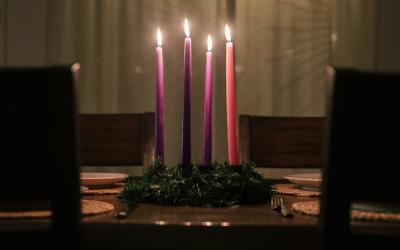
Based on the psalms the Common Lectionary recommends this year for the four Sundays in Advent

Rev. Dr. Harry Boonstra (1935–2017) was a theological editor of Reformed Worship and emeritus theological librarian of Calvin University and Calvin Theological Seminary, Grand Rapids, Michigan. Boonstra earned a PhD from Loyola University, Chicago and an MDiv from Western Theological Seminary. He was ordained in 1992 at age 50 and went on to preach at many churches from Indonesia to Grand Rapids until he retired in 1999.
Last Updated: June 27, 2026
Based on the psalms the Common Lectionary recommends this year for the four Sundays in Advent
In issue 7 of RW our Service Planning encompassed the beginning of the Season after Pentecost, and the Scripture commentary dealt with the three Common Lectionary passages for each Sunday. For this issue we have chosen the close of the Season after Pentecost (October 9-November 13), and rather than providing comment on all three passages, we have focused on the gospel reading. This focus will encourage preaching a brief series on one book—an aim of the lectionary for this season.

Some churches have Kinder Kirk. Others offer a children's message. Some have a children's worship center. Others largely ignore children in public worship. All of them are responding in some way to the question. How should children be involved in worship?

Grace Episcopal Church is very quiet when I enter at 9:20. In fact, even though the service is to start at 9:30, I am the only person in the sanctuary. A few minutes later several more people show, but it turns out the big service will be in the evening. (After the soup supper. Ah! even Episcopalians must be urged with food. But during Lent?)
The sermon about the dragon seemed an intrusion into our Advent and Christmas spirit. When entering church I was stili thinking about the VCR we had bought after long deliberation. And our children were coming home for Christmas; it had been six months since we had seen them last. The sanctaury, with its poin-settias and Advent wreath, looked beautiful and peaceful. And the choir anthem was marvelous. The spirit was one of peace, festivity, and joy.

Reformed Christians should celebrate the ascension with verve, with glory, and with full pews. The ascension, after all, is not marked by an isolated Thursday service in which the church tries to come to terms with a gravity-defying miracle. The ascension is rather linked to the sunburst expression of the victory and power of the risen Lord that we celebrate on Easter Sunday. So on Ascension Day we sing songs of victory.
Robert Webber. Waco, Texas: Word Books, 1985, 174 pp., $13.95.
In an attempt to answer that question we asked representatives of various denominations to sketch the history and current practices of psalm singing in their churches. The denominational material presented below is summarized or quoted from Robert Copeland (PCNA), Harry Boonstra (CRC), Norman Kansfield (RCA), Hugh McKeller (PCC), Arlo Duba (PCUSA), and John Frame (OPC and PCA).
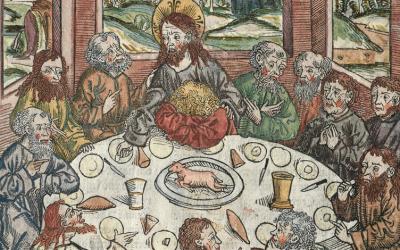
For many congregations the Tenebrae service, usually held on Maundy Thursday or Good Friday, is one of the most moving and meaningful worship services of the year. In a candle-lit sanctuary Christ's suffering is commemorated through Scripture and song. Candles are extinguished one by one as the congregation listens to the account of Christ's suffering and death.

Preaching "through" a book of the Bible, a process referred to as lectio continua, is a venerable preaching tradition. (One Puritan preacher, working his way through Hebrews, preached sixty-five sermons on the eleventh chapter!) Such preaching has usually not been related to the church year (I recall one pastor preaching on Leviticus 13 on Easter Sunday), but at times one can match a series with the church-year cycle.For our particular series we have chosen chapters 16-18 of the gospel of Matthew, chapters that focus on the life of Christ and on the cost of discipleship-both fitting themes for Lent. For each pas-sage we have selected a theme (realizing that not every expositor would select the same theme); that theme serves both as a possible focus for the sermon and as a guide for the choice of hymns and an-thems. The hymns are selected from the Psalter Hymnal (PH), the Trinity Hymnal (TH), Rejoice in the Lord (RL), and The Hymnbook (HB). First SundayMatthew 16:1-20: Peter's ConfessionThe discussion about the yeast of the Pharisees and Sadducees comes on the heels of Jesus' miracles of healing and plentiful feeding, described in the previous chapters. Those miracles had called forth praise and gratitude from the people. The Pharisees and Sadducees, however, failed to grasp the essence of Jesus' messiahship and. his kingdom, and Jesus warns his disciples against similar failure. Pe-ter then goes beyond the admiration of the crowds and sums up Jesus' ministry with the marvelous confession "You are the Christ, the Son of the living God." The first Sunday in Lent can properly focus on the need for seeing Christ as he truly is and for confessing his work in our salvation.Hymns:"Rejoice, the Lord Is King" Wesley"I Greet Thee" Strasbourg Psalter, 1545"Let All Things Now Living" Davis"LORD, My Petition Heed/Psalm 47" Psalter, 1912Anthems & Concertato:Christ, We Do All Adore Thee (Dubois. G. Schirmer, #9749)This anthem can be used as an introit for several weeks during Lent.The Lord Is a Mighty God (M. Jothen. 4-part Chorus.Coronet Press A.B.I.: New York, #C.P. 210) Praise, My Soul, the King of Heaven (Clokey. Unison. Harold Flammer, #86149)Rejoice, the Lord Is King (arr. S. D. Wol( Congr. acc. 2 T pts, SATB choir. Concordia, #98-2552 Second SundayMatthew 16:21-28: Suffering and DiscipleshipEven though Peter had voiced a beautiful confession, he still didn't understand Jesus' task. Peter probably envisioned Jesus as a king enthroned in Jerusalem, as one who would drive out the Roman oppressors. In emphasizing his impending trials, Jesus echoed Isaiah 53 and other Old Testament passages that portray the suffering Servant. Besides learning the hard truth about Jesus' coming death, the disciples also had to learn that followers of Christ must be willing to walk this same road of suffering.Hymns:"Jesus Calls Us" Alexander"At the Name of Jesus" Noel"O Master, Let Me Walk with Thee" Gladden"My God! O My God!/Psalm 22" SeerveldAnthems:When I Survey the Wondrous Cross (G. M. Martin. T. Presser, #312-40785)Lamb of God 0- M. Christiansen. Augsburg, #133)This anthem can be used as an introit for several weeks during Lent.Surely He Hath Borne Our Griefs (Healey Willan. SA. Concordia, #98-1769) Third SundayMatthew 17:1-13: The TransfigurationThe suffering motif is here put in its proper context. We learn from Luke's account of the trans-figuration (9:31) that Jesus' death was to be a "fulfillment" that is, his death had a purpose. And his death would culminate in a vision of glory of which we are given a brief glimpse here. The kingdom motif of "already but not yet," which we find in so much of the Christian life, comes to expression here.Hymns:"Hail, Thou Once Despised Jesus" Bakewell"O Wondrous Sight, O Vision Fair" Neale"Christ upon the Mountain Peak" Wren"Christ, Whose Glory Fills the Skies" WesleyAnthems:Surely He Has Borne Our Grief (Craun. Concordia, #98-1171)Christ the King (R. Ling W. with bells and flute. Augsburg, #112110) Fourth SundayMatthew17:14-27: "lf You Have Faith ... "This section has several themes. We have chosen to emphasize faith as reliance on God. If the disciples had relied on God, they would have had the power and the authority to cast out the demon and to restore the boy. Only through faith in God's power to work in and through them can the disciples follow Jesus.Hymns:"I Need Thee Every Hour" Hawks"If Thou But Suffer" Neumark"How Firm a Foundation" Keen, Keith"God Is Our Refuge and Our Strength/Psalm 46" Scottish Psalter, 1650; alt.Anthems:Wondrous Love (Arr. Shaw-Parker. G. Schirmer: New York, #907)O God, and Not on Human Trust (J. Pachelbel. Concordia, #98-1006)Lord, Give Me Faith (Roff. SA. R. D. Row, #25) Fifth SundayMatthew 18:1-14: The Importance of Little OnesAfter Jesus had established his messianic claim, he began stressing relationships in the messianic community. Verses 1-14 deal in several ways with the "little ones" in the community, those who often seem insignificant or go unnoticed. These little ones (children, recent converts, "average" members, wandering ones) are to be models for us of deep trust and humble reliance on God; and like God we should abhor the idea that any one of them be lost.Hymns:"Shepherd of Tender Youth" Dexter"Blessed Jesus, We Are Here" Schmolck"I Waited Patiently for God/Psalm 40" Polman"Defend Me, LORD, from Those Who Charge Me/Psalm 43" PostAnthems:I Will Rise (A. Lovelace. Sacred Press, #L-7425) Lift High the Cross (R. Vickery. AMSI, #380) Lead Me, Lord (Wesley. SA. B. F. Wood, #228) Sixth SundayMatthew 18:15-35: ForgivenessThis passage teaches that Christians have two ways of responding to sin and hurt and that both ways are aimed at reconciliation and restoration. The first response involves the official community ("tell it to the church") and may lead to excluding a no repentant member in the hope that he or she will return. The second response involves individual Christians: Peter asks Jesus how often we should forgive someone who does wrong to us, and Jesus demonstrates that the follower of Christ doesn't keep count. Remembering how much we have been forgiven by the King, we say, "Of course I'll forgive my sister or brother-always."Hymns:"I Love Thy Kingdom, Lord" Dwight"Blest Be the Tie That Binds" Fawcett"O Lord, make haste to hear my cry/Psalm 278" Public Domain"In the Day of Need/Psalm 20" IdleAnthems:The Gift of Love (H. Hopson. Agape: Carol Stream, Illinois, #3922)To Thee We Sing (P. Tkach. Neil Kjos: Park Ridge, Illinois, #6501)Praise the Lord (M. Jillson, CRC Pub.: Grand Rapids, Michigan, Bible Songs, Ps. 113)

Connect
Reformed Worship Resources in Your Inbox
Sign up for the newsletter to receive the latest Reformed Worship resources and other news.
