This is part of the Worship Series
A Better Righteousness
Series Introduction
Week 1 | Week 2 | Week 3 | Week 4
Second Sunday: DRESSED FOR THE OCCASION
"Tilley Endurables" hats are associated with people who enjoy both rugged outdoor activities and semi-formal dress activities. Alex Tilley, the Canadian founder of the company that makes this all-purpose clothing, boasts that Tilley clothing can be eaten by elephants, retrieved from their droppings several days later, and, after a good rinse in a creek, worn to a banquet. No wonder Mr. Tilley's wonderful garb holds special attraction for travelers— especially those who always want to be dressed for the occasion.
In this second week, the focus is again on a better righteousness. The passages for the week reveal that we are clothed in this righteousness—dressed for the occasion—as we travel onward.
NOTES ON THE LECTIONARY READINGS
Old Testament: Exodus 32:1–14
Comments on this lection will be brief since this passage will likely serve as secondary material for this Sunday. But notice that the primary concern is the question "Who saves?" In verses 1–6, a weak-kneed Aaron gives in to the demand to create an image of God. When he finishes his creating work, Aaron solemnly declares: "These are your gods, O Israel, who have brought you up out of the land of Egypt" (v. 4, cf. v. 8). In the next section (vv. 7–10) God adopts the faithless language of Aaron (and the people?) as he tells Moses to go "to your people, whom you brought out of Egypt." But Moses turns the clause around when he responds to God, returning to the language of the covenant and speaking of Israel as: "your people, whom you brought out of the land of Egypt" (v. 11).
This incredibly poignant interchange between God and Moses is concluded with the amazing words: "And the LORD changed his mind about the disaster he planned to bring on his people." Why? Because, unlike Israel, God keeps covenant. Unlike Israel, God is unchangeably committed to his people.
Psalter: Psalm 106:1–6, 19–23
Epistle: Philippians 4:1–9
The choice of this passage fittingly complements the Old Testament lesson today and last Sunday's communion theme: the faithfulness of God. Present, too, is the counterpoint of idolatry (last Sunday's reference to the idolatry of the law and self-salvation, and today's golden calf incident come to mind). Confidence in church membership/affiliation rather than a daily walk (communing) with God are present idolatries or "other gods." Self-righteousness (self-rightness) has also pitted two prominent women against each other in Philippi. Paul admonished them to be of the same mind—to seek unity actively.
As we travel on from World Communion to the commemoration of the Reformation—a celebration of a dispute that led to an ecclesiastical divorce—we will want to listen with care to Paul's words. The apostle reminds the congregation that this conflict, and all similar strife, must always reckon with the fact that the Lord is near (both temporally and spatially). He is close by spatially as God-with-us to help us, empowering us to image him; and he is near in time as the just Judge who will render justice at history's end, enabling us to turn the other cheek and live with certain unresolved questions and disagreements.
Gospel: Matthew 22:1–14
This parable of the final eschatological banquet is a marvellous liturgical choice for today's theme. We note that merely heeding the invitation is not enough. One must be clothed for the occasion. Though a man responded positively to the host's invitation, his failure to arrive in the proper attire, the wedding garment, landed him in hell.
The wedding garment, especially in the context of the entire gospel, concerns righteous conduct. Be careful, Euodia and Syntyche and all modernday church quibblers! The final verdict is swift and merciless and utterly devoid of all modern niceties and sensibilities. One does not mess with righteousness.
BULLETIN COVER
The lectionary readings for this week reminded me of George Herbert's poem "The Altar":
A broken altar, Lord, thy servant rears,
Made of a heart, and cemented with tears
Whose parts are as Thy hand did frame:
No workman's tool hath touched the same.
A heart alone
Is such a stone
As nothing but
Thy power doth cut.
Wherefore each part
Of my hard heart
Meets in this frame
To praise Thy name:
That, if I chance to hold my peace,
These stones to praise thee may not cease.
O let thy blessed sacrifice be mine,
And sanctify this altar to be thine.
—George Herbert, P.D.
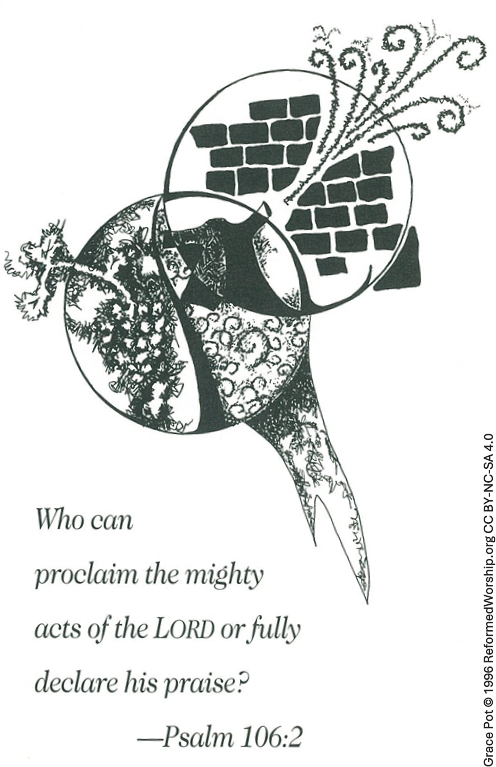
The prominent image of the stone altar symbolizes law/works (it has an ordered pattern but is not quite squared away or perfect) and the altar upon which sacrifices are made to the golden calf. The stone is separated or cut by the power of God as our "altered" hearts are cut by him. The swirls suggest the scent of sacrifice and the voice of rejoicing (Psalm 106; Philippians 4) coming forth from the rocks.
The stone standing outside of the law/works circle represents Christ, the cornerstone whom the builders rejected and, with an ironic twist, also depicts the guest without proper attire, called but not chosen (Matt. 22). The wedding garmet is in the center.
The two circles again point to the theme of law/works and faith: the golden rings used to make the calf, the rings of God's covenant with his people.
—Grace Pot
SERVICE SUGGESTIONS
Choral Introit
"O Praise the Lord, for He Is Good" Psalm 106/Post, Bristol
Call to Worship
Great is the Lord, and greatly to be praised
in the city of our God.
We come as children of God,
longing for a closer walk with our Creator.
God's name endures forever,
his faithfulness to all generations.
We rejoice in the gift of his Spirit,
we seek the righteousness that comes from God.
Bring thanksgiving and supplication to God,
who supplies needs and answers our prayers.
God has been our refuge and strength
and will supply our every need.
Hymn
"The Lord, My Shepherd, Rules My Life" Psalm 23/Idle
Service of Reconciliation
Scripture
Exodus 32:1–14
Response
Psalm 106 (two suggestions)
"O Praise the Lord, for He Is Good" Psalm 106/Post
Reading of Psalm 106:1–6, 19–23, followed by the choral anthem "Offertory" John Ness Beck.
Scripture
Philippians 4:1–9; Matthew 22:1–14
[Phil. 4:4–7 could be sung rather than read, using the anthem "Rejoice in the Lord Alway" Purcell .]
Text
Matthew 22:11
Sermon
"Dressed for the Occasion"
Hymn of Response
"Where Cross the Crowded Ways of Life" North
Commission and Blessing
We have experienced God's grace;
we have heard the words of life.
Now we are commissioned to do what we have heard;
we are called to serve in God's name.
Equipped with the assurance of God's presence,
we reach out to others.
Confronted by God's call, we seek the bond of unity.
We will praise God in our daily walk.
With every step, we remember God's faithfulness.
The Aaronic Blessing
The peace of God goes with us;
we will praise God in all we do.
Amen
Revised Common Lectionary
Year A: Season after Pentecost—Proper 23 (28)