This is part of the Worship Series
A Better Righteousness
Series Introduction
Week 1 | Week 2 | Week 3 | Week 4
Third Sunday : Staying the Course
God told Moses to get on with his travels— "Leave this place" (Ex. 33:1). The journey begins for Moses, even as ours continues, with a word of promise from God. God assures Moses, as he assures us, that he is our constant companion. A tired old maxim says, "People are known by the company they keep." What a wonderful thought to keep in mind as we move on toward our celebration next Sunday of the truth that we are justified by grace through faith. We are not alone—not as stewards of the vineyard and not as citizens of a frequently anti-Christian world.
NOTES ON THE LECTIONARY READINGS
Old Testament: Exodus 33:12–23
Moses asks to see God—actually to "know" him, which is infinitely richer than merely seeing. The exchange between God and Moses recorded in these verses is one of the most—if not the most—touching and gracious encounters between God and humanity in all of Scripture. Moses asks God, "Show me your glory," and God responds, "I will make all my goodness pass before you."
Only a very brave pastor would dare to use these words as a preaching text. These are words to be read, not explained; to be heard, not preached. They are words for quiet reflection and meditation. The liturgist will want to work creatively for a sensitive, dramatic reading of these words, followed by a carefully chosen anthem based on the psalter choice for today.
Psalter: Psalm 99
An "enthronement psalm" provides us with a fitting response to the Exodus 33:12–23 passage: "The Lord is king, let the people tremble! He sits enthroned upon cherubim; let the earth quake!" Psalm 99 requires that we think of God both as far-giver and avenger. We stand in awe, fearful but always hopeful.
Epistle: 1 Thessalonians 1:1–10
In the opening verses of Thessalonians, Paul expresses his thankfulness for their faith. The recipients of this letter, we learn, were converted only recently from idol worship. They are a living witness to the truth that the gospel is more than a lesson to be learned, a persuasive word to be savored, or fodder for arguments. The gospel transforms, reforms. It has creative power (v. 5). It is not the preacher who has a clever way with words, but the Spirit of God, working with and in the Word, who generates fruits of righteousness.
As we think about our walk with the Lord this month, we note just how concrete or actual such a faith is, even in its infancy. In this congregation of newborn believers, Paul celebrates works produced by faith, labor prompted by love, and endurance inspired by hope (v. 3).
Gospel: Matthew 22:15–22
Two opposing factions (the Pharisees, who contest the tax, and the Herodians, a Roman puppet-government who are therefore pro-tax) approach Jesus with a question. The choice of words is significant in this lection. The word "test" in verse 18 is the same word used in Matthew 4, where Jesus is tempted or tested by Satan in the wilderness; the word "malice" in 18 is also found in Matthew 6:13: "deliver us from the evil [or malicious] one." The choice is a kingdom choice: the kingdom of light versus the kingdom of darkness. God or Satan?
Living righteously involves painfully difficult choices for God's people every day. For those who recognize and submit to God as king (see Exodus lesson and the Psalm 99 response) the choices are never simple. If we can label Caesar either "Lord" (the Herodian position) or "Satan" (the Pharisees' position), the answer is instant and easy. But for God's people, the search for righteousness involves choices that are always excruciatingly difficult and never final. Our relationship to and our support of or opposition to Caesar must be constantly reexamined and rethought in community. Seeking righteousness and being righteous are no mere child's play.
BULLETIN COVER
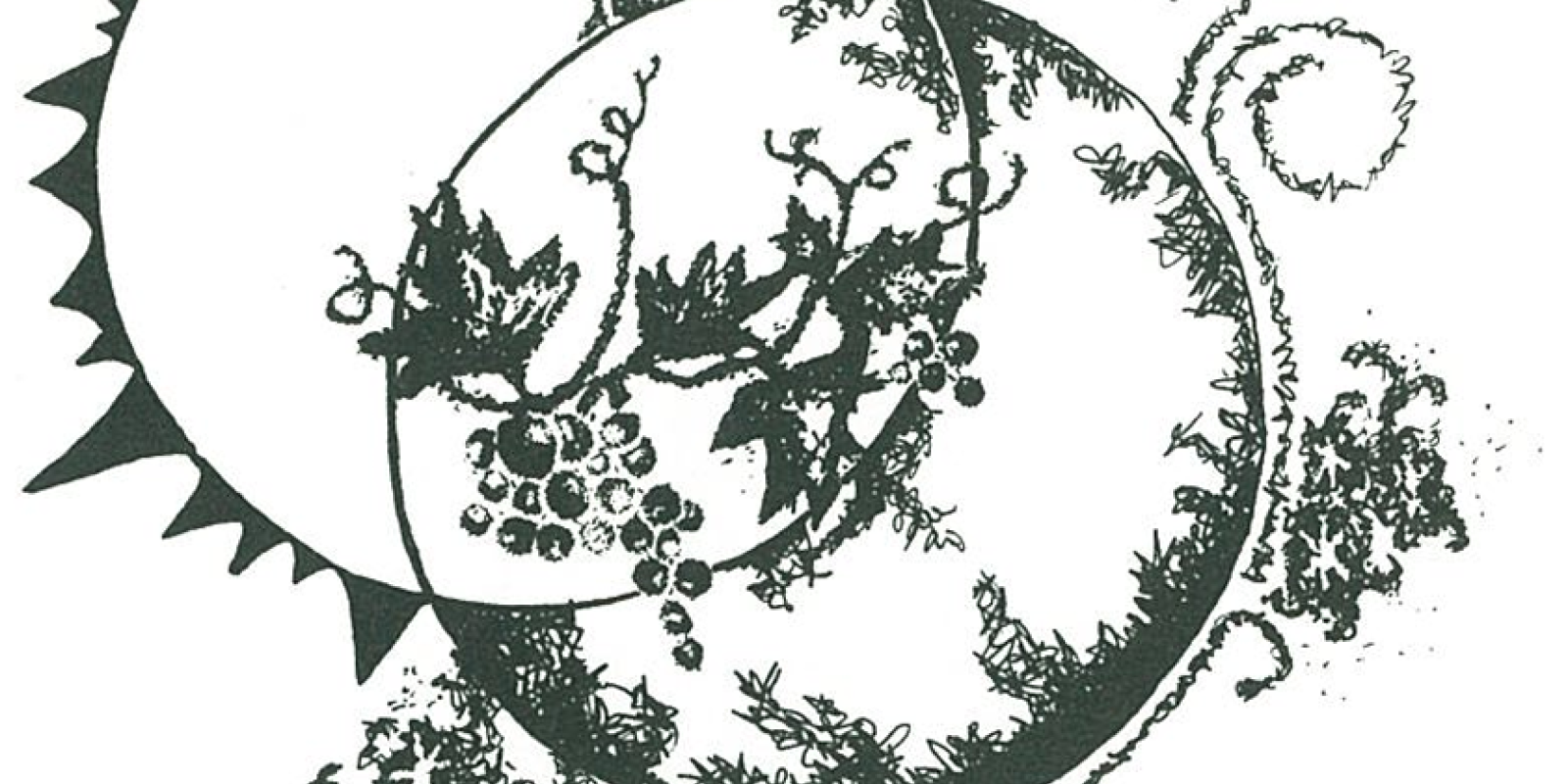
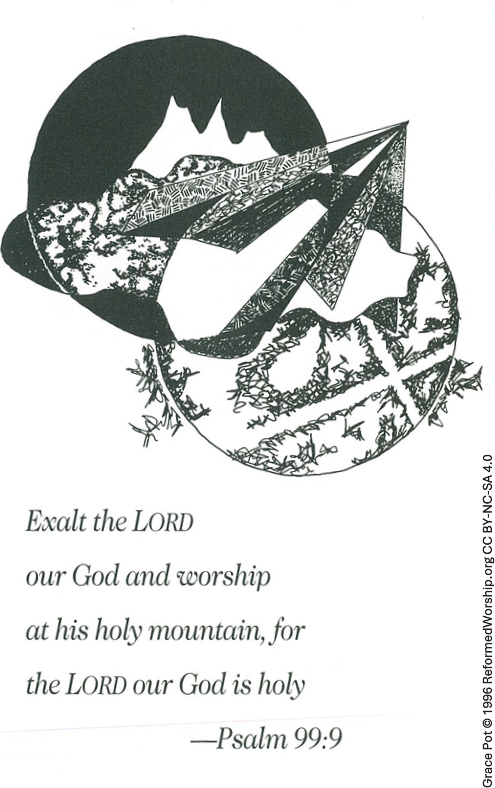
The two circular images are again present, depicting the faith and law elements of this month's theme. God on high (Psalm 99), who shows his glory (beams of light shining through and in and among the circles, cloud/rock, and mountain in varying patterns and degrees), is in the midst of faith and law (which is given upon the mountain).
—Grace Pot
SERVICE SUGGESTIONS
Choral Introit
"Holy, Holy, Holy" Schubert
Call to Worship
"I am the Lord, and there is no other;
besides me there is no god.
I arm you, though you do not know me,"
—Isaiah 45:5 NRSVUE
We hear God's sovereign declaration over all things;
his promise to be with us in every situation.
From the rising of the sun, God will be known,
in both sorrow and joy; in prosperity and adversity.
God lifts up those who are bowed down;
prisoners he sets free; the blind eyes see.
Hymn
"How Vast the Benefits Divine " Toplady
Service of Reconciliation
[The liturgist might seek to incorporate Exodus 33:12–23 and Psalm 99, sung either by the choir or congregation ("The Lord God Reigns in Majesty" Psalm 99 or "Psalm 99," in The Psalter, Westminster/John Knox Press)]
Scripture
Matthew 22:15–22; 1 Thessalonians 1:1–10
Text
Matthew 22:16; 1 Thessalonians 1:3
Sermon
"Staying the Course"
Hymn
"O Jesus, I Have Promised" Bode
Choral Offertory
"E'en So, Lord Jesus, Quickly Come" Manz
Commission and Blessing
Christ promises never to leave us;
we are assured that God's presence goes with us.
We face the world with renewed faith and hope;
God's Word endures and abides with us.
God watches over all of us, great and small,
upholding all in need, helping all who call on him.
All God's children are our brothers and sisters,
God's loving care is ours to pass on.
God reigns! Let the nations be glad.
God calls us the channels of his grace.
In every step of the way we will show our faith;
in all we do and say, may God be praised!
The Benediction
Hymn
"God Himself Is with Us" Tersteegen
Revised Common Lectionary
Year A: Season after Pentecost—Proper 24 (29)