This is part of the worship Series:
Focus on the Father
Series Introduction
Week 1 | Week 2 | Week 3 | Week 4
Drama: The Wayward, Wasteful Daughter
Introduction
This series of services based on the parable of the prodigal son was developed by Rolf Bouma when he was co-pastor of Eastern Avenue Christian Reformed Church of Grand Rapids, Michigan. He was influenced by Henri Nouwen's The Return of the Prodigal Son and Robert Farrar Capon's The Parables of Grace. Bouma also acknowledges contributions by others in churches where he preached this series, including copastors Leonard Vander Zee and Roy Berkenbosch at Eastern Avenue and Paul Brink and Charlotte Larsen of the Ann Arbor (Michigan) Christian Reformed Church.
The sermon excerpts are meant to give a general direction. Note that the series comes to its most crucial moment in the third week, when the focus is upon the Father. It works very well to divide the sermon into two parts, the first illuminating the gracious character of God, which goes against our intuitions, and the second using Nouwen's insight that our strongest identification with the parable needs to be with the Father, not either of the sons.
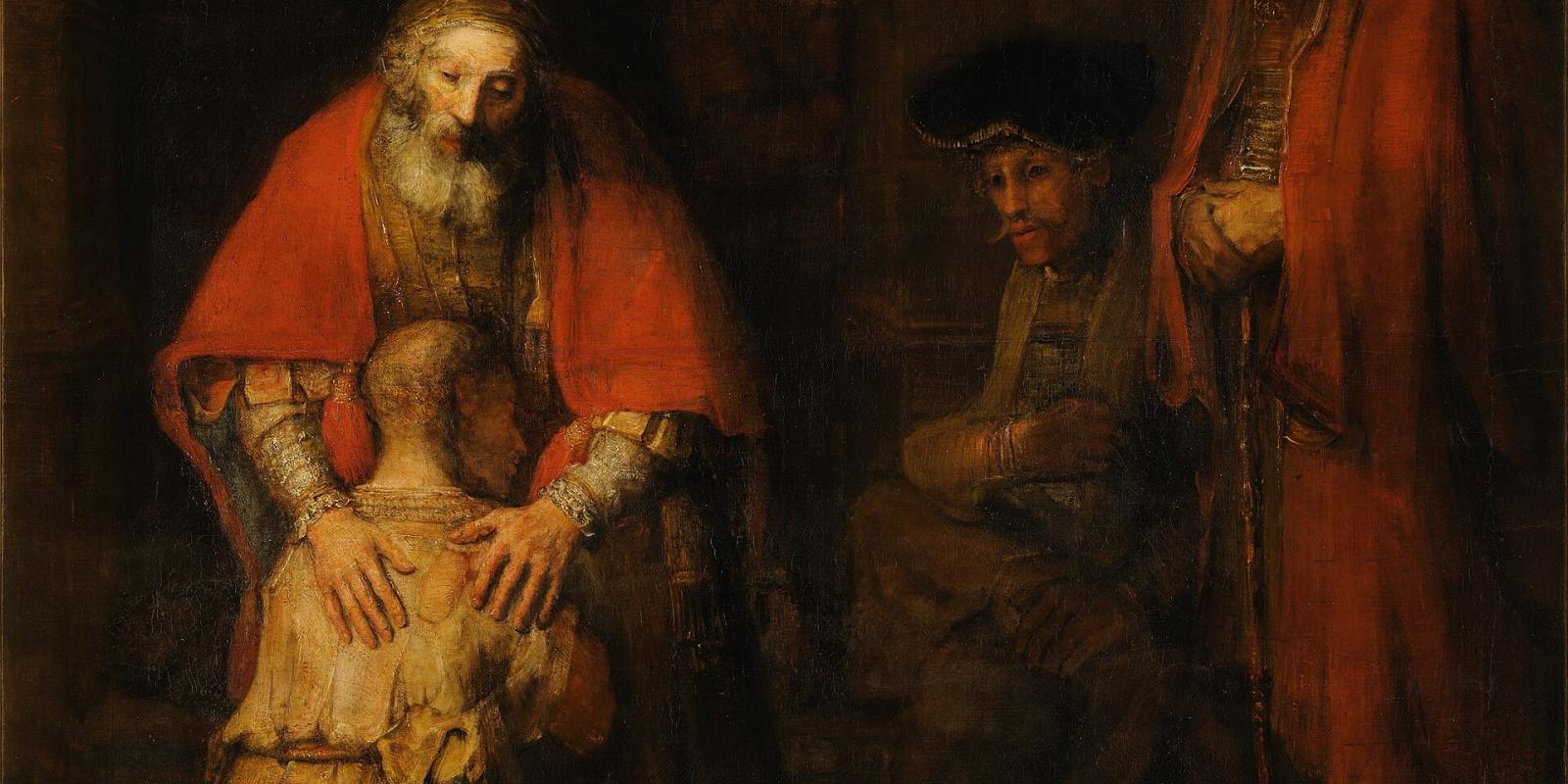
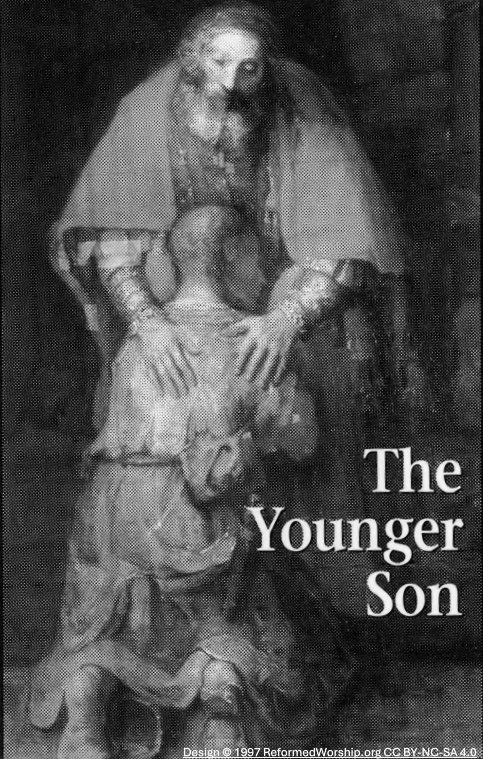
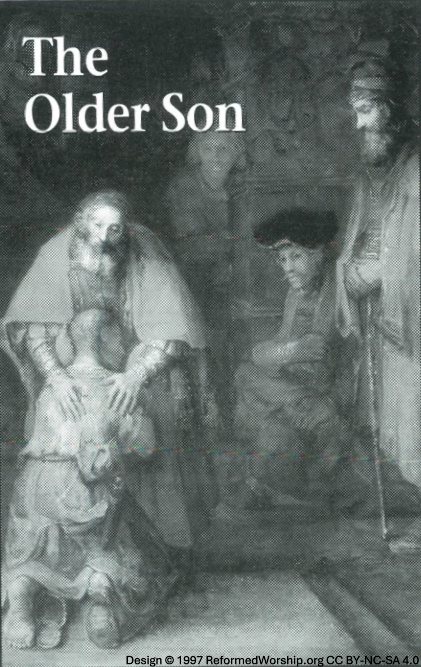
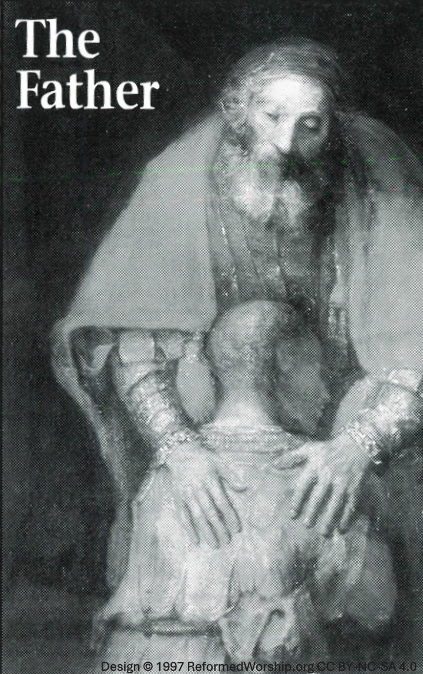
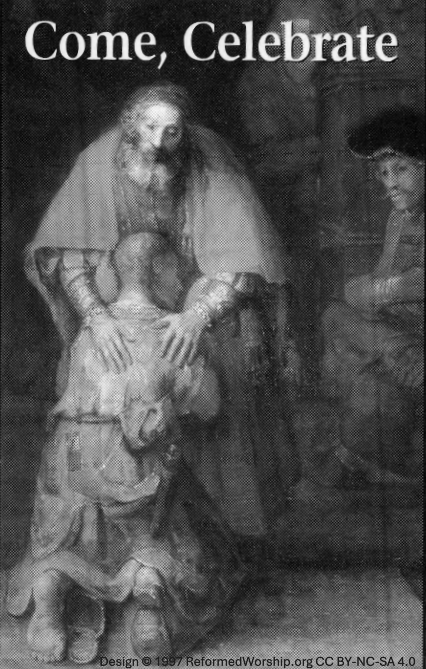
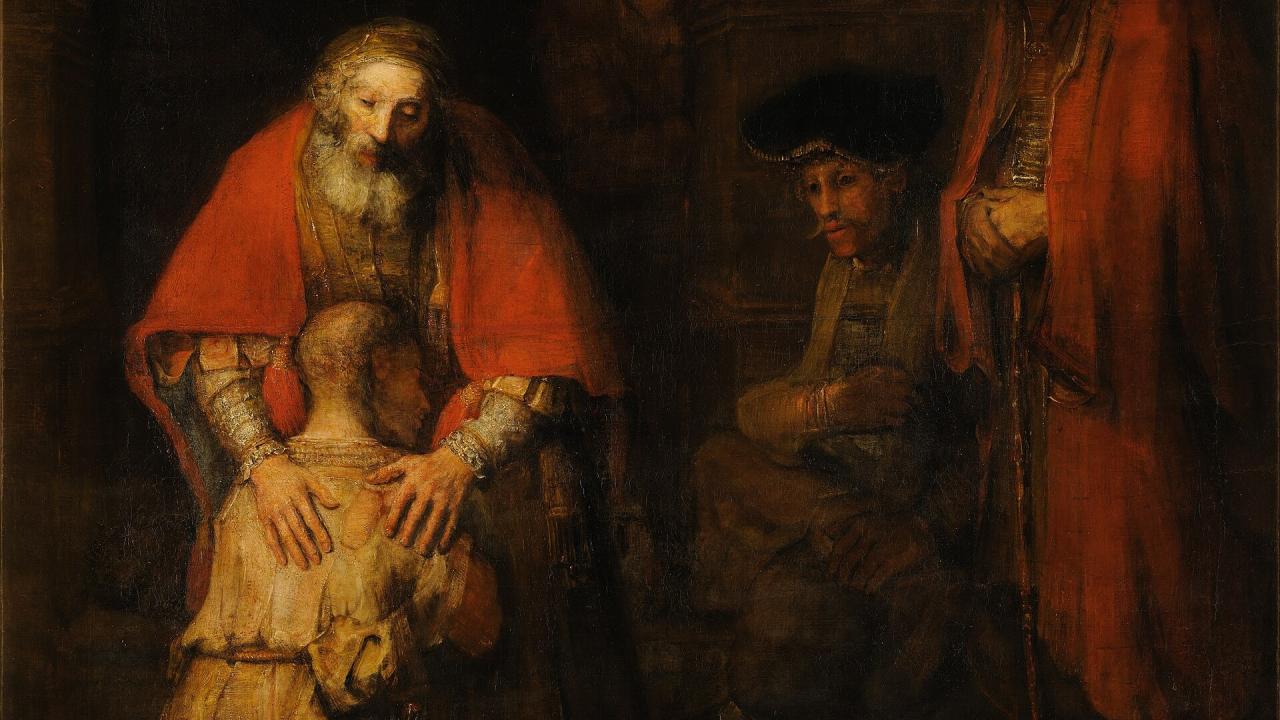
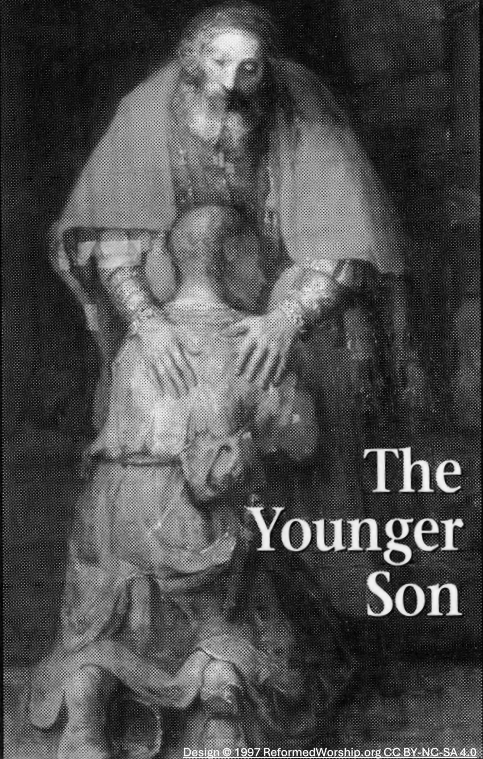
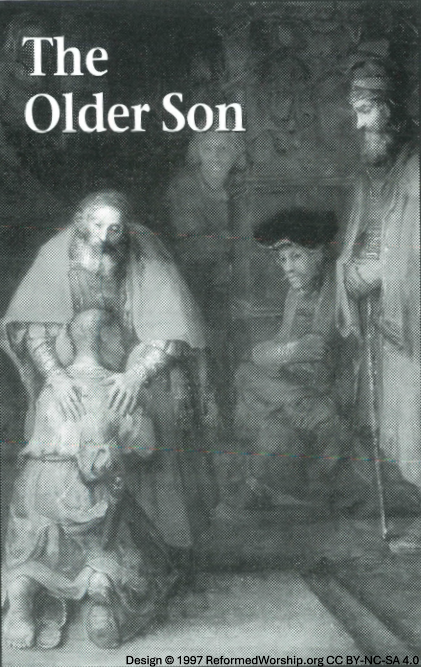
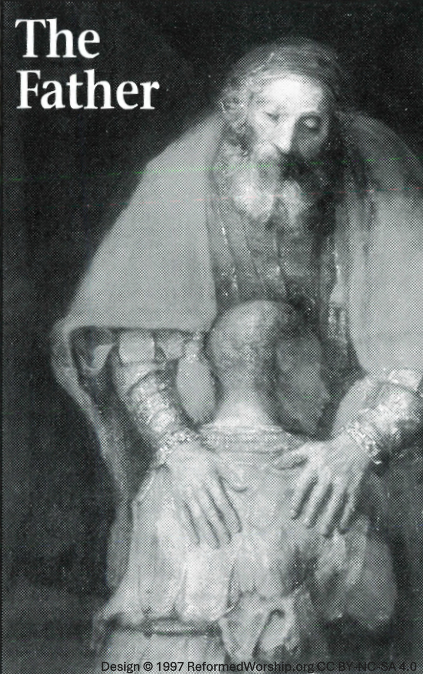
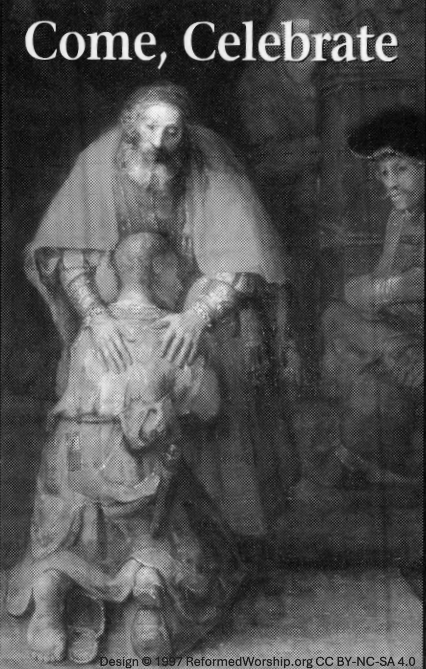
The painting The Return of the Prodigal Son is by Rembrandt, and can be found in most collections of Rembrandt's works. Henri Nouwen's book provides an excellent commentary on the painting. The bulletin covers for this series provide different focal points in the painting that correspond to the focus of the different weeks. These are available for download in the resource section below using the following copyright line: Design © 1997 ReformedWorship.org CC BY-NC-SA 4.0.
Series Outline
| Sermon Title | Scripture | Bulletin Cover | |
| Week 1 | The Younger Son | Luke 15:11–32 | |
| Week 2 | The Elder Son | Luke 15:25–32 | |
| Week 3 | The Father | Luke 15:11–32 | |
| Week 4 | Come, Celebrate | Luke 15:1–32 |
Week Four: Come, Celebrate
GOD GATHERS US FOR WORSHIP
Opening is structured as congregation is accustomed. Songs should be celebrative. Include the song "And Jesus Said," by Gloria Grindall and Joy Paterson (see here). Include prayers of the people in this section.
GOD INVITES US TO A PARTY
Prayer for Illumination
Scripture
Luke 15:1–32
Sermon: "It's Party Time!"
It is by way of explaining his "partying" behavior that Jesus tells the wonderful stories of Luke 15, culminating in the parable of the prodigal son. There are two basic factors that tie all three of the stories of this chapter together: finding what is lost and then having a party when you find it.
"Celebrate with me," says the shepherd. "I have found my sheep that was lost. Let's party!"
"Celebrate with me," says the woman. "I have found the coin I lost. Let's party!"
"Celebrate with me," says the father. "This son of mine was lost and now is found. Let's party!"
God's desire to have a good party is an attribute of God we sometimes miss. We miss the spirit of wild joy that leaps in God's heart, the sheer exuberant gladness of the Creator and Redeemer of the universe. God wants us to know that at the end of the day, at the end of the journey from the far country, at the end of our struggle with resentment, there is a pure celebration of joy awaiting us, an eternal party of gladness and praise. No tickets needed. Everyone is invited.
There is an alternative to celebration. It is called cynicism, and as Christians we face the choice between cynicism and joy every day. Face it, we can stay cool while being cynical. We can be amusing.
It keeps the world at arms' length. As Henri Nouwen points out, "Cynics seek darkness wherever they go. They always point to approaching dangers, impure motives, and hidden schemes. They call trust naive, care romantic, and forgiveness sentimental. They sneer at enthusiasm, ridicule spiritual fervor, and despise charismatic behavior. They consider themselves realists who see reality as it truly is."
Cynicism is not spirituality. Granted, until we look hard at the mess in ourselves and in the world, our joy will be the superficial partying of the passengers on the Titanic. But a spirituality that looks at the world in the light of the kingdom experiences follows what the psalmist is talking about in Psalm 126: "Those who sow in tears will reap with shouts of joy." The end of the world is not doomsday but a party day.
God's party is no ordinary party. It is not made possible by our own wishful thinking, our own sheer determination to think positively, as if we could. It is made possible by Jesus Christ, who by his death and resurrection guarantees the blessed conclusion of human history. His death on the cross, by which he banished forever the power of sin and death and hell, is our ticket out of cynicism and into joy. Jesus is the occasion for joy.
If the kingdom of heaven is a party then the main event is the banquet of communion. For here we meet Jesus, broken as bread, poured out as wine. Come and celebrate, meet the Lamb who was slain, who turns the insipid water of our lives into wine, who transforms his own funeral into a banquet, who convinces us that life is better than death and that joy is the serious business of heaven. If you believe this, then say yes! and come with joy to meet your Lord.
Hymn
"I Come with Joy to Meet My Lord" (st. 1–4) Wren
WE ACCEPT GOD'S INVITATION TO THE FEAST
Let us feast this glorious day on Christ the Bread of Heaven.
The word of Grace has purged away the old and evil leaven.
Christ alone our souls will feed.
Christ is our meat and drink indeed.
Faith lives upon no other!
Alleluia!
Hymn
"Lift Up Your Hearts unto the Lord" Early Christian liturgy
The Institution
Prayer of Consecration
The Invitation
The Communion
Offering of Thanksgiving
Closing Hymn
"I Come with Joy to Meet My Lord" (st. 5) Wren
Benediction
The Wayward, Wanton, and Wasteful Daughter
Characters: Younger Daughter, Elder Daughter, Mother, Bartender/Diner, Neighbors, Interrupter
Props: Textbooks, apron, bottles and glass, table settings, food scraps, bar stool, desk, knapsack, suitcase
Note: In week one, use the script as printed below. In week three, add the two shaded portions of script included at the end of the drama and indicated in the script.
[Mother and two daughters go to the center platform, one on each side, mother's arms on their shoulders].
Narrator: There once was a woman who had two daughters. When the elder daughter turned eighteen, she went away to college, worked very hard, and did well in her studies.
[Older daughter breaks away and sits down at a school desk.]
Narrator: But when the younger daughter turned eighteen, she said to her mother,
[Younger daughter breaks away, confronts her mother.]
Younger Daughter: I don't want to go to college. I want to live on my own for a while away from this place. Let me have the money you would have spent on my education, and I'll leave. If you were to die right now, that money would come to me, and I could do whatever I want with it. Why can't I do what I want with it now?
Insert the following portion for week three version:
[Mother goes to get cash and, just as she reaches for it, is interrupted by someone from outside the drama who takes her aside.]
Interrupter: Hey, hey, hold everything. Mom, let me have a word with you a minute. I couldn't help overhearing what your daughter just said to you, and I have to say that it was the most ungrateful-little-wretch-like thing I've ever heard someone say to their mother. It's like she wishes you were dead! Now I'm not going to tell you what to do, but think about it. She's just going to blow it all. If you're going to give her anything, at least give her a guilt trip so she won't enjoy spending it, and she'll be properly sorry when she comes crawling back. Think about it!
[Mother goes back to youngest daughter, and the drama picks up again.]
Younger Daughter: I don't want to go to college. I want to live on my own for a while away from this place. Let me have the money you would have spent on my education and I'll leave. If you were to die right now, that money would come to me, and I could do whatever I want to with it. Why can't I do what I want to with it now?
Narrator: Her mother gave her the money, and the younger daughter moved to a faraway city.
[Mother hands over a wad of bills, and daughter walks away.]
Narrator: In that distant city, the younger daughter lived it up and had a wild time. She caroused and threw money away like it was water.
[Daughter goes to end of table, leans on it like a bar. Bartender walks up and pours her a drink. She throws a couple of bills at him].
Narrator: But after a time, the city was struck by a deep recession. Her money ran out. The younger daughter was forced to look for work, but the only job she could find was waiting tables in a little greasy-spoon restaurant. Things got so bad that she longed to eat the scraps of food that the diners left on their plates.
[Daughter messes up hair, takes apron from the bartender, goes to other end of table, which has place settings on it with dirty plates. She begins to clear the table, picking up a bread crust and looking at it longingly].
Narrator: Finally, one day, she came to her senses.
[Daughter wearily sets down plates, brushes back hair, and heaves a sigh].
Younger Daughter: Even the waitresses back in my hometown have it ten times better than I do here. Just think of how good I had it when I was at home. I know what I'll do. I'll go home and say, "Mother, I know I've offended you and disappointed you. I don't deserve to live with you as your daughter. Please let me come home. I'll get a job. I'll pay for my room and board, and you can treat me just as you would any other boarder."
[She takes off the apron and walks off the stage, then back on].
Narrator: So she set off and went back to her hometown. She didn't have any money for a cab, so she had to walk from the bus station.
[Daughter walks towards platform holding a single suitcase].
Narrator: The mother was sitting on the front porch. She looked up and saw her daughter walking at a distance. The mother jumped off the porch, ran down the street, and flung her arms around her daughter.
[Mother, seated on a chair, stands and looks, then runs across platform to daughter and hugs her.]
Insert the following portion for week three version:
Interrupter: Whoa! Whoa! Whoa! Wait a minute. Sorry to spoil this Kodak moment and all, but, Mom, I need a word with you. You didn't listen to me last time, and that was your choice, but hear me out this time. Your daughter's come back, having blown it big time and feeling like dirt. That's okay. It's good for her. Children almost never say they're sorry, so enjoy it. Let her grovel a bit. Lay down some conditions for her return. Let her know she's on a short leash, and that if it ever happens again, there'll be no next time. But whatever you do, don't get too excited and don't do something rash like throwing a party for her.
[Interrupter leaves stage, mother returns to chair, and daughter once again approaches home.]
Narrator: The mother was sitting on the front porch. She looked up and saw her daughter walking at a distance. The mother jumped off the porch and ran down the street and flung her arms around her daughter.
[Mother seated on a chair stands and looks, then runs across platform to daughter and hugs her.]
[Mother and two daughters go to the center platform, one on each side, mothers arms on their shoulders.]
Narrator: The daughter tried to push her away.
Younger Daughter: Mother, I've been so wrong. I don't deserve to be one of your daughters.
[Daughter pushes mother, but mother clings. When mother lets go, she turns to the congregation to invite them to the party.]
Narrator: But the mother held on, and when she finally let go, she yelled to the curious neighbors who had come out on their front porches to see what the commotion was.
Mother: Quick. Come over to our house tonight. Bring whatever you have in the house. We need to have a welcome home party. My daughter's come home.
[Mother and daughter head for table area.]
Narrator: About an hour later, when the older daughter was coming home from school, she saw all the lights on in her house. She heard the noise and laughter of a party.
[Older daughter comes toward platform, carrying books. Stops as if listening with puzzled look on face.]
Narrator: She called to one of the neighbors,
[Older daughter turns to congregation and asks:]
Older Daughter: What's going on?
Neighbor: Your sister's come home and your mom's throwing a party to welcome her.
[Daughter throws books on the ground.]
Narrator: Infuriated, the older daughter refused to go in the house. Finally her mother came out and pleaded with her to come inside.
[Mother comes outside and tries to put arm around older daughter. Daughter confronts mother.]
In her anger, the older daughter said to her mother,
Older Daughter: Look, for all these years, I've done everything you've asked of me. I've never given you trouble. I've always done what you thought was best. And yet you've never seen fit to throw any kind of celebration for even a few of my friends. Your other daughter is back after spending all your hard-earned money on drink and sex and carousing, and you throw a party for her and invite the whole world to come to it.
Mother: Daughter, you'll always be mine, and everything I have is yours. But we had to throw a party because this sister of yours was as good as dead, and now she's come back to life.
[Youngest daughter comes out and stands at arm's length. Mother grasps each by the shoulder. Trio stands there for moment, oldest daughter looking down, mother looking from one to the other, youngest looking at mother.]