This is part of the worship series,
"God in Three Persons"
Series Introduction
Week 1 | Week 2 | Week 3 | Week 4
Ascension Sunday
God the Son
Scripture
John 16:16-24; John 17:1–11; Acts 1:1–11; Psalm 97
Sung Prayer of Illumination
“God of the Word” by Ken Medema (from his collection With Every Breath, 1993, available from Briar Patch Music, 4324 Camel, Grandville, MI, 49418; 616-534-6571)
Sermon-Building Ideas
Art historian David Morgan is fond of pointing out that “a substantial portion of the ‘wetware’ strung between our ears—40 percent of the brain cells composing the neocortex—is dedicated to processing visual information . . . the brain craves images.” We are created as creatures who function and relate significantly to visual images.
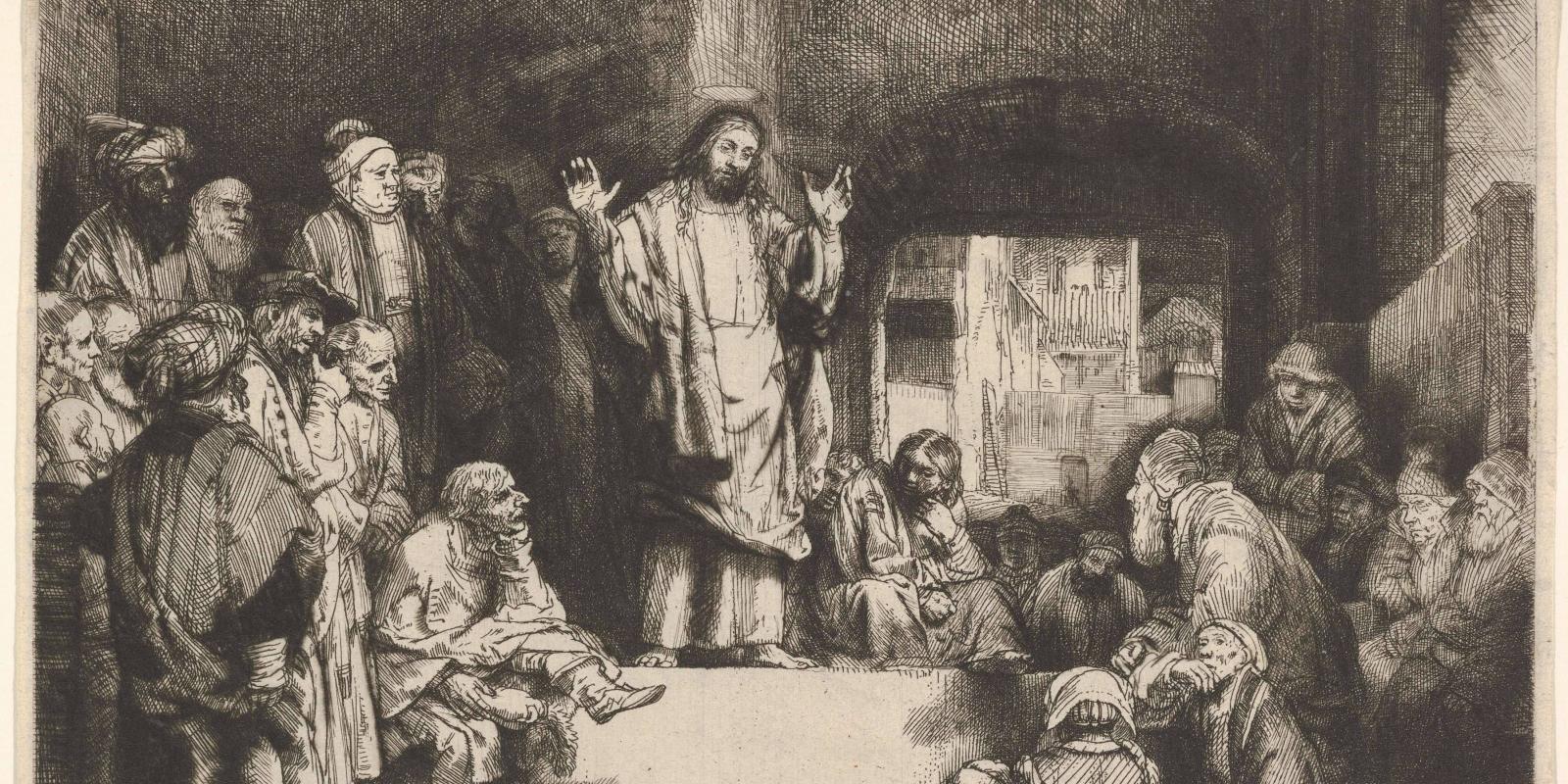
The God who designed us uses this primary way of perceiving to bring us to a knowledge of him. Jesus is the “image of the invisible God” (Col. 1:15). The incarnation is the essence of God made visible. This facet of Christian faith captivated Rembrandt as an artist. His genius was an ability to communicate spiritual truth enfleshed, which implies more than understanding the man from Nazareth as only a visual representation of God. Beyond giving us a visual picture of God, Jesus brings salvation by engaging in our humanity. This too is expressed by the etching. Many of the people around Jesus are not even looking directly at him. They are hearing his words of life. Jesus is engaging them with voice as well as appearance, hands, and his physical presence. Salvation involves much more than head knowledge (the Gnostic and New-Age heresy). It encompasses our whole being: emotions, bodies, hearts, minds, and relationships.
The Bible is packed with metaphorical language to describe God: God is a rock, an eagle, a nursing mother, a leader of an army, a father. In Jesus, metaphor turns to reality. God actually became flesh and shared in our humanity—he lived as one of us in our world. Jesus appears totally at ease among us—whether out on the street, on a subway car, or in a crowded shopping mall. He wants to be here—he loves people, and they matter to him. In turn, those around him seem at home in his presence.
John Calvin noted that even knowing God truly as Creator, as Almighty, is impossible apart from revelation in Jesus Christ. “For even if God wills to manifest His father favor to us in many ways, yet we cannot by contemplating the universe infer that He is Father” (Institutes, II.vi.1). It seems that the disciples of Jesus realized this truth. Why else would they have been so upset at the news that Jesus was going to leave them? They had become intimately acquainted with the heart of the Father only because of Jesus.
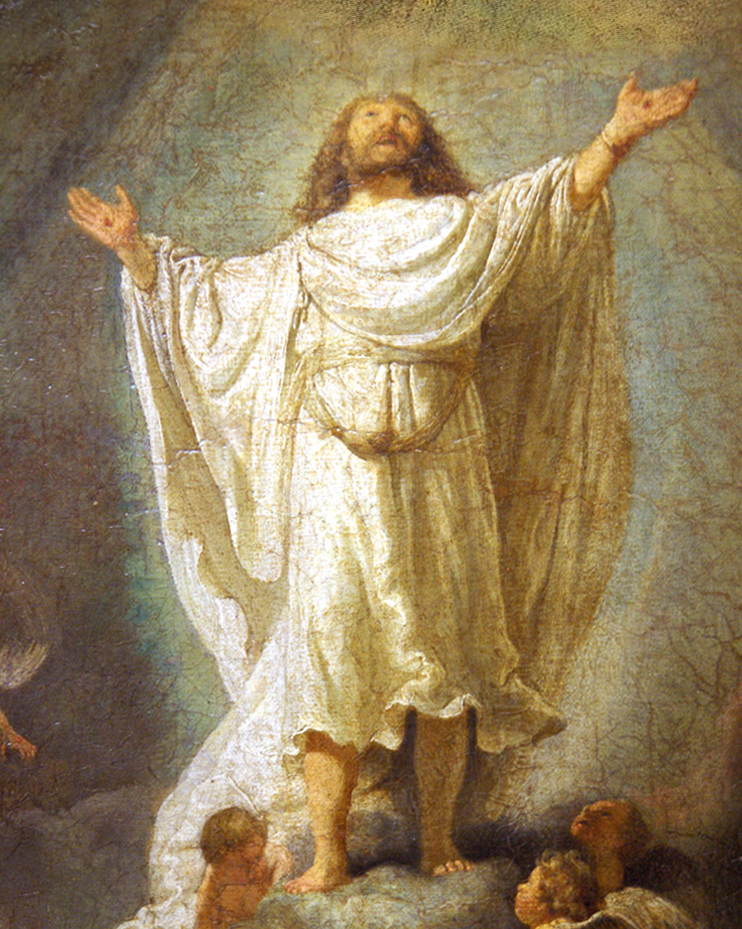
Today we celebrate the ascension of a flesh-and-blood Jesus. The crown of glory he receives comes by way of suffering service. One painting Rembrandt made of the ascension pictures Christ being taken up with outspread hands vividly marked with red scars. Why are we comforted by the fact that it is Jesus who now rules and will judge on the last day? “In all my distress and persecution I turn my eyes to the heavens and confidently await as judge the very One who has already stood trial in my place before God and so has removed the whole curse from me” (Heidelberg Catechism Q&A 52). The scarred hands of the Judge, acquired when he hung suffering on a tree, are my assurance that I share in his reign.
Today we already share the victory. People in the pew who struggle with fear and failure need to hear this good news. There may be a dad who is feeling inadequate as a father. A mother may be wrestling to accept her daughter just as she is. Some may live in fear of dying. A son may be feeling bad about slandering his parents before friends. A wife could be questioning her husband’s commitment to their marriage. A businessman may be paralyzed by financial burdens. A single mom may be finding it difficult to overcome her anger over a divorce. A student may be frustrated with a class that remains difficult, in spite of best efforts. Still others may have been hurt by another church member just once too often and wonder if the Christian message is real. Against all of this and more, we need to know about the victory Jesus has won through sharing in our plight. “I have told you these things, so that in me you may have peace. In this world you will have trouble. But take heart! I have overcome the world” (John 16:33). The last word is victory over fear and failure. Jesus, who sits on the throne, has the scars to prove it.
Jesus means joy. The Lord explained that after a time of grief, “I will see you again and you will rejoice, and no one will take away your joy” (John 16:22). During medieval times in Europe there was a holiday known as the Feast of Fools. On this occasion the general population, along with clergy and even serious community leaders, donned masks, dressed in costumes, and sang a lot under the mock rule of a Lord of Misrule. In a satirical way this event sought to remember the outrageous joy of the gospel that was becoming increasingly scarce. For a few days the people imagined and enacted a world where the last were first, the lowly were lifted up, peacemakers were blessed, the poor seated in the place of honor, kings were generous, and rulers just. Such Kingdom revelry can fire sanctified imaginations with the joyful truth that our workaholic ways and gross national product can never bring us salvation. Jesus’ ascension serves as a catalyst for such mirth—he prays that his joy may be complete in us. Intoxicating joy comes with the arrival of the Holy Spirit.
Prayer
Dear Jesus,
Your head that once was crowned with thorns is crowned with glory now;
a royal diadem adorns your mighty victor's brow.
The highest place that heaven affords is yours, is yours by right—
the King of kings, Lord of lords, and heaven’s eternal light;
the joy of all who dwell above, the joy of all below,
to whom you manifest your love and grant your Name to know.
To us the cross with all its shame, with all its grace, is given;
your Name, an everlasting Name; our joy, the joy of heaven. Amen.
—Adapted from Thomas Kelly’s hymn, “The Head That Once Was Crowned with Thorns,” public domain.
Songs
“The Lord Reigns” (Psalm 97) Stradwick
Settings of Psalms 47 and 110
“The Head That Once Was Crowned with Thorns” Kelly
“Jesus Is Our King” Clark et al.
Revised Common Lectionary
Years A, B, C: Easter—Ascension of the Lord