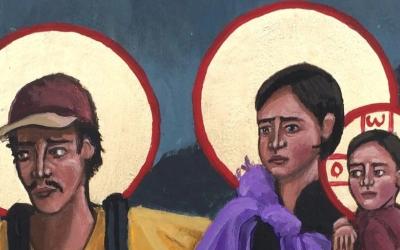
I am glad I wasn’t one of those first disciples. I can’t imagine journeying with Christ through what we call Holy Week without knowing the end of the story. Can you imagine thinking that the cross was the end?
Rev. Joyce Borger is a program manager at the Calvin Institute of Christian Worship. She curates and develops practical worship planning resources and manages the ReformedWorship.org website. She served as associate editor of the print journal Reformed Worship from 2003-2006 and senior editor from 2006-2025. She has edited seven musical collections, including Lift Up Your Hearts: Psalms, Hymns, and Spiritual Songs (Faith Alive Christian Resources, 2013) and Psalms for All Seasons (Faith Alive Christian Resources, 2011). In addition she has taught worship courses at Kuyper College and is an ordained minister in the Reformed Church in America.
Last Updated: November 20, 2025
I am glad I wasn’t one of those first disciples. I can’t imagine journeying with Christ through what we call Holy Week without knowing the end of the story. Can you imagine thinking that the cross was the end?
Joy to the world, the Lord has come! For those who observe it, Christmas is a day of much anticipation and celebration. In my home it is no different. Blessed with many friends and family, we have multiple celebrations to attend and gifts to exchange. It is a busy time with all the preparations and events at church. And there are so many traditions: the children’s Christmas pageant, our church’s Living Nativity, the Christmas Eve candlelight service, monkey bread on Christmas morning, family worship. Christmas is a wondrous time—a joy-filled time.
Welcome to this theme issue on shalom. You may not see that word outside of this editorial, but the whole issue can be summed up in that one Hebrew word. In reality, shalom is more than a word—it’s a concept, a dream, a promise. Whether we are talking about becoming a hospitable community, caring for the needs of people with disabilities, fighting human trafficking, working for immigration reform, or seeking solutions for the conflicts in the Middle East, we are talking about becoming a people of shalom.
While I was talking with someone the other day, she spoke of the “time collapse” of the Christian year. “Every year, Christ is born, then dies, and rises again. The next year he is born, then dies, and rises again. . . .” Why do we rehearse the entire gospel message year after year? We do it because we are people who forget. We need to be reminded of the truths the Christian year contains. We need to be reminded of the grace of God’s story and of the fact that we are God’s beloved, saved, and redeemed children.
How do we speak in worship? What language do we use? Sometimes the best response is silence, awe, and wonder. Sometimes we need to spring to our feet with joy, raise our hands in praise, and clap with the trees of the field. We speak with unscripted words such as “amen” and “praise the Lord” and with scripted but equally sincere phrases such as “thanks be to God” and “hear our prayer.” And sometimes we speak in poetry.
For many of us, Advent marks the beginning of the church year. But is it the proper place to start? The season from Advent to Epiphany is only one chapter in the metanarrative that began with the creation of the world. Scripture makes it clear that the mission of God is to redeem the world, to bring the nations to himself. In the Old Testament, God chose to work primarily through the Hebrew people to bring others into the covenant community. In Genesis 12 God says to Abraham:
Some years ago at a Calvin Theological Seminary chapel service, the college choir led us in singing “My Life Flows on in Endless Song” by Robert Lowry, also known as “How Can I Keep from Singing” (see p. 3). It was a good service, but I don’t remember reflecting on it much as I tucked the bulletin into my coat pocket.
“I don’t like change,” I wrote in a previous editorial. Since transitions include change, I don’t like transitions much either. Transitions are difficult and scary times, since the future often seems unclear.
What do Lent, Good Friday, Easter, the psalms, and caring for God’s creation have in common? Two things: they are all themes present in this issue of Reformed Worship, and they all have to do with living “in the tension.”
Connect
Reformed Worship Resources in Your Inbox
Sign up for the newsletter to receive the latest Reformed Worship resources and other news.